What Is a Linear Pair of Angles?
Root Concept
A linear pair is supplementary and adjacent: the total comes from the straight line the two outer arms make.
CodePLU Goal
Upgrading Human Mental Models
Learn how to think in Workflows

Concept Development By codeplu.com
Look for two conditions at once: the angles must touch along a shared arm, and their two outer arms must lie on one straight line.
Why Does This Pair Get a Name of Its Own?
In the last tutorial, complementary and supplementary turned out to be claims about a total and nothing else. Two angles adding to 180° are supplementary whether they are drawn touching, drawn on opposite sides of the page, or drawn in different books. Position was irrelevant. A linear pair is the first angle name in this track where position is part of the definition, and that is exactly why it is worth a tutorial of its own.
A linear pair is two angles that sit next to each other, sharing a vertex and one arm, whose two outer arms together form a straight line. Picture a flat line with a single ray standing up from a point on it. That ray has cut the flat 180° into two pieces, and those two pieces are a linear pair. Because the whole they are cutting up is a straight line, they are guaranteed to add to 180° — the total is not an extra rule to memorise, it is a consequence of how they are drawn.
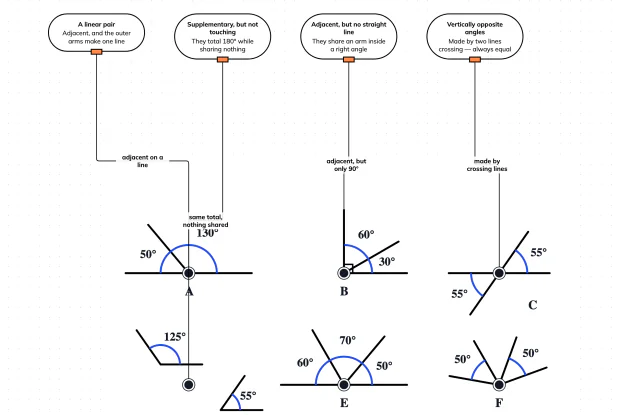
The playground below is a sorting problem rather than a calculation. Six arrangements are drawn, and only one of them is a genuine linear pair. The rest fail the definition in different ways: angles that touch but fill a right angle, angles that add to 180° but are drawn nowhere near each other, angles that meet at a point but share no arm. Getting them sorted is what fixes the definition in place.
What Makes an Arrangement a Linear Pair?
What Are the Two Conditions?
Two conditions have to hold at the same time, and most mistakes come from checking only one. First, the angles must be adjacent: they share the same vertex and one arm sits between them, so they are genuinely side by side with no gap and no overlap. Second, their two outer arms — the ones not shared — must lie on a single straight line running through the vertex. Take away the first condition and you have two angles that happen to total 180° but are drawn apart. Take away the second and you have two adjacent angles that fill something other than a line, such as a right angle. Neither of those is a linear pair, even though each looks a lot like one at a glance. Both conditions, or it does not count.
Why Does a Linear Pair Always Add to 180°?
Because of what the arms are doing, not because of a rule anyone imposed. A straight line through a point represents a half turn, and a half turn is 180°. When a ray stands on that line at the same point, it does not add anything or take anything away; it simply divides the half turn into two parts. Two parts of one whole must add back up to that whole, so the two angles total 180°. This is worth understanding rather than memorising, because it tells you when the rule applies and when it does not. If the outer arms are not in a straight line, there is no half turn being divided, and the total is whatever the figure actually shows — 90° in a right-angled corner, or something else entirely.
How Is This Different From Supplementary?
Every linear pair is supplementary, but not every supplementary pair is a linear pair, and the direction of that sentence matters. Supplementary is the wider idea: it asks one question, do these two angles total 180°, and it does not care where they are drawn. Linear pair is narrower: it asks the same question and then asks a second one about position. So a linear pair is a supplementary pair that also happens to be adjacent on a straight line. A 125° angle in one corner of a page and a 55° angle in another are supplementary and will never be a linear pair. If an exam question says linear pair, you have been told something about the drawing as well as about the arithmetic, and that extra information is usually the part you are meant to use.
How Do You Use One to Find a Missing Angle?
This is where linear pairs earn their keep, because spotting one turns a drawing into a subtraction. If you can see a straight line with a ray standing on it, you know instantly that the two angles at that point total 180°, so knowing either one gives you the other. An angle of 118° on one side leaves 62° on the other. The habit worth building is to scan a diagram for straight lines first, because every ray meeting one hands you a free relationship. Be careful of one trap: if two or more rays stand on the same line, the angles still total 180° altogether, but they are no longer a pair, and subtracting one from 180 will not give you either of the others.
Real World Example
Why Does a Level Crossing Barrier Show a Linear Pair?
The road is a straight line and the barrier turns about a point on it, which is precisely the arrangement that makes a linear pair.
The barrier as it lifts
70° above the road
The barrier arm is hinged at a post at the edge of the road, and it swings up and down about that hinge. Halfway through lifting, the arm sits at 70° to the stretch of road in front of it. That 70° is the angle an engineer would actually specify, because it is what the motor has to drive the arm through and what a driver sees. The important feature of the arrangement is easy to miss: the road does not stop at the hinge. It carries on behind the post in a straight line, which means the hinge sits on a line rather than at the end of one, and that single fact is what brings a linear pair into existence.
The angle behind it
110°, and forced
Now look at the angle between the barrier arm and the road running away behind the post. Nobody measures it and nobody chooses it. The arm and the two directions of road share a vertex, the arm is the shared boundary between the two angles, and the two stretches of road form one straight line — so the angles either side of the arm are a linear pair and must total 180°. The angle behind is therefore 180 minus 70, which is 110°. Every position the barrier passes through on its way up produces a new pair of angles, and every one of those pairs still totals 180°, because the road never stops being straight.
Why the pair matters
One reading, both angles
A sensor on the hinge only needs to report one number. From that single reading, the angle on the other side comes free, and so does the answer to the question the system actually cares about — whether the arm is close enough to flat to be blocking the road. This is the practical value of recognising a linear pair: it halves what you need to know. It also shows why the definition insists on the straight line. If the post stood at a bend in the road rather than on a straight stretch, the two angles would still be adjacent, but they would no longer total 180°, and a control system built on that assumption would be reading the barrier's position wrong.
FAQs
Final Words
A linear pair is the point where angle names stop being purely about arithmetic and start describing arrangements. Two conditions have to hold together: the angles must be adjacent, sharing a vertex and an arm, and their outer arms must lie on one straight line. When they do, the 180° total follows automatically, because the pair is simply a half turn cut in two.
The reason this matters beyond the vocabulary is that a linear pair is a free relationship hiding in an ordinary diagram. Any time a ray meets a straight line, you already know the two angles there add to 180°, so one measurement gives you both. The next tutorial takes the other arrangement you sorted in the playground — two straight lines crossing — and shows why the angles opposite each other are always equal, which turns out to follow from linear pairs rather than from anything new.
Continue This Track
This concept is part 2 of Angle Pairs and Parallel Lines.
What Are Complementary and Supplementary Angles?
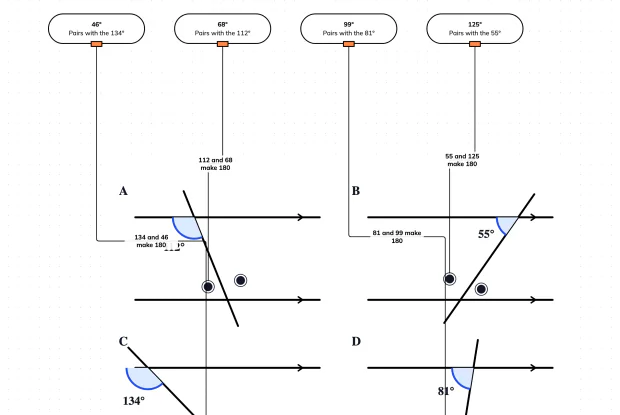
Complementary and supplementary are not shapes or positions. They are a claim about a total: two angles that add to 90° are complementary, two that add to 180° are supplementary. Learn to read which total a figure is asking for, then find the missing angle yourself in an interactive playground.
What Is a Linear Pair of Angles?
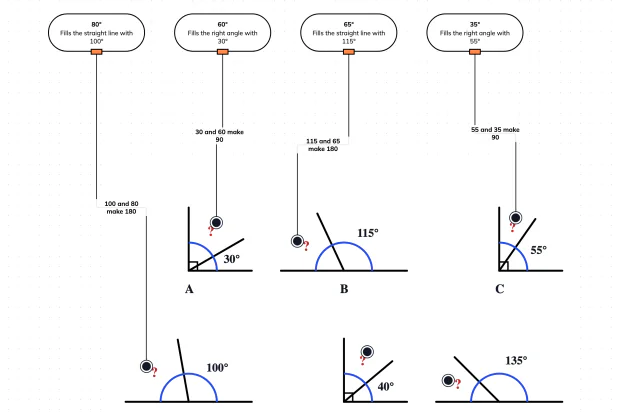
A linear pair is the first angle name where position matters as much as size. The two angles must sit next to each other, and their outer arms must form a straight line — which is what forces them to add to 180°. Sort the real linear pairs from the convincing near-misses in an interactive playground.
Why Are Vertically Opposite Angles Always Equal?
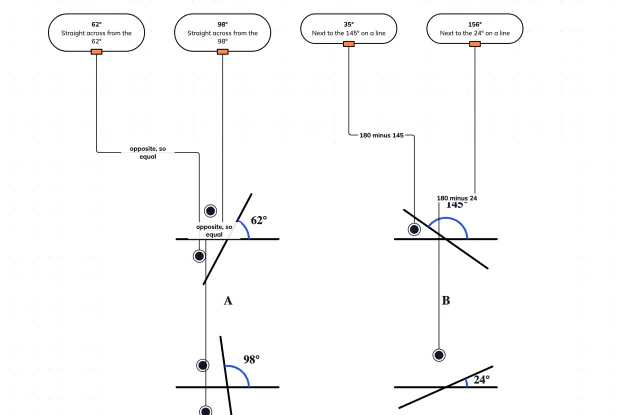
When two straight lines cross they make four angles, and the pairs facing each other across the crossing are always equal. That is not a coincidence to memorise — it follows from linear pairs in two steps. Prove it to yourself, then use it to fill in a crossing from one given angle in an interactive playground.
What Does a Transversal Do to Two Parallel Lines?
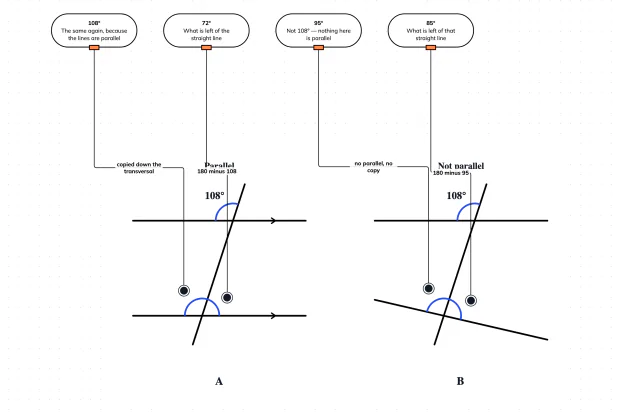
A transversal is a line that cuts across two others. When the two lines it cuts are parallel, something remarkable happens: the two crossings become identical copies, so all eight angles are one of only two sizes. See exactly what parallelism buys you — and what happens without it — in an interactive playground.
What Are Corresponding and Alternate Angles?
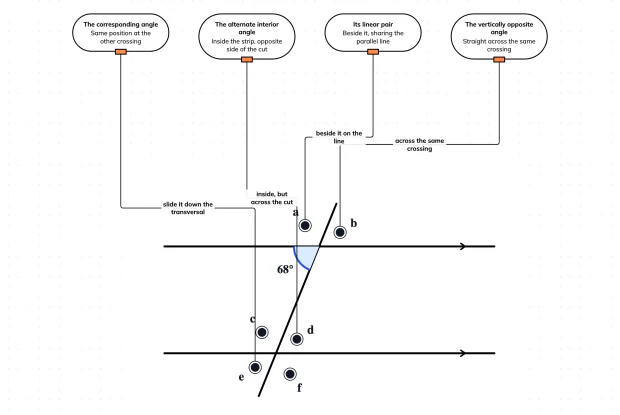
Corresponding angles sit in matching positions at the two crossings; alternate angles sit on opposite sides of the transversal. Both are equal when the lines are parallel, and both are just ways of asking which of the two available sizes an angle is. Name them on a real diagram in an interactive playground.
Why Do Co-Interior Angles Add Up to 180 Degrees?
Every other named pair on parallel lines turns out to be equal. Co-interior angles are the exception: they add to 180° instead. The reason is short, and once you see it the exception stops feeling arbitrary. Find the missing partner on four diagrams in an interactive playground.