What Are Complementary and Supplementary Angles?
Root Concept
Complementary and supplementary are names for a sum, not for a shape or a position: 90° and 180°.
CodePLU Goal
Upgrading Human Mental Models
Learn how to think in Workflows

Concept Development By codeplu.com
A small square at the corner means the two angles must total 90°; a straight line through the vertex means they must total 180°.
Why Do Two Angles Get a Special Name?
Most angle words describe one angle on its own. Acute, right, obtuse and reflex are all sizes, and you can decide which one applies by looking at a single opening. Complementary and supplementary are different. Neither word tells you anything about one angle by itself. They describe a relationship between two angles, and the relationship is always the same kind of thing: what the two of them add up to.
Two angles are complementary when they add to 90°, the size of a right angle. Two angles are supplementary when they add to 180°, the size of a straight line. That is the entire definition. There is nothing else to learn about what the words mean — the difficulty is never the definition, it is noticing which of the two totals a particular drawing is handing you.
That is what the playground below drills. Six pairs are drawn, and in each one a single ray cuts a whole opening into two parts. One part has its size printed; the other is a question mark. Your job is to work out the missing size, which means first deciding whether the whole opening is a right angle or a straight line, because that decides whether you subtract from 90 or from 180.
How Do You Tell the Two Apart and Use Them?
What Does Complementary Actually Mean?
Two angles are complementary when their sizes add to exactly 90°. A 30° angle and a 60° angle are complementary because 30 + 60 = 90. So are 1° and 89°, and so are 45° and 45°. Because the total is only 90°, both angles in a complementary pair have to be acute — smaller than a right angle. If one of them were 90° or more, there would be nothing left for the other, and an angle of 0° is not an angle at all. That is a useful check: if you are told two angles are complementary and one of them is obtuse, something is wrong with the question, not with your arithmetic. The word itself is worth a moment, because it is not the everyday one. A complement is the thing that completes something; these two angles complete a right angle between them.
What Does Supplementary Mean?
Two angles are supplementary when their sizes add to exactly 180°, which is the amount of turning in a straight line. A 115° angle and a 65° angle are supplementary because 115 + 65 = 180. So are 90° and 90°, and so are 179° and 1°. Because there is twice as much room to share, a supplementary pair can include an obtuse angle — in fact if one of them is obtuse the other is forced to be acute, since the two still have to reach 180° and no further. The only pair where both are the same is 90° and 90°. A supplement, in ordinary English, is something added on to make a whole. Here the whole is a straight line, and each angle supplies whatever the other one is short of.
Do the Two Angles Have to Be Touching?
No, and this is the single most common misunderstanding. Because these pairs are usually drawn side by side, sharing a vertex and an arm, it is easy to believe that touching is part of the definition. It is not. Complementary and supplementary are claims about a sum and nothing else. An angle of 20° drawn in one corner of a page and an angle of 70° drawn in the other corner are complementary, because 20 + 70 = 90, even though they share no point and no line. The same goes for a 140° angle here and a 40° angle a mile away. Touching does matter for other names — a linear pair, which comes next in this track, is defined partly by position — but not for these two. Test the total, not the picture.
How Do You Find the Missing Angle?
The method is one subtraction, and the only real decision is what to subtract from. Read the figure first and ask what the two angles fill between them. If they fill a right angle — usually marked with a small square at the corner — the total is 90°, so the missing angle is 90 minus the one you were given. If they fill a straight line, the total is 180°, so the missing angle is 180 minus the one you were given. A 55° angle inside a right angle leaves 35°; a 100° angle on a straight line leaves 80°. Beginners lose marks here far more often by subtracting from the wrong total than by subtracting badly, which is why the playground gives you both kinds mixed together rather than one kind at a time.
Real World Example
Why Does a Ramp Builder Care About Angle Pairs?
A ramp is fixed to an upright post and runs down to a flat path. One angle gets measured on site; the other two follow from the totals, with no measuring at all.
The slope itself
6° with the ground
The builder measures one angle: the one between the ramp and the flat ground it lands on. It comes out at 6°, a deliberately shallow slope, because a ramp any steeper than about 1 in 12 is hard to push a wheelchair up. This is the only angle anybody actually measures on the job, and it is the one the regulations are written about. Everything else on the drawing is going to come from it. Notice that 6° is acute, and quite strongly so — which, if the ramp is going to meet an upright post, already tells you the other angle at that corner is going to be large, because the two of them have a fixed total to share between them.
Against the upright post
84°, complementary
The post at the top of the ramp stands at a right angle to the ground, which is what makes it a post rather than a lean. That right angle is the total the ramp and the post have to share, so the angle between the ramp and the post is complementary to the slope: 90 minus 6, which is 84°. The builder never measures this one. It is forced by the 6° and by the fact that the post is upright. This is exactly why the pairing is worth knowing — a single measurement plus a known total gives a second angle for nothing, and the bracket that joins the ramp to the post has to be cut at 84° whether anyone works it out or not.
Along the path the other way
174°, supplementary
Now look at the angle on the other side, between the ramp and the path running away from the bottom of the ramp. The path and the ground the ramp sits on form one straight line, so this angle and the 6° slope share a total of 180°: the answer is 174°. The same 6° has now produced two more angles, one by completing a right angle and one by completing a straight line, and the only thing that changed between them was which total applied. That is the habit to take away from this tutorial. Do not start by asking whether a pair is complementary or supplementary; start by looking at what the two angles fill, because the shape of the figure is what decides the total.
FAQs
Final Words
Complementary and supplementary are two of the easiest definitions in geometry and two of the most often muddled, because the words are long and the idea behind them is short. Two angles that add to 90° are complementary; two that add to 180° are supplementary. Nothing about where they sit, how they are drawn or whether they touch has any bearing on it.
The skill worth carrying forward is not reciting the two totals but reading a figure to find out which total is in play, because that is the step that actually decides the answer. A small square at a corner means 90°; a straight line through the vertex means 180°. In the next tutorial that second case gets a name of its own — a linear pair — and you will see why position starts to matter once angles have to sit next to each other.
Continue This Track
This concept is part 1 of Angle Pairs and Parallel Lines.
What Are Complementary and Supplementary Angles?
Complementary and supplementary are not shapes or positions. They are a claim about a total: two angles that add to 90° are complementary, two that add to 180° are supplementary. Learn to read which total a figure is asking for, then find the missing angle yourself in an interactive playground.
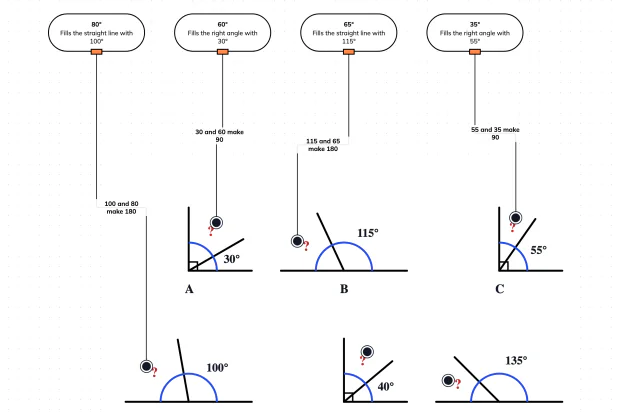
What Is a Linear Pair of Angles?
A linear pair is the first angle name where position matters as much as size. The two angles must sit next to each other, and their outer arms must form a straight line — which is what forces them to add to 180°. Sort the real linear pairs from the convincing near-misses in an interactive playground.
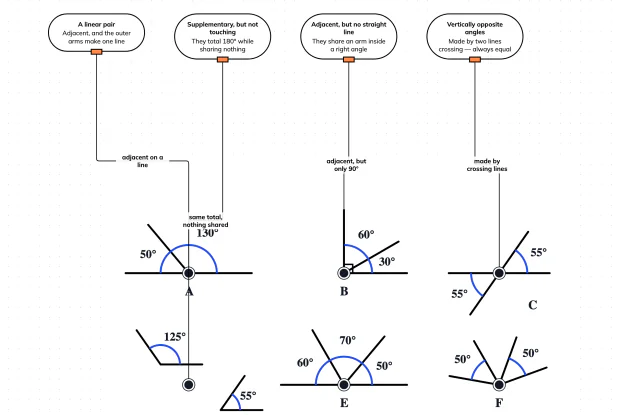
Why Are Vertically Opposite Angles Always Equal?
When two straight lines cross they make four angles, and the pairs facing each other across the crossing are always equal. That is not a coincidence to memorise — it follows from linear pairs in two steps. Prove it to yourself, then use it to fill in a crossing from one given angle in an interactive playground.
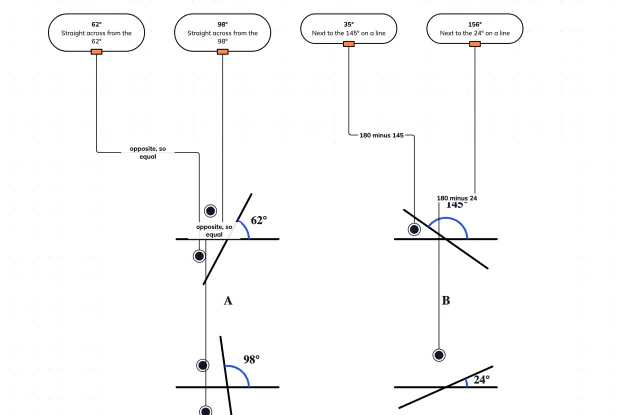
What Does a Transversal Do to Two Parallel Lines?
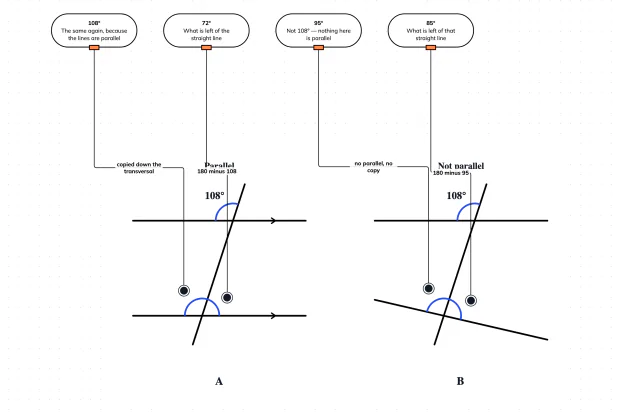
A transversal is a line that cuts across two others. When the two lines it cuts are parallel, something remarkable happens: the two crossings become identical copies, so all eight angles are one of only two sizes. See exactly what parallelism buys you — and what happens without it — in an interactive playground.
What Are Corresponding and Alternate Angles?
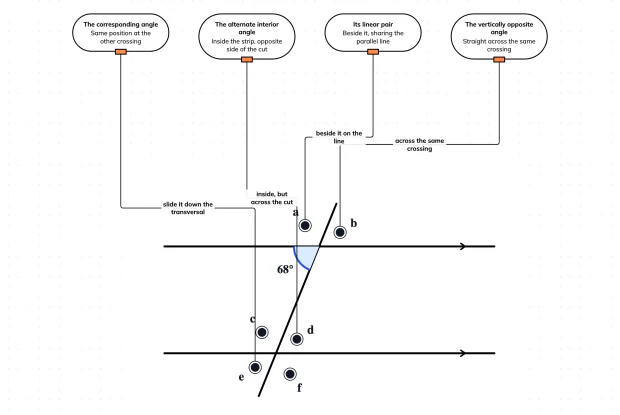
Corresponding angles sit in matching positions at the two crossings; alternate angles sit on opposite sides of the transversal. Both are equal when the lines are parallel, and both are just ways of asking which of the two available sizes an angle is. Name them on a real diagram in an interactive playground.
Why Do Co-Interior Angles Add Up to 180 Degrees?
Every other named pair on parallel lines turns out to be equal. Co-interior angles are the exception: they add to 180° instead. The reason is short, and once you see it the exception stops feeling arbitrary. Find the missing partner on four diagrams in an interactive playground.