What Does a Transversal Do to Two Parallel Lines?
Root Concept
A transversal across parallel lines makes two identical crossings, so there are eight angles but only two sizes.
CodePLU Goal
Upgrading Human Mental Models
Learn how to think in Workflows

Concept Development By codeplu.com
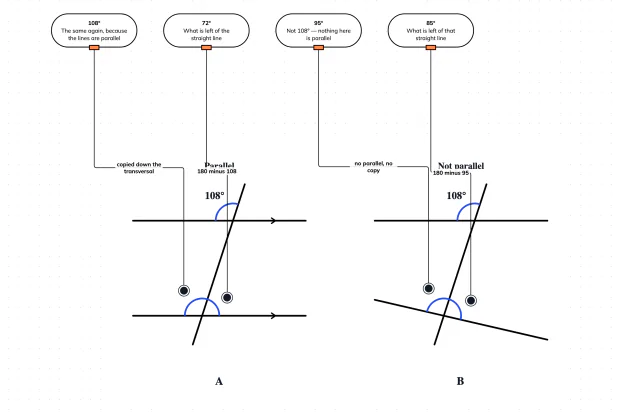
Matching arrowheads mean the two lines are parallel. Without that mark, nothing about one crossing tells you anything about the other.
What Is a Transversal, and Why Does It Matter?
A transversal is simply a line that crosses two or more other lines. There is nothing special about the line itself; the name describes what it is doing rather than what it is. Draw two lines on a page and then draw a third line cutting through both of them, and that third line is the transversal. Each place it cuts is an ordinary crossing of the kind you met in the last tutorial, with four angles and the usual rules.
So a transversal across two lines produces two crossings and eight angles in total. On its own that is not interesting: you would need to measure one angle at each crossing, because the two crossings have nothing to do with each other. Everything changes when the two lines being cut are parallel. Parallel lines run in exactly the same direction, so the transversal meets both of them at exactly the same slant, and the two crossings come out as identical copies of one another.
That is the whole content of this tutorial, and it is worth stating plainly: eight angles, but only two different sizes, and those two sizes add to 180°. One measurement now fixes all eight. The playground puts the parallel case next to a case where the lines are almost parallel but not quite, so you can see that the copying really does depend on the parallelism and not on the diagram merely looking tidy.
How Does the Diagram Actually Work?
What Are Interior and Exterior Angles Here?
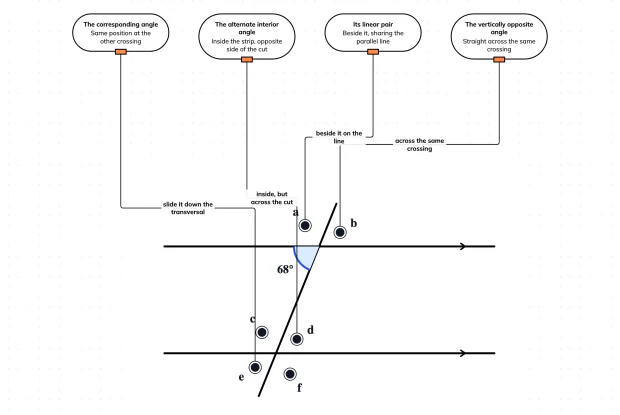
The two parallel lines divide the page into three strips, and the names for the eight angles all depend on which strip an angle sits in. The strip between the two parallel lines is called the interior, and the four angles that open into it are the interior angles — two at each crossing. The regions above the upper line and below the lower one are the exterior, and the four angles opening into those are the exterior angles. Angles are also described as being on the same side of the transversal or on alternate sides of it. That is the entire vocabulary: interior or exterior, same side or alternate side. Every named pair in the next tutorial is built from those two questions, so it is worth being able to point at the interior of a diagram before going further.
Why Are the Two Crossings Identical?
Parallel lines have the same direction — that is what parallel means. The transversal has one direction of its own, so the angle it makes with the first line and the angle it makes with the second line are produced by exactly the same pair of directions. There is nothing left for them to differ by. Slide the whole upper crossing down along the transversal and it lands perfectly on the lower one. This is why the eight angles collapse into two sizes: at each crossing there are only two sizes anyway, because neighbouring angles form linear pairs and opposite ones are equal, and the second crossing repeats the first. If the lines were not parallel, the transversal would meet them at two different slants and the two crossings would have nothing in common.
How Do You Fill In All Eight Angles?
Measure or read one angle, and everything else follows. Suppose one angle is 108°. At that crossing, the angle opposite it is 108° and the two beside it are 180 − 108 = 72° each. Because the second crossing is a copy, its four angles are 108°, 72°, 108° and 72° in the matching positions. So the diagram contains four angles of 108° and four of 72°, and the two sizes are supplementary, which is a quick sanity check: if your two sizes do not add to 180°, something has gone wrong. The only real skill is deciding, for any angle you are asked about, which of the two sizes it is — and that comes down to whether it sits in the same position as the known angle or in a neighbouring one.
What Goes Wrong When the Lines Are Not Parallel?
Everything that depended on copying. The two crossings are still perfectly ordinary crossings, so within each one the opposite angles are still equal and the neighbours still add to 180°. What is lost is any connection between the two crossings, which means knowing an angle at the top tells you nothing at all about the bottom. In diagram B of the playground the lower line is tilted by only thirteen degrees, which is little enough that the picture still looks orderly, and the angle that would have been 108° comes out at 95° instead. That is the trap worth remembering: a diagram that looks parallel is not parallel. Look for the matching arrowheads, or for a statement in the question, before copying any angle from one crossing to the other.
Real World Example
Why Does a Zebra Crossing Rely on Parallel Lines?
The painted bars are the parallel lines and the kerb is the transversal. If the bars are truly parallel, one measured angle sets every bar on the crossing.
Setting out the first bar
108° to the kerb
A road crew marking out a crossing sets the first white bar at an angle to the kerb. Suppose the kerb runs at a slight diagonal to the bars and the angle measured between the kerb and the first bar, on the upstream side, is 108°. That single measurement is the only one anybody takes with an instrument. The kerb here is playing the part of a transversal: it is a straight line cutting across all the bars, and each bar it crosses gives a crossing with four angles. The crew does not think of it in those words, but the geometry is what makes the rest of the job quick.
Every other bar follows
108°, bar after bar
The bars are painted parallel to each other, which is the entire point of the design — a crossing with bars fanning out would look wrong and would be harder to walk. Because they are parallel, the kerb meets every one of them at the same slant, so every bar makes the same 108° angle with the kerb on its upstream side and the same 72° on the downstream side. The crew can set each bar with a simple template rather than measuring again, and an inspector can check the whole crossing by testing one angle anywhere along it. Eight angles per bar, but still only two numbers in the whole job.
When the road bends
The copying stops
Now suppose the crossing runs over a slight bend, so the kerb on one side is not straight. The kerb is no longer a single transversal, and the bars at one end meet it at a different slant from the bars at the other. Measuring the first bar tells you nothing about the last, and a crew working from one template ends up with bars that visibly fan. This is the practical version of the warning in the playground's second diagram. The equalities do not come from the picture looking neat; they come from the lines genuinely running in the same direction, and the moment that stops being true they stop being available.
FAQs
Final Words
A transversal is just a line cutting across others, and on its own it does nothing special. What makes the arrangement worth a name is what happens when the lines being cut are parallel: the transversal meets both at the same slant, the two crossings become copies, and the eight angles collapse into two supplementary sizes. One measurement then fills in the entire diagram.
You now have the vocabulary the rest of this topic is built on — interior and exterior, same side and alternate side — and the reason the equalities exist at all. The next tutorial gives names to the particular pairs: corresponding angles, which sit in matching positions at the two crossings, and alternate angles, which sit on opposite sides of the transversal. Both are just ways of asking which of the two sizes an angle happens to be.
Continue This Track
This concept is part 4 of Angle Pairs and Parallel Lines.
What Are Complementary and Supplementary Angles?
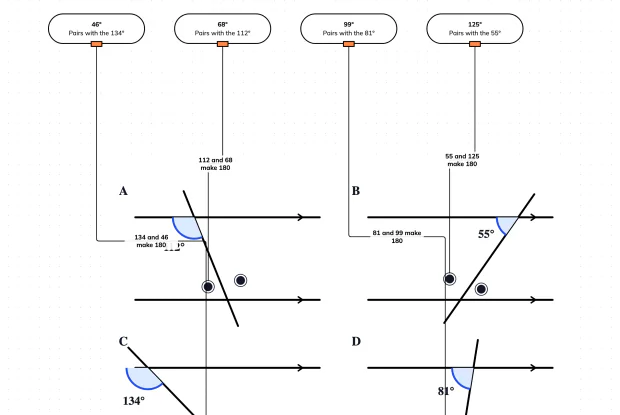
Complementary and supplementary are not shapes or positions. They are a claim about a total: two angles that add to 90° are complementary, two that add to 180° are supplementary. Learn to read which total a figure is asking for, then find the missing angle yourself in an interactive playground.
What Is a Linear Pair of Angles?
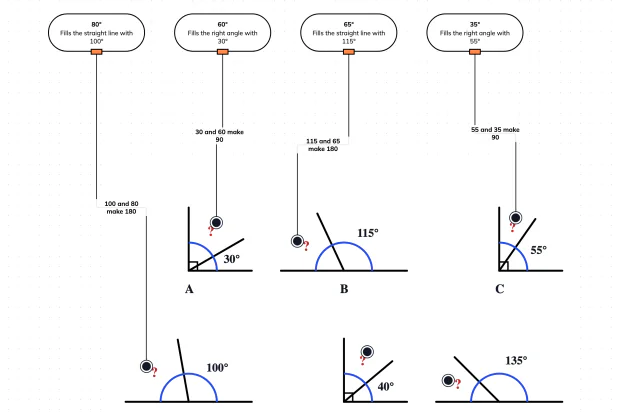
A linear pair is the first angle name where position matters as much as size. The two angles must sit next to each other, and their outer arms must form a straight line — which is what forces them to add to 180°. Sort the real linear pairs from the convincing near-misses in an interactive playground.
Why Are Vertically Opposite Angles Always Equal?
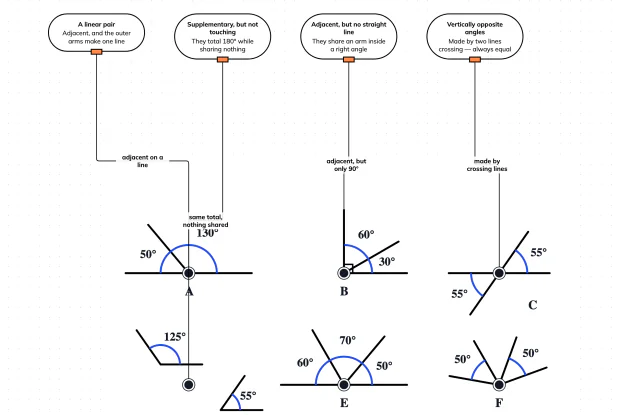
When two straight lines cross they make four angles, and the pairs facing each other across the crossing are always equal. That is not a coincidence to memorise — it follows from linear pairs in two steps. Prove it to yourself, then use it to fill in a crossing from one given angle in an interactive playground.
What Does a Transversal Do to Two Parallel Lines?
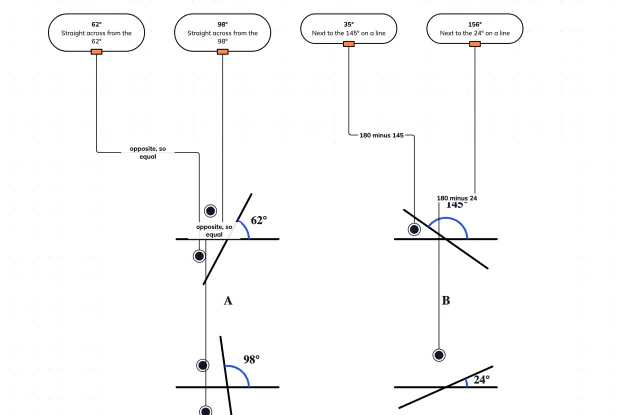
A transversal is a line that cuts across two others. When the two lines it cuts are parallel, something remarkable happens: the two crossings become identical copies, so all eight angles are one of only two sizes. See exactly what parallelism buys you — and what happens without it — in an interactive playground.
What Are Corresponding and Alternate Angles?
Corresponding angles sit in matching positions at the two crossings; alternate angles sit on opposite sides of the transversal. Both are equal when the lines are parallel, and both are just ways of asking which of the two available sizes an angle is. Name them on a real diagram in an interactive playground.
Why Do Co-Interior Angles Add Up to 180 Degrees?
Every other named pair on parallel lines turns out to be equal. Co-interior angles are the exception: they add to 180° instead. The reason is short, and once you see it the exception stops feeling arbitrary. Find the missing partner on four diagrams in an interactive playground.