Why Are Vertically Opposite Angles Always Equal?
Root Concept
Two crossing lines make four angles, but only one measurement: the rest follow from opposite pairs and straight lines.
CodePLU Goal
Upgrading Human Mental Models
Learn how to think in Workflows

Concept Development By codeplu.com
Straight across the crossing means equal; next to it along a straight line means the two together make 180°.
What Happens When Two Lines Cross?
Draw two straight lines that cross, and four angles appear around the crossing point. They come in a pattern that never changes. The two angles facing each other across the point — the ones that share only the vertex, not an arm — are called vertically opposite, and they are always equal. The two angles sitting next to each other are a linear pair, so they always add to 180°.
The word vertically is a nuisance here, because it has nothing to do with up and down. A vertically opposite pair can be arranged left and right, or on a slant, and still qualify. The word comes from vertex, the point where the lines meet, so vertically opposite really means opposite through the vertex. Plenty of textbooks avoid the confusion by calling them vertical angles or opposite angles instead.
What makes this worth a tutorial is not the fact but the reason, because the reason is short enough to hold in your head and it comes from something you already know. You do not need a new rule for opposite angles; two applications of the linear pair rule from the last tutorial force them to be equal. Once you have seen why, the practice below stops being guesswork: one given angle is enough to fill in an entire crossing.
Where Does the Rule Come From, and How Do You Use It?
Which Angles Count as Vertically Opposite?
At a crossing, each angle has two neighbours and one angle directly across from it. The one across is its vertically opposite partner. The test is simple: a vertically opposite pair shares the vertex and nothing else, while a neighbouring pair shares the vertex and one arm between them. Four angles therefore make exactly two vertically opposite pairs, not four, and it is worth counting them once to be sure. If the four angles run round the crossing as first, second, third and fourth, then the first pairs with the third and the second pairs with the fourth. One common slip is to assume the two equal-looking angles must be the two big ones or the two small ones; that happens to be true at a crossing, but it is the position that defines the pair, not the size.
Why Must They Be Equal?
Here is the whole argument, and it takes two steps. Call the four angles at the crossing a, b, c and d, going round in order, so a and c are opposite and b and d are opposite. Now look at a and b: they are next to each other on one of the straight lines, so they are a linear pair and a + b = 180°. Next look at b and c: they are next to each other on the other straight line, so b + c = 180° as well. Both a and c are therefore equal to 180° minus the very same angle b, and two things equal to the same thing are equal to each other. So a = c. Nothing was measured and no new rule was introduced; the result was already contained in the two straight lines.
How Do You Fill In a Whole Crossing?
One angle is enough. Suppose you are told one of the four angles at a crossing is 62°. The angle straight across from it is vertically opposite, so it is 62° too. Each of the other two sits beside the 62° on a straight line, so each is 180 − 62 = 118°, and they are vertically opposite each other, which is a useful check that you have not gone wrong. The four angles come out as 62°, 118°, 62° and 118°, and they total 360°, which is the full turn round the point. The decision that does all the work is the first one: for each angle you want, is it across from the given angle or beside it?
Where Does This Rule Get Used?
Everywhere a diagram has lines crossing, which in practice means almost every geometry question from here on. Vertically opposite angles are one of the standard reasons you are allowed to quote in a written solution, alongside angles on a straight line and angles in a triangle, so being able to name it matters as much as being able to use it. It also becomes the quiet workhorse of the next few tutorials: when a line cuts across two parallel lines, there are two crossings, and half the relationships between the eight angles produced are just vertically opposite pairs. Recognising them lets you shrink an intimidating diagram down to one or two genuinely new facts.
Real World Example
Why Do Opposite Angles Matter to a Pair of Scissors?
A pair of scissors is a crossing you can hold. The two blades are the lines and the rivet is the vertex, so all four angles behave exactly as the rule says.
The blades open
28° between the edges
Open a pair of scissors a little and look at the gap where the cutting edges are. Suppose it is 28°. Each blade continues past the rivet into a handle, so each blade is really a straight line through the pivot rather than a line that starts there, and that is the detail that matters. Two straight lines crossing at the rivet make four angles, and the 28° gap between the edges is only one of them. The others are the gap between the handles and the two larger angles on either side. Nobody designs scissors by thinking about this, but the geometry is doing its work whether it is noticed or not.
The handles follow
28°, with no choice
Look now at the gap between the two handles, on the far side of the rivet. It is vertically opposite the gap between the blades: the same two straight lines, the same vertex, the opposite side. So it must be 28° as well, and it is. This is why the handles spread exactly as much as the blades do, and why you can judge how far a pair of scissors is open by looking at the handles alone, which is what your hand is doing anyway. Squeeze the handles to 10° and the blades close to 10° in the same instant. The two gaps are not merely linked, they are forced to be the same number.
And the sides
152° each
The remaining two angles, between a blade on one side and a handle on the other, are each beside the 28° on a straight blade, so each is 180 − 28 = 152°. They are also vertically opposite one another, which is the check: they came out the same, as they had to. Add the four angles and you get 28 + 152 + 28 + 152 = 360°, a complete turn around the rivet, which is another check worth doing. One measured angle produced the other three with no measuring at all, and that is the whole practical point of the rule: at a crossing, three of the four angles are never news.
FAQs
Final Words
Two straight lines crossing produce four angles, but only one piece of information. The angles facing each other across the vertex are equal, and each neighbouring pair adds to 180°, so any single measurement fills in the whole crossing. The reason the opposite angles match is worth keeping rather than the fact alone: both are 180° minus the same angle, so both have to be the same size.
This is the last tutorial that deals with a single crossing. From here the diagrams get one line bigger — a line cutting across two parallel lines makes two crossings at once, eight angles in total — and the rules you now have do a surprising amount of the work on them. Before any new relationship is introduced, half of those eight angles can already be named using vertically opposite pairs and straight lines.
Continue This Track
This concept is part 3 of Angle Pairs and Parallel Lines.
What Are Complementary and Supplementary Angles?
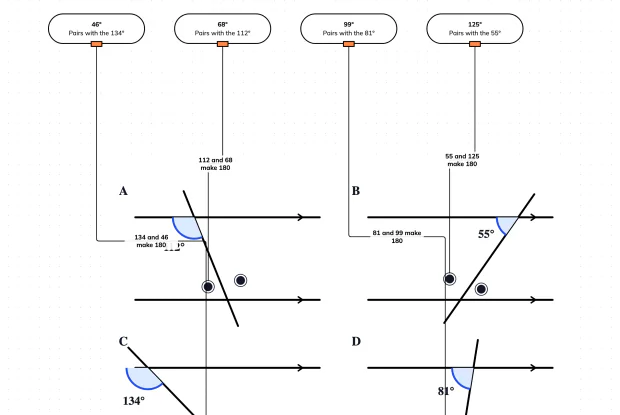
Complementary and supplementary are not shapes or positions. They are a claim about a total: two angles that add to 90° are complementary, two that add to 180° are supplementary. Learn to read which total a figure is asking for, then find the missing angle yourself in an interactive playground.
What Is a Linear Pair of Angles?
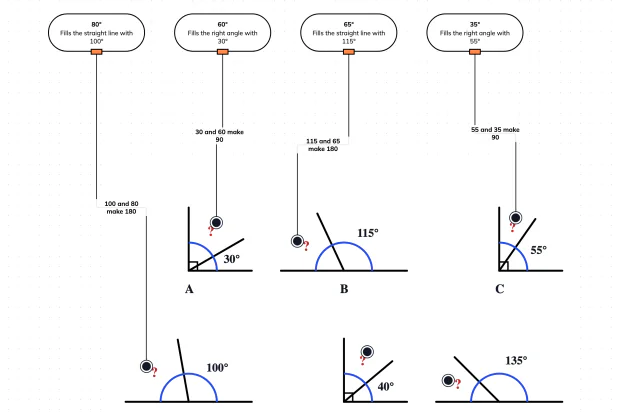
A linear pair is the first angle name where position matters as much as size. The two angles must sit next to each other, and their outer arms must form a straight line — which is what forces them to add to 180°. Sort the real linear pairs from the convincing near-misses in an interactive playground.
Why Are Vertically Opposite Angles Always Equal?
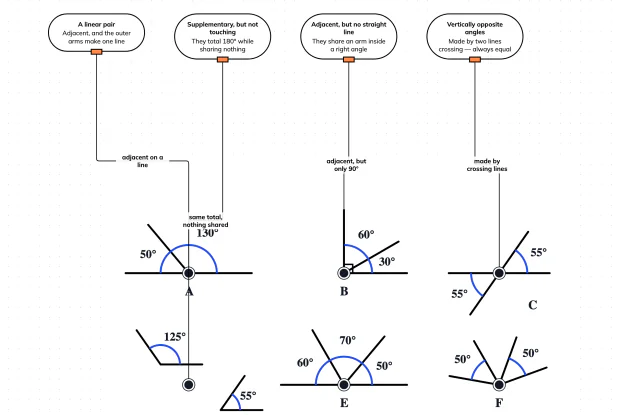
When two straight lines cross they make four angles, and the pairs facing each other across the crossing are always equal. That is not a coincidence to memorise — it follows from linear pairs in two steps. Prove it to yourself, then use it to fill in a crossing from one given angle in an interactive playground.
What Does a Transversal Do to Two Parallel Lines?
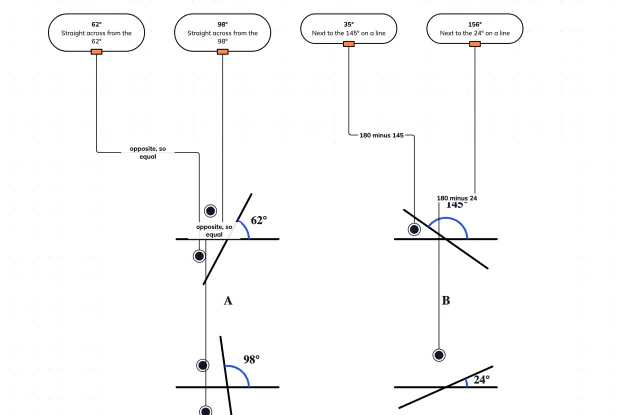
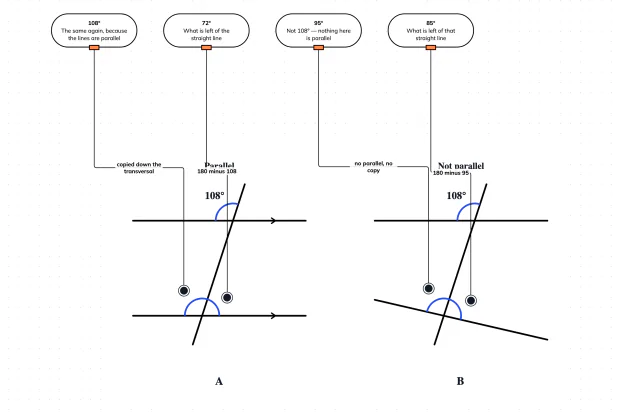
A transversal is a line that cuts across two others. When the two lines it cuts are parallel, something remarkable happens: the two crossings become identical copies, so all eight angles are one of only two sizes. See exactly what parallelism buys you — and what happens without it — in an interactive playground.
What Are Corresponding and Alternate Angles?
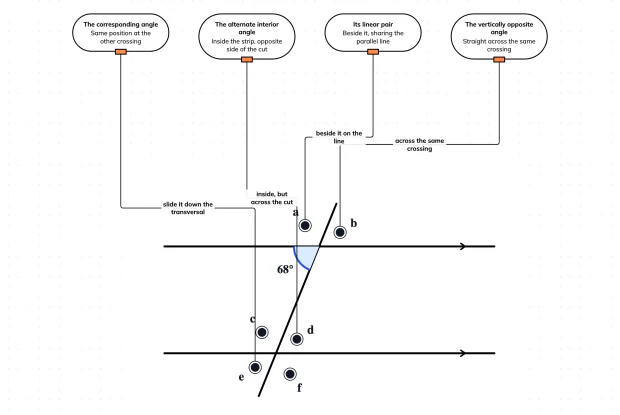
Corresponding angles sit in matching positions at the two crossings; alternate angles sit on opposite sides of the transversal. Both are equal when the lines are parallel, and both are just ways of asking which of the two available sizes an angle is. Name them on a real diagram in an interactive playground.
Why Do Co-Interior Angles Add Up to 180 Degrees?
Every other named pair on parallel lines turns out to be equal. Co-interior angles are the exception: they add to 180° instead. The reason is short, and once you see it the exception stops feeling arbitrary. Find the missing partner on four diagrams in an interactive playground.