Why Do Co-Interior Angles Add Up to 180 Degrees?
Root Concept
Co-interior angles are supplementary because one of them is the linear pair of an angle equal to the other.
CodePLU Goal
Upgrading Human Mental Models
Learn how to think in Workflows

Concept Development By codeplu.com
Same side of the transversal and both inside the strip means add to 180°. Cross the transversal and the pair becomes equal instead.
Why Is This Pair the Odd One Out?
By now the pattern on parallel lines looks reassuringly simple: corresponding angles are equal, alternate interior angles are equal, alternate exterior angles are equal. It would be tidy if every named pair were equal. One is not. Two angles that both sit inside the strip between the parallel lines and on the same side of the transversal are called co-interior, and they add to 180° rather than matching.
You will also meet them as allied angles or as same-side interior angles. The names all point at the same two conditions, and the second one is what makes the difference: same side of the transversal, not opposite sides. Change that single word and the pair flips from supplementary to equal, which is exactly why people mix the two up under exam pressure. Some textbooks teach co-interior angles as the C shape, since the two angles sit in the hollow of a C.
The good news is that this is not a fourth fact to memorise. It follows in one step from things you already have, and the step is worth seeing because it explains why the exception exists at all. The playground then gives you four diagrams to work through, with a couple of alternate interior angles thrown in to make sure you are reading the side of the transversal rather than guessing.
Where the Rule Comes From and How to Use It
Which Two Angles Are Co-Interior?
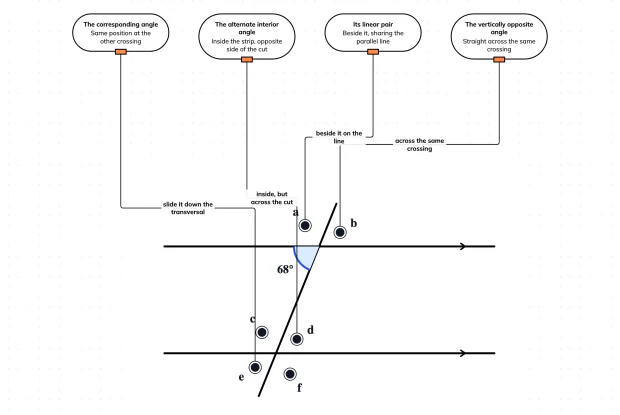
Two conditions, and both must hold. First, both angles must be interior — opening into the strip between the two parallel lines. That rules out the four angles above the top line and below the bottom one. Second, both must be on the same side of the transversal. There are four interior angles in total, two at each crossing, and they form exactly two co-interior pairs: the two on the left of the transversal, and the two on the right. The other two ways of pairing up the interior angles give you alternate interior pairs, which cross the transversal and are equal. So the interior of the diagram contains both kinds, and the only thing separating them is which side of the cut each angle sits on. Read that first, before deciding whether to match or to subtract.
Why Must They Add to 180°?
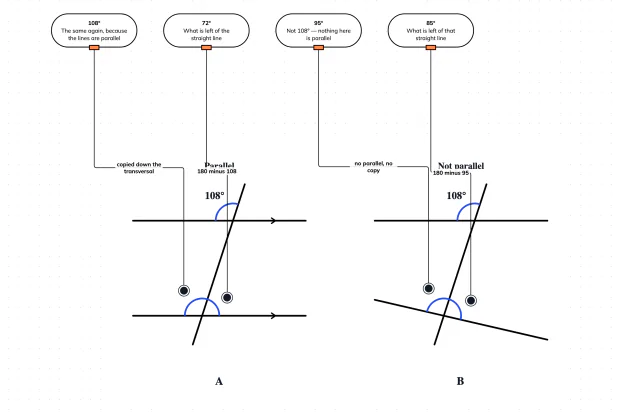
Take a co-interior pair and call them P and Q, with P at the upper crossing and Q at the lower one. Now look at the angle sitting next to P at the upper crossing, on the other side of the parallel line. Call it R. P and R are a linear pair, because they sit next to each other on the same straight line, so P + R = 180°. But R is in the same position at the upper crossing as Q is at the lower one, which makes R and Q corresponding angles — and corresponding angles on parallel lines are equal, so R = Q. Substituting gives P + Q = 180°. That is the whole derivation. The supplementary total is inherited from a linear pair; the corresponding-angle rule is only what carries it from one crossing to the other.
How Do You Use It to Find an Angle?
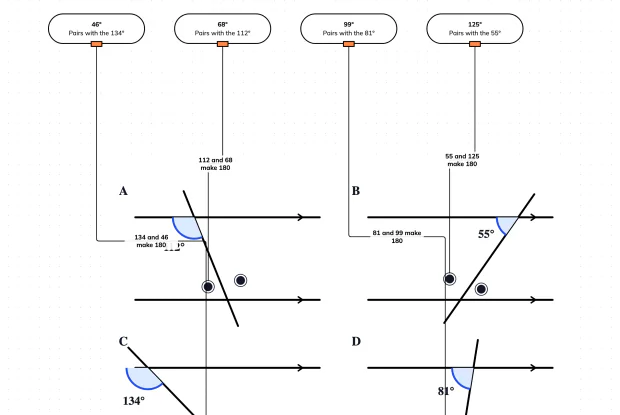
Locate the angle you want and the angle you know. If they are both inside the strip and both on the same side of the transversal, subtract the known one from 180° and you are done. A shaded 112° interior angle gives a co-interior partner of 68°; a 55° one gives 125°. The mistake to guard against is mechanical: having just learned three rules where the answer is copy the number across, it is very easy to copy this one too. The playground deliberately mixes the two, so that half the interior angles you meet want subtraction and half want copying. Building the habit of checking the side of the transversal first is more valuable than remembering which name goes with which behaviour.
What Happens if the Lines Are Not Parallel?
The rule collapses, exactly as all the others do. Every step of the derivation held together because corresponding angles are equal, and corresponding angles are only equal when the two crossings are identical copies, which requires the lines to be parallel. Cut two non-parallel lines with a transversal and the two interior angles on the same side will add to something other than 180°. In fact this gives a useful test in reverse: if you can show that two co-interior angles do add to 180°, the lines must be parallel. That converse is a standard way of proving parallelism rather than assuming it, and it was the form in which this result was first written down, more than two thousand years ago.
Real World Example
Why Does a Staircase Handrail Need This Rule?
The posts are the parallel lines and the rail is the transversal. The angles inside, where the brackets go, are a co-interior pair.
The first bracket
112° at the lower post
A handrail runs up a staircase, fixed to a series of upright posts. The posts are all vertical, so they are parallel to one another, and the rail crosses every one of them at the same slant. At the lower post, the angle between the post and the rail on the upper side — the side facing up the stairs, inside the space between this post and the next — comes out at 112°. That is the angle the bracket has to hold, and it is the one a joiner would set on a bevel gauge before cutting anything. It is an interior angle, because it opens into the space between the two posts.
The bracket above it
68°, not 112°
Now move up to the next post and look at the angle between that post and the rail on the lower side — again facing into the space between the two posts, and again on the same side of the rail. This is the co-interior partner, so it is not 112°; it is 180 − 112 = 68°. A joiner who assumed both brackets were the same would cut the second one to 112° and find it would not sit flat against the post. The two brackets at either end of one span genuinely are different, and the difference is not a small tolerance — 44 degrees is the width of the gap that would be left open.
Checking a rail is true
The totals must reach 180°
The rule reads usefully backwards as well. Measure the two interior angles on the same side of the rail at consecutive posts and add them. If the total is 180°, the posts are parallel, which on a staircase means they are all genuinely vertical. If the total comes out at 174° or 186°, one post is leaning, and the measurement tells you so without any need for a spirit level. This is the converse mentioned above put to work: a pair of co-interior angles adding to 180° is not merely a consequence of parallel lines, it is evidence of them.
FAQs
Final Words
Co-interior angles are the one named pair on parallel lines that does not match. Both sit inside the strip between the lines and both sit on the same side of the transversal, and together they make 180°. The reason is a single substitution: one of them forms a linear pair with an angle that corresponds to the other, so the straight line's 180° is handed across the diagram.
That completes the set. Given one angle anywhere in a transversal diagram, you can now name and find every other angle in it: equal if the pair corresponds or alternates, supplementary if it is a linear pair or co-interior. These relationships are the working tools for the rest of geometry — the next track uses them to prove facts about triangles, starting with why an exterior angle equals the two interior angles it is not touching.
Continue This Track
This concept is part 6 of Angle Pairs and Parallel Lines.
What Are Complementary and Supplementary Angles?
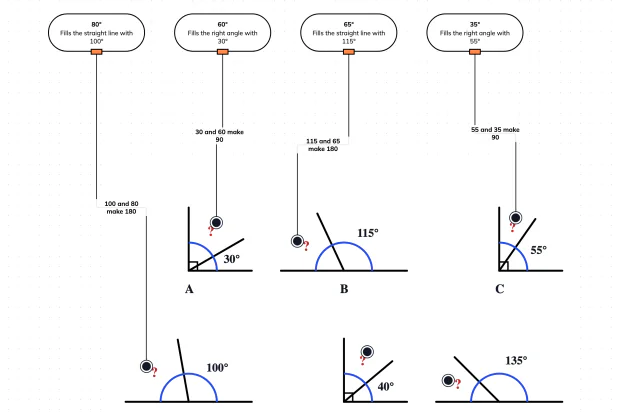
Complementary and supplementary are not shapes or positions. They are a claim about a total: two angles that add to 90° are complementary, two that add to 180° are supplementary. Learn to read which total a figure is asking for, then find the missing angle yourself in an interactive playground.
What Is a Linear Pair of Angles?
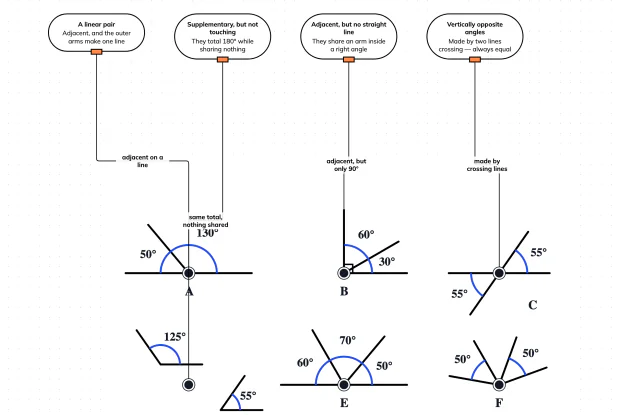
A linear pair is the first angle name where position matters as much as size. The two angles must sit next to each other, and their outer arms must form a straight line — which is what forces them to add to 180°. Sort the real linear pairs from the convincing near-misses in an interactive playground.
Why Are Vertically Opposite Angles Always Equal?
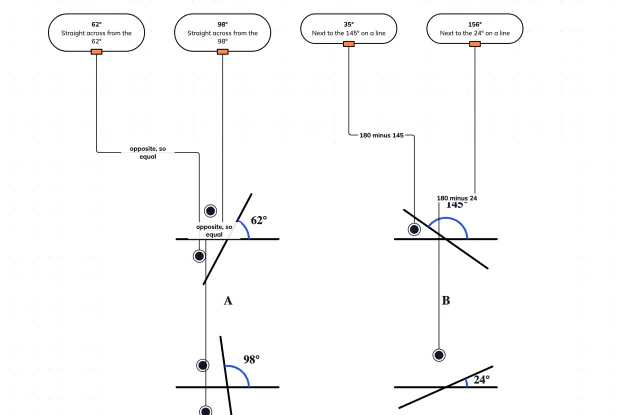
When two straight lines cross they make four angles, and the pairs facing each other across the crossing are always equal. That is not a coincidence to memorise — it follows from linear pairs in two steps. Prove it to yourself, then use it to fill in a crossing from one given angle in an interactive playground.
What Does a Transversal Do to Two Parallel Lines?
A transversal is a line that cuts across two others. When the two lines it cuts are parallel, something remarkable happens: the two crossings become identical copies, so all eight angles are one of only two sizes. See exactly what parallelism buys you — and what happens without it — in an interactive playground.
What Are Corresponding and Alternate Angles?
Corresponding angles sit in matching positions at the two crossings; alternate angles sit on opposite sides of the transversal. Both are equal when the lines are parallel, and both are just ways of asking which of the two available sizes an angle is. Name them on a real diagram in an interactive playground.
Why Do Co-Interior Angles Add Up to 180 Degrees?
Every other named pair on parallel lines turns out to be equal. Co-interior angles are the exception: they add to 180° instead. The reason is short, and once you see it the exception stops feeling arbitrary. Find the missing partner on four diagrams in an interactive playground.