Angle Pairs and Parallel Lines
Up to here every angle has been measured on its own. This track is about what one angle tells you about another. It opens with the two totals that matter — 90° and 180° — and the discovery that complementary and supplementary are claims about a sum and nothing else, not about where the angles are drawn. Position then starts to count: a linear pair is supplementary and adjacent, and two crossing lines force the angles facing each other to be equal for a reason that takes two lines to write down. From there the diagrams grow one line bigger. A transversal cutting two parallel lines makes eight angles but only two sizes, because the two crossings are identical copies of each other, and the last two tutorials give names to the pairs: corresponding and alternate angles, which are equal, and co-interior angles, which are the single exception and add to 180°. By the end, one angle anywhere in such a diagram is enough to find all eight, with a reason for each.
CodePLU Goal
Upgrading Human Mental Models
Learn how to think in Workflows
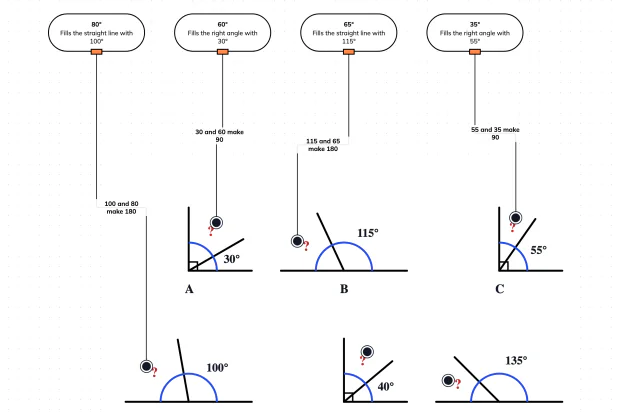
What Are Complementary and Supplementary Angles?
Complementary and supplementary are not shapes or positions. They are a claim about a total: two angles that add to 90° are complementary, two that add to 180° are supplementary. Learn to read which total a figure is asking for, then find the missing angle yourself in an interactive playground.
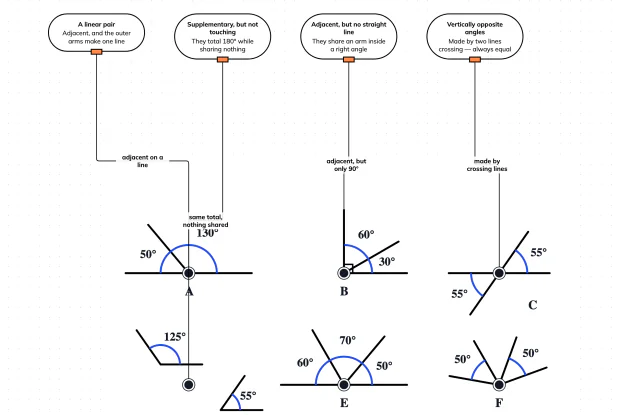
What Is a Linear Pair of Angles?
A linear pair is the first angle name where position matters as much as size. The two angles must sit next to each other, and their outer arms must form a straight line — which is what forces them to add to 180°. Sort the real linear pairs from the convincing near-misses in an interactive playground.
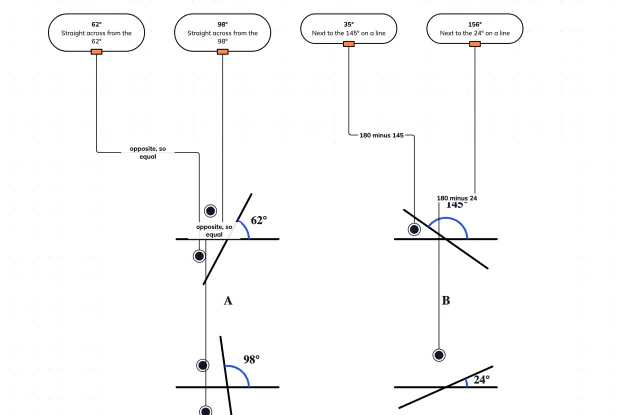
Why Are Vertically Opposite Angles Always Equal?
When two straight lines cross they make four angles, and the pairs facing each other across the crossing are always equal. That is not a coincidence to memorise — it follows from linear pairs in two steps. Prove it to yourself, then use it to fill in a crossing from one given angle in an interactive playground.
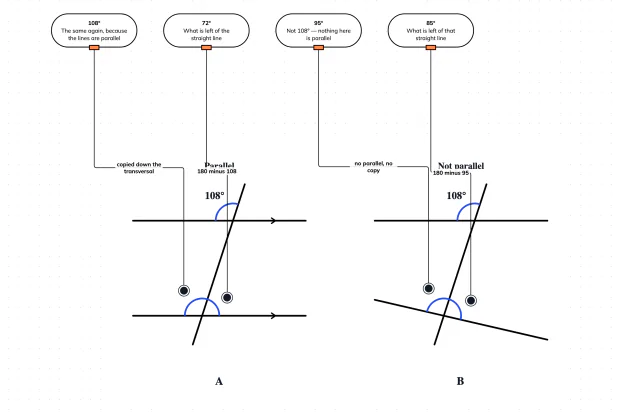
What Does a Transversal Do to Two Parallel Lines?
A transversal is a line that cuts across two others. When the two lines it cuts are parallel, something remarkable happens: the two crossings become identical copies, so all eight angles are one of only two sizes. See exactly what parallelism buys you — and what happens without it — in an interactive playground.
What Are Corresponding and Alternate Angles?
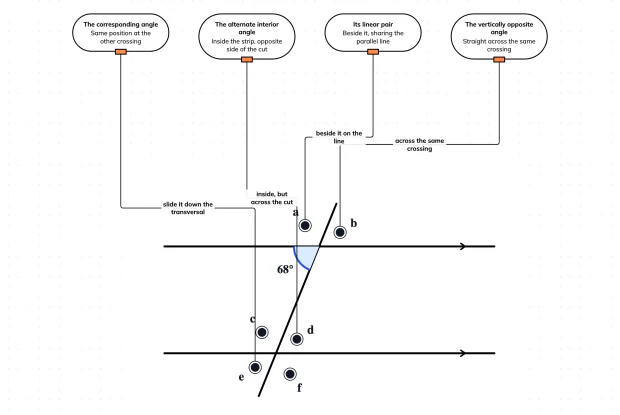
Corresponding angles sit in matching positions at the two crossings; alternate angles sit on opposite sides of the transversal. Both are equal when the lines are parallel, and both are just ways of asking which of the two available sizes an angle is. Name them on a real diagram in an interactive playground.
Why Do Co-Interior Angles Add Up to 180 Degrees?
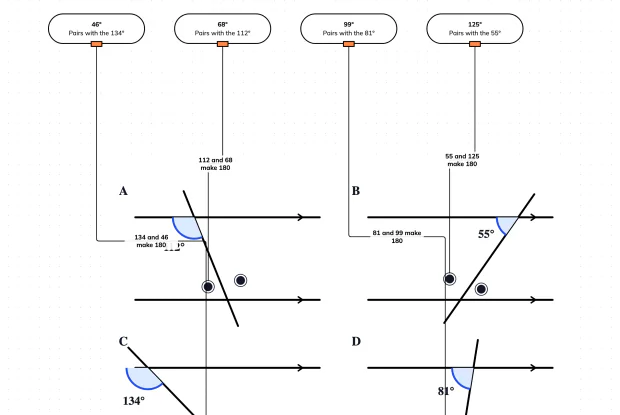
Every other named pair on parallel lines turns out to be equal. Co-interior angles are the exception: they add to 180° instead. The reason is short, and once you see it the exception stops feeling arbitrary. Find the missing partner on four diagrams in an interactive playground.