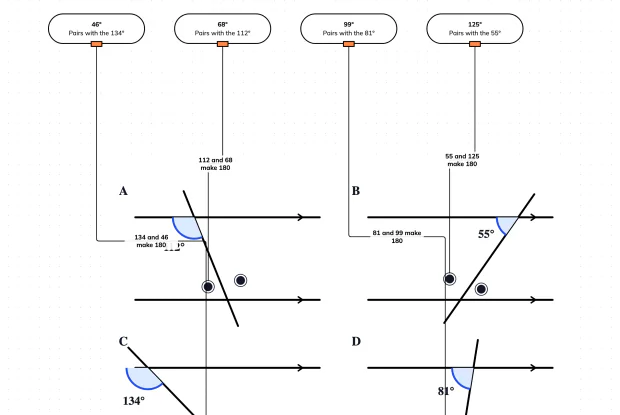
What Are Corresponding and Alternate Angles?
Root Concept
Corresponding and alternate are position words: they tell you where to look for an angle equal to the one you have.
CodePLU Goal
Upgrading Human Mental Models
Learn how to think in Workflows

Concept Development By codeplu.com
Ask two questions about any angle: is it inside or outside the strip, and which side of the transversal is it on? Those two answers name every pair.
Why Do These Pairs Need Names?
From the last tutorial you already know the useful fact: a transversal across parallel lines makes eight angles of only two sizes. What you do not yet have is a quick way of saying which of the two sizes a particular angle is. That is the job these names do. Corresponding, alternate interior and alternate exterior are not new rules — they are labels for positions, and each label comes with a guarantee about equality.
Every one of them is decided by two questions. Is the angle inside the strip between the two parallel lines, or outside it? And which side of the transversal does it sit on? Two angles in the same position relative to their own crossing are corresponding. Two angles on opposite sides of the transversal, both inside the strip, are alternate interior. Both outside, on opposite sides, are alternate exterior. In every case, when the lines are parallel, the two angles are equal.
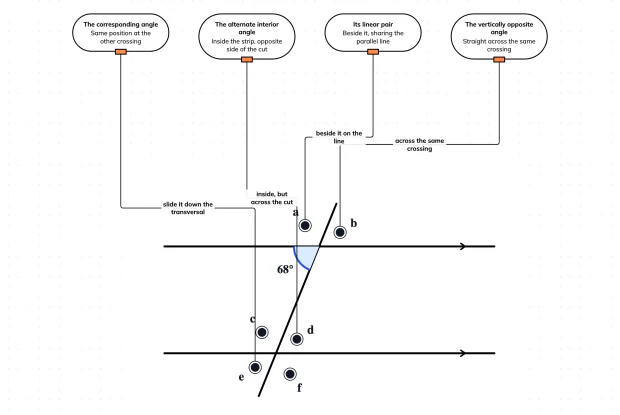
The playground below shades one angle and letters six others. Rather than asking for numbers, it asks you to point at the angle that stands in each named relation to the shaded one. That is the skill worth having, because once you can find the corresponding angle by eye you can solve most parallel-line questions without writing anything down.
How Do You Recognise Each Pair?
What Makes Two Angles Corresponding?
Corresponding angles occupy the same position at their own crossings. Take any angle, note where it sits relative to its crossing — above the parallel line and to the left of the transversal, say — then go to the other crossing and find the angle in that same position. Those two are corresponding, and on parallel lines they are equal. The mental picture that makes this obvious is sliding: imagine picking up one whole crossing and sliding it along the transversal until it lands on the other. Because the lines are parallel the two crossings are identical, so everything lands exactly on its match, and corresponding angles are simply the pairs that land on each other. Some people learn this as the F shape, because the two arms of an F point at a corresponding pair, but the sliding picture survives a rotated diagram and the letter shape does not.
What Makes Two Angles Alternate?
Alternate angles sit on opposite sides of the transversal, one at each crossing. The word alternate is doing the work: it means the two angles swap sides of the cut. There are two kinds, depending on whether they also sit inside the strip between the parallel lines or outside it. Alternate interior angles are both inside and on opposite sides; alternate exterior angles are both outside and on opposite sides. Both kinds are equal on parallel lines. Alternate interior angles are sometimes taught as the Z shape, because the two angles sit in the two hooks of a Z, and again the shape is a memory aid rather than a definition — the Z becomes an S or an N when the diagram is turned round, but inside and opposite sides never stop being true.
Why Are They Equal?
You do not need a separate reason for each name; one of them does all the work and the others follow. Corresponding angles are equal because the two crossings are identical copies, which is the fact established in the last tutorial. Alternate interior angles then come free: an alternate interior angle is vertically opposite the corresponding angle, and vertically opposite angles are equal, so the two are equal to each other. Alternate exterior angles work the same way. This is worth noticing because it means the whole topic rests on two ideas you already had — identical crossings and vertically opposite angles — rather than on three separate facts to be memorised. If you ever forget which pairs are equal, rebuild them from the sliding picture instead of guessing.
How Do You Use Them in a Question?
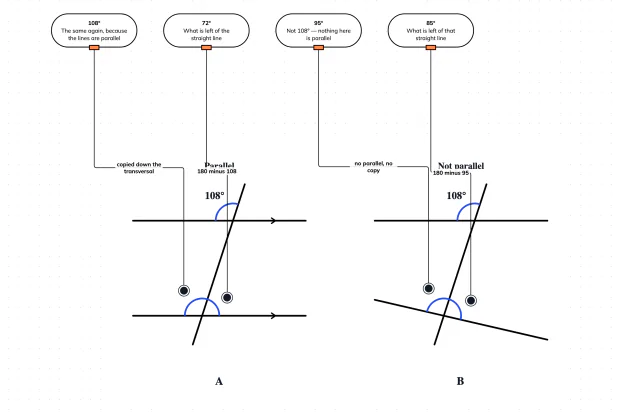
Work backwards from the angle you want. Find it on the diagram, decide whether it is inside or outside the strip and which side of the transversal it is on, then look for the known angle and ask how the two are related. If they are corresponding or alternate, they are equal and you are finished. If they are neighbours on a line, subtract from 180°. In written work, name the reason: corresponding angles are equal, or alternate angles are equal, is a standard justification and is often worth a mark of its own. One caution carried over from the last tutorial: all of this depends on the lines being parallel. Without the arrowheads or a statement in the question, corresponding angles are simply two angles in similar-looking places, with no equality attached.
Real World Example
How Does a Carpenter Copy an Angle Without Measuring It?
A ladder is a transversal problem in wood: two parallel rails, and every rung crossing both of them at the same slant.
The first joint
68° against the rail
A carpenter building a ladder sets the first rung against the left rail and cuts it so that the angle between rung and rail, measured on the upper side, is 68°. On a plain step-ladder that angle would be a right angle, but on a leaning ladder with slanted rungs it is not, and it has to be cut deliberately. The rung is behaving exactly like a transversal: it is a straight piece crossing two other straight pieces. The two rails are built parallel, because a ladder whose rails converged would be unusable, and that parallelism is what the rest of the work depends on.
The far end of the same rung
68° again, corresponding
At the right rail, the same rung makes an angle in the matching position — upper side, same side of the rung — and because the rails are parallel that angle is corresponding to the first one and therefore also 68°. The carpenter cuts both ends of every rung to the same 68° without measuring the second end at all. If the rails were not truly parallel, each rung would need its two ends cut differently, and every rung would need a different pair of cuts depending on where it sat up the ladder. Parallel rails turn a variable job into a single repeated cut.
Checking the work
Alternate angles agree
There is a neat way to check a finished ladder without a protractor. Look at the angle under the rung at the left rail and the angle above the rung at the right rail: these are alternate interior angles, both inside the strip between the rails, on opposite sides of the rung. On a correctly built ladder they are equal, and a discrepancy you can see by eye means the rails are not parallel or a rung has been cut wrong. This is the practical value of having names for the pairs. Knowing that two particular angles must agree turns a vague sense that something looks off into a specific thing to measure.
FAQs
Final Words
Corresponding and alternate are position words, not new rules. Corresponding angles sit in matching places at the two crossings; alternate angles swap sides of the transversal, either inside the strip or outside it. On parallel lines every one of these pairs is equal, and all of it traces back to two things you already had: the crossings are identical copies, and vertically opposite angles are equal.
There is one more named pair, and it is the odd one out. Two angles inside the strip on the same side of the transversal are not equal at all — they add to 180°. That pair is co-interior, it is lettered c in the playground you just worked through, and the next tutorial explains why it behaves differently from everything else here.
Continue This Track
This concept is part 5 of Angle Pairs and Parallel Lines.
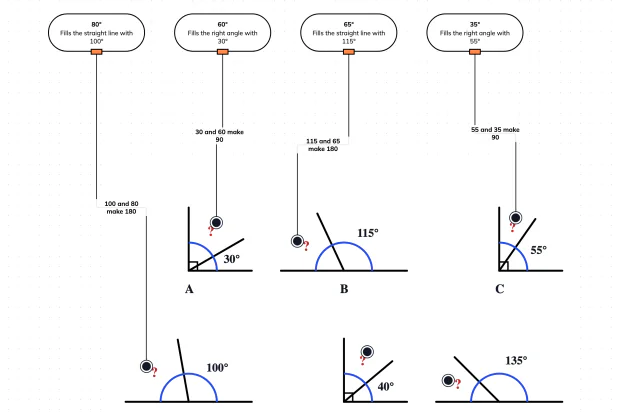
What Are Complementary and Supplementary Angles?
Complementary and supplementary are not shapes or positions. They are a claim about a total: two angles that add to 90° are complementary, two that add to 180° are supplementary. Learn to read which total a figure is asking for, then find the missing angle yourself in an interactive playground.
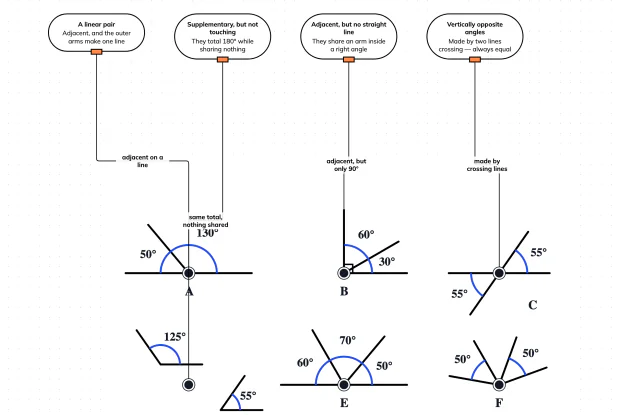
What Is a Linear Pair of Angles?
A linear pair is the first angle name where position matters as much as size. The two angles must sit next to each other, and their outer arms must form a straight line — which is what forces them to add to 180°. Sort the real linear pairs from the convincing near-misses in an interactive playground.
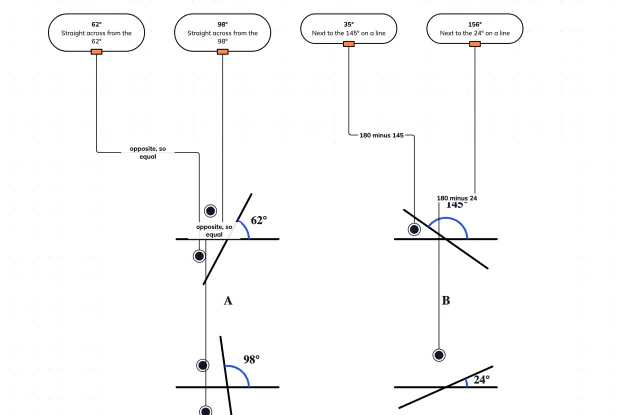
Why Are Vertically Opposite Angles Always Equal?
When two straight lines cross they make four angles, and the pairs facing each other across the crossing are always equal. That is not a coincidence to memorise — it follows from linear pairs in two steps. Prove it to yourself, then use it to fill in a crossing from one given angle in an interactive playground.
What Does a Transversal Do to Two Parallel Lines?
A transversal is a line that cuts across two others. When the two lines it cuts are parallel, something remarkable happens: the two crossings become identical copies, so all eight angles are one of only two sizes. See exactly what parallelism buys you — and what happens without it — in an interactive playground.
What Are Corresponding and Alternate Angles?
Corresponding angles sit in matching positions at the two crossings; alternate angles sit on opposite sides of the transversal. Both are equal when the lines are parallel, and both are just ways of asking which of the two available sizes an angle is. Name them on a real diagram in an interactive playground.
Why Do Co-Interior Angles Add Up to 180 Degrees?
Every other named pair on parallel lines turns out to be equal. Co-interior angles are the exception: they add to 180° instead. The reason is short, and once you see it the exception stops feeling arbitrary. Find the missing partner on four diagrams in an interactive playground.