What Makes Two Terms Like Terms?
Root Concept
Two terms are alike when their letter parts are identical; then you add the coefficients and leave the letters completely alone.
CodePLU Goal
Upgrading Human Mental Models
Learn how to think in Workflows

Concept Development By codeplu.com
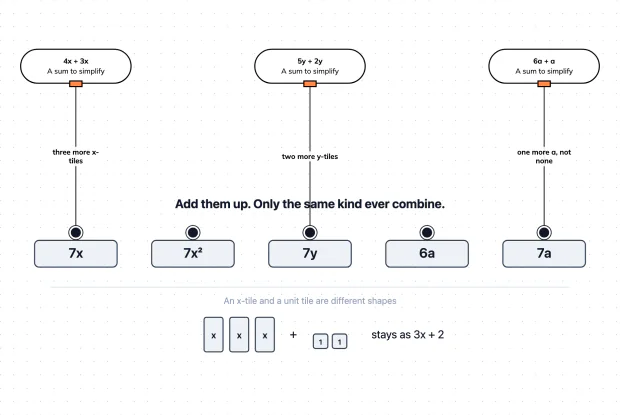
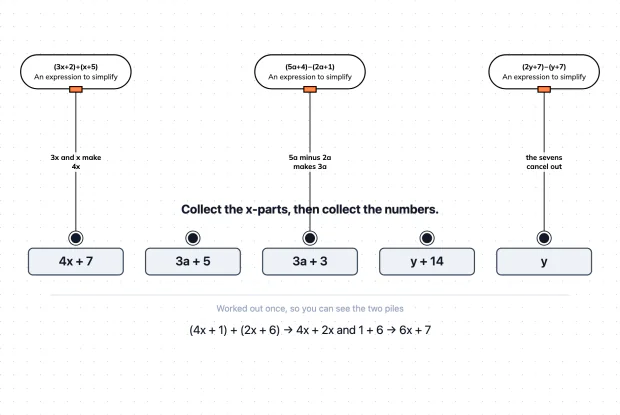
Add the coefficients, leave the letters alone — match each sum to its answer
Why Can't You Add Everything Together?
Faced with 4x + 3y, a lot of beginners want to write 7xy, and the instinct is completely understandable — four of something plus three of something usually makes seven. The trouble is that x and y are not the same something. Four apples plus three oranges does not make seven apple-oranges; it makes four apples and three oranges, and that is the whole answer.
Terms that can be combined are called like terms, and the test is strict: the letter parts must be identical, right down to the exponents. So 4x and 3x are alike, and so are 2y² and 7y². But 4x and 3x² are not alike, because an x-tile and an x-by-x square are different shapes and no amount of pushing them together makes one kind.
When two terms do pass the test, combining them is easy: add the coefficients and leave the letter part exactly as it was. 4x + 3x is 7x, not 7x² — you are counting how many x you have, not multiplying them. In the playground below you will simplify three sums, with two of the offered answers being exactly what you get if you change the letters when you should not.
When Can Two Terms Be Added?
What is the test for like terms?
Cover up the coefficients and look at what is left. If the letter parts are character for character identical, the terms are alike. In 4x and 3x, covering the numbers leaves x and x, so they combine. In 4x and 3x² it leaves x and x², which are different, so they do not. Exponents count as part of the letter part, and so does every letter present: 2ab and 5ab are alike, but 2ab and 5a are not. The order the letters are written in does not matter, because multiplication can be done either way round, so 3ab and 4ba are alike and come to 7ab. That last one surprises people, and it is worth tidying letters into alphabetical order so you can see such pairs at a glance.
What happens to the letters when you combine?
Nothing at all. You add the coefficients, and the letter part is copied straight across. 4x + 3x is 7x, because you had four x and gained three more, so now you have seven x. The classic error is to write 7x², which comes from a half-memory that something gets added to the powers. Something does, but only when terms are multiplied, and this is addition. Think of the tiles: three long x-tiles beside four long x-tiles is seven long x-tiles, all still the same shape. The shape is the letter part, and adding never changes it.
What about a term that looks like it has no number?
A bare letter carries an invisible coefficient of 1, and forgetting it is the quickest way to get a simplification slightly wrong. 6a + a is not 6a; it is 7a, because that lone a is one more a. The same goes for subtraction: 5y − y leaves 4y, not 5y. When you are learning, it is worth writing the 1 in explicitly — 6a + 1a — so the arithmetic is in front of you rather than in your head. A related trap is a term that disappears entirely: 2y − 2y is 0, and writing nothing at all is the right answer rather than a mistake.
Real World Example
What Does Collecting Actually Look Like?
Like terms are just the rule that you can only count things together when they are the same thing:
Two trips to the shop
4 apples, 3 oranges, 2 more apples
You come back from the shop with four apples and three oranges. Somebody else arrives with two more apples. Asked how much fruit there is now, nobody hesitates: six apples and three oranges. Nobody is tempted to say nine fruit-things or to invent a new category. The apples joined the apples because they were the same thing, and the oranges sat out because they were not. Write it with letters, using a for apples and o for oranges, and the sum is 4a + 3o + 2a, which comes to 6a + 3o. The algebra has not added a single new idea; it has only given the fruit shorter names.
Why the answer keeps two pieces
6a + 3o, and that is finished
A lot of beginners feel that 6a + 3o cannot be the final answer, because it still has a plus sign in it and answers are supposed to be tidy. It is finished. There is no single number that describes six apples and three oranges, and pretending otherwise by writing something like 9ao would be inventing a fruit that does not exist. An expression is fully simplified when no two remaining terms are alike, however many terms that leaves. Learning to stop at the right moment is as much a part of this skill as knowing when to combine.
When the shapes differ
boxes of apples are not apples
Now somebody turns up with two boxes, each holding a apples. That is 2 lots of a-times-a if each box holds a rows of a apples — in other words 2a², which is not the same kind of thing as an apple at all. You cannot add it to the 6a, because one counts single apples and the other counts square arrangements of them. The answer stays as 2a² + 6a + 3o, with three separate pieces. This is exactly why exponents count in the like-terms test: a and a² describe genuinely different quantities, not two sizes of the same one.
FAQs
Final Words
Two terms combine only when their letter parts match exactly, exponents and all. When they do, you add the coefficients and copy the letter part across untouched — 4x + 3x is 7x, never 7x², because addition counts things rather than multiplying them.
The two slips that cost the most marks are changing the letters when combining, and forgetting the invisible 1 on a bare letter. Write that 1 in while you are learning. Next comes the question of how many terms an expression has in the first place, which is how expressions get their names.
Continue This Track
This concept is part 2 of Working With Expressions.
What Are Terms, Factors and Coefficients?
An expression is made of terms, and each term is a number multiplied by some letters. Learn the names for those pieces and read them off real terms in an interactive playground.
What Makes Two Terms Like Terms?
Only terms with exactly the same letter part can be added together. Learn the test for like terms and simplify three sums in an interactive playground.
Monomial, Binomial, Polynomial: What's the Difference?
Expressions are named after how many terms they contain, and that is the whole rule. Learn the names and sort real expressions in an interactive playground.
How Do You Add and Subtract Algebraic Expressions?
Adding two expressions means collecting the terms that are alike. Subtracting means the same, with one trap. Work three of them in an interactive playground.
How Do You Multiply a Term Through a Bracket?
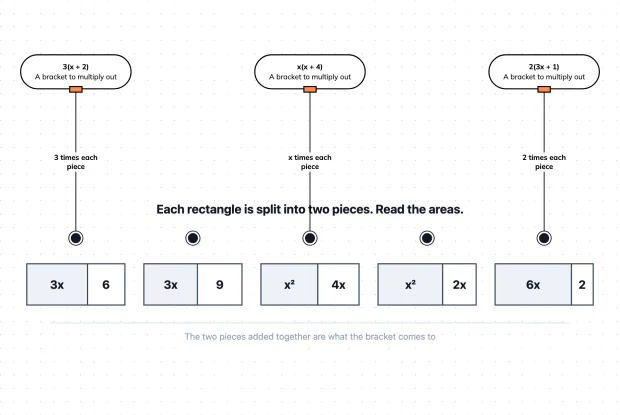
Multiplying out a bracket means the term in front reaches every term inside. See why on a rectangle's area, and match three brackets to their pieces in a playground.
How Do You Multiply Two Brackets Together?
Multiplying two brackets means every term in the first meets every term in the second. See the four pieces as areas and match three products in a playground.