How Do You Multiply Two Brackets Together?
Root Concept
Two brackets draw a rectangle cut both ways, so the product is always four pieces added together — two of which usually combine.
CodePLU Goal
Upgrading Human Mental Models
Learn how to think in Workflows

Concept Development By codeplu.com
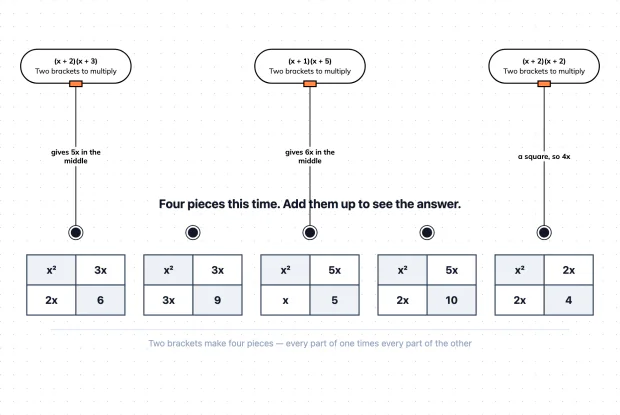
Four pieces every time — match each pair of brackets to its grid
Why Does One Bracket Give Two Pieces and Two Give Four?
Multiplying out 3(x + 2) gave two pieces, because there was one term outside and two inside. Multiplying (x + 2)(x + 3) gives four, because now there are two terms on each side and every one of them has to meet every one of the others. Two times two is four, and that is the entire reason for the number.
The rectangle picture handles it without any new ideas. Draw a rectangle x + 2 tall and x + 3 wide, then cut it both ways — once across and once down. You get four smaller rectangles with areas x², 3x, 2x and 6. Add them and you have the whole thing: x² + 5x + 6, because the 3x and the 2x are like terms and collect into 5x.
That final collecting step is what makes the answer look shorter than four pieces. It is also where the middle term of a trinomial comes from, which is worth noticing now because it explains a great deal of later algebra. In the playground below, five rectangles are drawn with their four areas showing, and you match each product to the one it builds.
Where Do the Four Pieces Come From?
How do you make sure you get all four?
Take each term of the first bracket in turn and multiply it by both terms of the second. For (x + 2)(x + 3), start with the x: x times x is x², and x times 3 is 3x. Then take the 2: 2 times x is 2x, and 2 times 3 is 6. Four products, and now you add them all together. Working in this fixed order is what stops a piece going missing, and a piece going missing is the most common failure here — people multiply the first terms and the last terms, get x² + 6, and never notice that two thirds of the rectangle is unaccounted for. If the answer to a pair of brackets like this has only two terms, something has been dropped.
Why does the answer usually have three terms, not four?
Because two of the four pieces are almost always like terms. In the example above, 3x and 2x both have the same letter part, so they collect into 5x and the four pieces become three terms: x² + 5x + 6. The middle term of the answer is the sum of those two, which gives you a quick way to check your work — add the two numbers in the brackets and the result should be the coefficient in the middle. Here 2 + 3 is 5, and the middle term is 5x. The last term is the two numbers multiplied: 2 times 3 is 6. Neither of these is a shortcut to learn instead of the method, but both catch mistakes quickly.
What happens when both brackets are the same?
You get a square, and the picture is literally a square. (x + 2)(x + 2) draws a shape x + 2 on each side, cut into x², two identical strips of 2x, and a small square of 4. Adding them gives x² + 4x + 4. The trap here is enormous and worth naming plainly: (x + 2)² is not x² + 4. Squaring a bracket does not mean squaring each piece, and the two strips of 2x are the part people leave out. Test it with a number. With x as 1, (1 + 2)² is 9, while 1 + 4 is 5. The missing 4x is the four square units the two strips were covering.
Real World Example
What Does This Look Like on Real Ground?
Two brackets multiplied is what happens whenever a rectangle grows in both directions:
The patio you start with
x metres square
A square patio measures x metres along each side, so its area is x times x, which is x² square metres. Nobody has to think hard about that one. The interesting part starts when the patio is extended, because most people's instinct about what happens to the area is wrong, and drawing it is what fixes the instinct. Keep the original square in mind as the top-left corner of everything that follows, because it stays exactly the same size however much is added around it. Everything the extension adds is genuinely new ground laid around that unchanged square, and the algebra is only a way of counting it.
Extending in both directions
(x + 2)(x + 3)
Now add two metres along one side and three metres along the other. The new patio is x + 2 metres one way and x + 3 metres the other, so its area is (x + 2)(x + 3). Draw the shape and the original square is still there in the corner, at x². Along one edge runs a strip three metres wide and x long, giving 3x. Along the other runs a strip two metres wide and x long, giving 2x. And in the far corner sits a small rectangle two by three, which is 6. Four pieces, exactly as the method says, and they are all visible on the ground.
Why the corner piece is the one people forget
x² + 5x + 6
Adding the four pieces gives x² + 3x + 2x + 6, which collects to x² + 5x + 6. The piece most often left out is the little corner rectangle, because it feels like an afterthought next to the two long strips. Put numbers in and it stops feeling optional: with x as ten, the patio goes from a hundred square metres to a hundred and fifty-six, and six of those extra square metres are that corner. Leave it out and you order too little paving, which is the physical version of dropping a term.
FAQs
Final Words
Two brackets always make four pieces, because every term in one has to meet every term in the other. Drawn as a rectangle cut both ways, the four pieces are simply the four smaller rectangles, and adding them gives the answer. Two of them are usually like terms, which is why the finished expression has three terms rather than four.
The error that costs most is squaring a bracket by squaring its pieces: (x + 2)² is x² + 4x + 4, not x² + 4. The two missing strips are visible the moment you draw it. With this, the whole of working with expressions is in place — naming them, collecting them, and multiplying them out.
Continue This Track
This concept is part 6 of Working With Expressions.
What Are Terms, Factors and Coefficients?
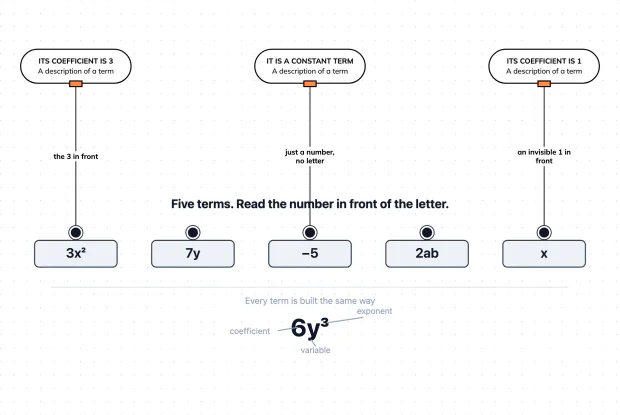
An expression is made of terms, and each term is a number multiplied by some letters. Learn the names for those pieces and read them off real terms in an interactive playground.
What Makes Two Terms Like Terms?
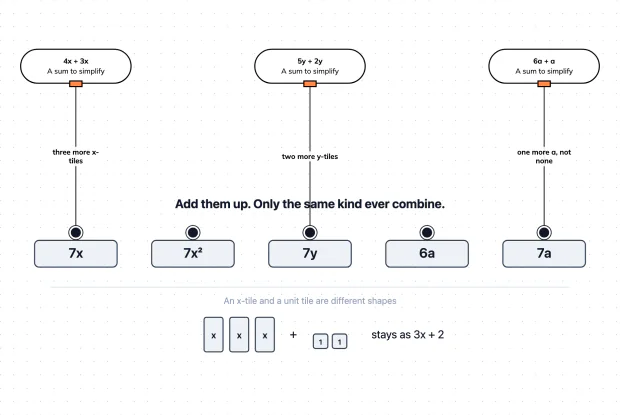
Only terms with exactly the same letter part can be added together. Learn the test for like terms and simplify three sums in an interactive playground.
Monomial, Binomial, Polynomial: What's the Difference?
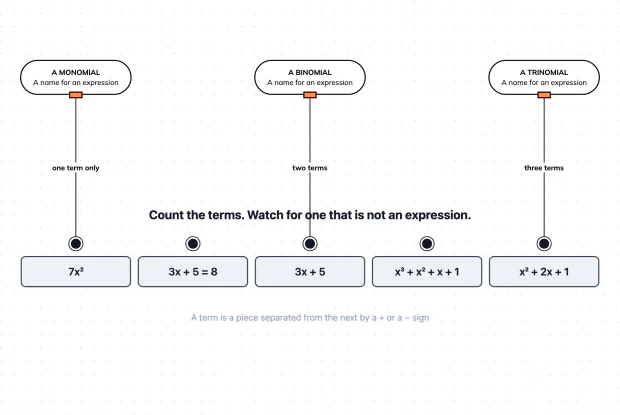
Expressions are named after how many terms they contain, and that is the whole rule. Learn the names and sort real expressions in an interactive playground.
How Do You Add and Subtract Algebraic Expressions?
Adding two expressions means collecting the terms that are alike. Subtracting means the same, with one trap. Work three of them in an interactive playground.
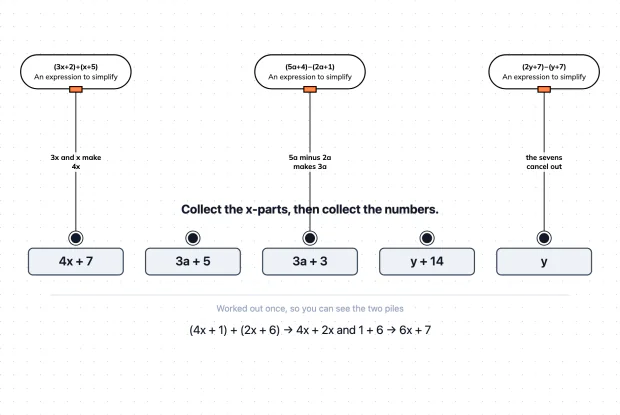
How Do You Multiply a Term Through a Bracket?
Multiplying out a bracket means the term in front reaches every term inside. See why on a rectangle's area, and match three brackets to their pieces in a playground.
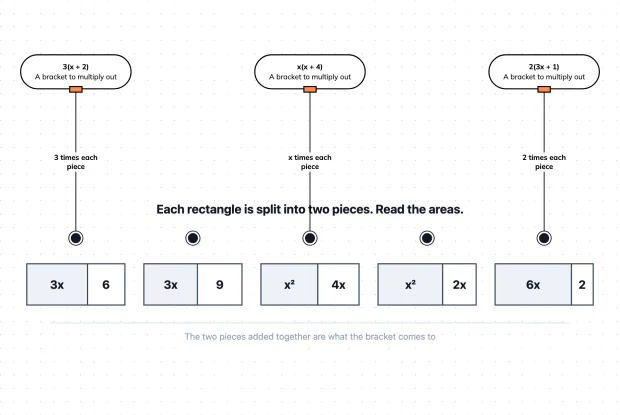
How Do You Multiply Two Brackets Together?
Multiplying two brackets means every term in the first meets every term in the second. See the four pieces as areas and match three products in a playground.