Monomial, Binomial, Polynomial: What's the Difference?
Root Concept
Mono, bi and tri are counting words, so naming an expression is nothing more than counting the terms it is built from.
CodePLU Goal
Upgrading Human Mental Models
Learn how to think in Workflows

Concept Development By codeplu.com
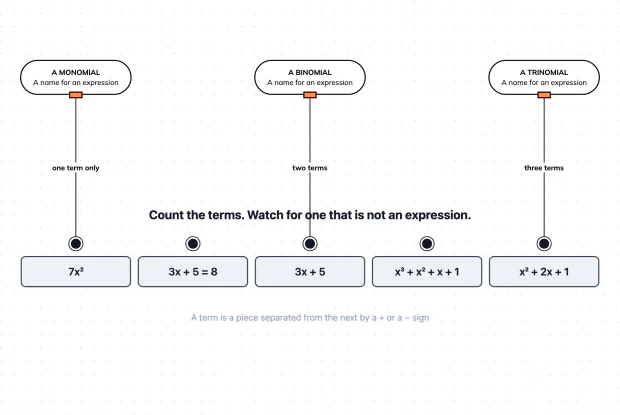
Count the terms — and spot the one with an equals sign in it
Why Do Expressions Have Different Names?
Monomial, binomial, trinomial, polynomial. Four intimidating words that between them describe something entirely ordinary: how many pieces an expression has. Mono means one, bi means two, tri means three, and poly means many — the same prefixes as in monorail, bicycle and tricycle. Once you see them as counting words the whole vocabulary collapses into one rule.
So 7x² is a monomial because it is a single term. 3x + 5 is a binomial because the plus sign splits it into two. x² + 2x + 1 is a trinomial, with three. Anything with terms at all can be called a polynomial, which is the general word; the specific names are just handy when the count is small.
The one thing to watch is that all of these are expressions, not equations. The moment an equals sign appears you no longer have a polynomial — you have a claim about one, and that is a different kind of object entirely. The playground below has five things in boxes, and one of them is an impostor for exactly that reason.
How Are Expressions Named?
How do you count the terms?
Count the plus and minus signs that are not inside a bracket, then add one. In x³ + x² + x + 1 there are three such signs, so there are four terms. The part people get wrong is assuming that a longer term must be more than one term. 5abc is a single term, even though it has four symbols in it, because those symbols are multiplied rather than added. So 5abc is a monomial, and it is a bigger-looking monomial than x but no less a single piece. Read the operation, not the length. If you can travel from one end of a chunk to the other without stepping over a plus or minus sign, it is one term.
What does polynomial actually cover?
Polynomial is the umbrella word, so every monomial, binomial and trinomial is also a polynomial. That surprises people who expect the names to be exclusive, like categories in a sorting exercise. They are not: poly simply means many, and one is not excluded from many any more than a square is excluded from being a rectangle. In practice the specific names are used when the count is two or three, because those are common enough to be worth naming, and polynomial is used for anything longer or when the count does not matter. You will also meet the word for an expression with four terms, but almost nobody uses it, and polynomial is what people actually say.
What stops something being a polynomial at all?
Two things, and both appear at this level. The first is an equals sign: 3x + 5 = 8 is not a binomial, because it is not an expression. It is an equation, a claim that one expression and another are equal, and it contains a binomial rather than being one. The second is a letter in an awkward place — polynomials have whole-number powers of their letters, so x² and x³ are fine, but a letter under a square root or on the bottom of a fraction is not. That second rule matters later; the equals sign is the one to hold on to now, because it is the distinction between something you evaluate and something you solve.
Real World Example
Where Do the Counts Actually Matter?
The name tells you at a glance how much is going on, which is exactly why it is worth having:
One term: the lawn
A monomial, 8w
A rectangular lawn is eight metres long and w metres wide, so its area is 8w square metres. That is a monomial — one term, one number multiplied by one letter. Expressions of this size are the easiest to work with, because there is nothing to collect and nothing to keep separate. If you double the lawn's width, you double the area, and you can see that immediately from the single term. A great deal of early algebra is about getting messy expressions back down to something this simple, so it is worth recognising the shape when you arrive at it.
Two terms: the lawn and a path
A binomial, 8w + 12
Now add a paved path along one end with a fixed area of twelve square metres. The total paved-and-grassed area becomes 8w + 12, which is a binomial: two terms, separated by a plus sign. Notice what the two terms are doing differently. The 8w responds to how wide you make the lawn; the 12 does not move at all. That is the practical reason binomials are so common in real problems — most situations have one part that scales with something and one part that is simply fixed, and two terms is the natural shape for that.
Three terms: adding a border
A trinomial, w² + 8w + 12
Put a square flower bed of side w at the far end and the total becomes w² + 8w + 12 — a trinomial. This particular shape, a squared term then a plain letter term then a number, turns up constantly in later algebra, and it is exactly what you get when two brackets are multiplied together. Being able to say at a glance that something is a trinomial of this form is genuinely useful, because it tells you which techniques are likely to apply to it long before you start working on it. Three terms is also about the point at which the specific names stop being worth the trouble.
FAQs
Final Words
The vocabulary is far smaller than it looks. Count the terms, and the prefix tells you the name: one is mono, two is bi, three is tri, and poly covers everything including all of those. Terms are separated by plus and minus signs only, so a long multiplied chunk is still one term.
The distinction worth carrying forward is not between the names but between an expression and an equation. Everything here is something you evaluate; add an equals sign and it becomes something you solve. Next comes the first real operation on these expressions — adding two of them together.
Continue This Track
This concept is part 3 of Working With Expressions.
What Are Terms, Factors and Coefficients?
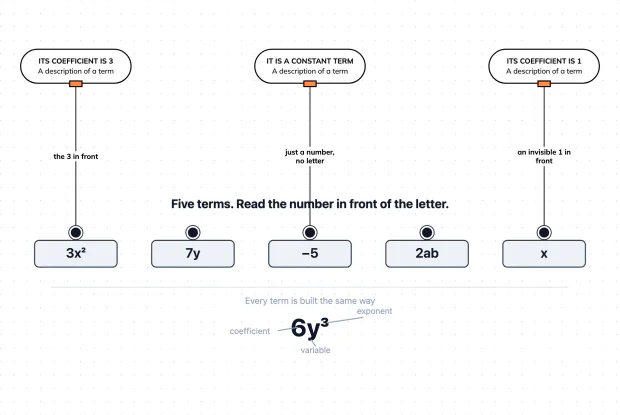
An expression is made of terms, and each term is a number multiplied by some letters. Learn the names for those pieces and read them off real terms in an interactive playground.
What Makes Two Terms Like Terms?
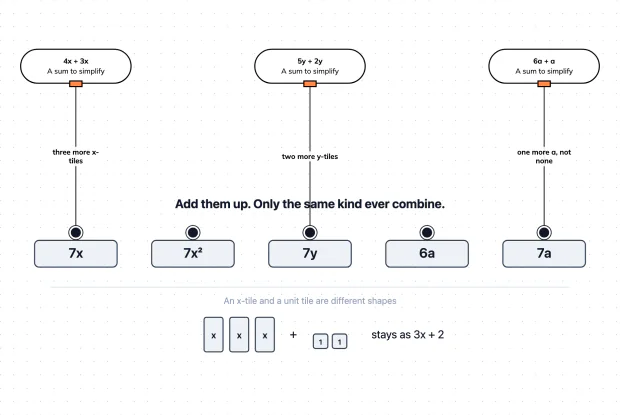
Only terms with exactly the same letter part can be added together. Learn the test for like terms and simplify three sums in an interactive playground.
Monomial, Binomial, Polynomial: What's the Difference?
Expressions are named after how many terms they contain, and that is the whole rule. Learn the names and sort real expressions in an interactive playground.
How Do You Add and Subtract Algebraic Expressions?
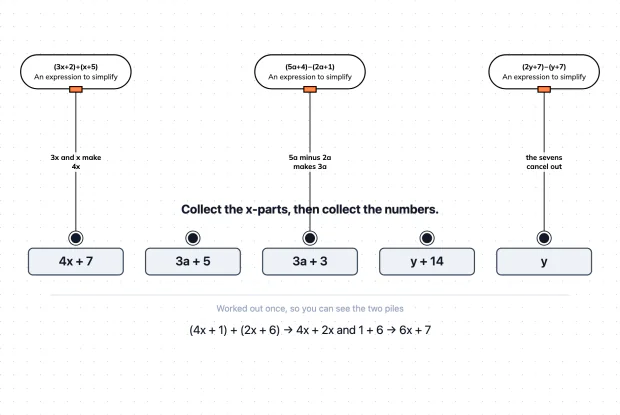
Adding two expressions means collecting the terms that are alike. Subtracting means the same, with one trap. Work three of them in an interactive playground.
How Do You Multiply a Term Through a Bracket?
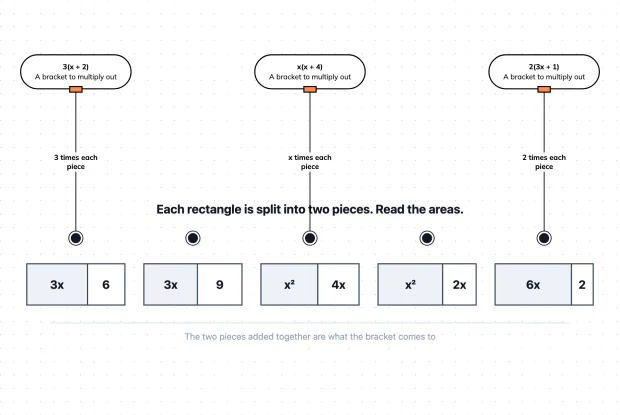
Multiplying out a bracket means the term in front reaches every term inside. See why on a rectangle's area, and match three brackets to their pieces in a playground.
How Do You Multiply Two Brackets Together?
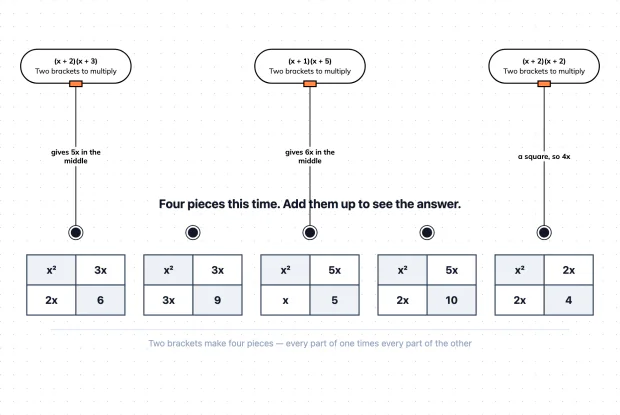
Multiplying two brackets means every term in the first meets every term in the second. See the four pieces as areas and match three products in a playground.