How Do You Add and Subtract Algebraic Expressions?
Root Concept
Adding expressions is sorting terms into piles and doing arithmetic on each pile; subtracting is the same, once the minus sign has reached every term.
CodePLU Goal
Upgrading Human Mental Models
Learn how to think in Workflows

Concept Development By codeplu.com
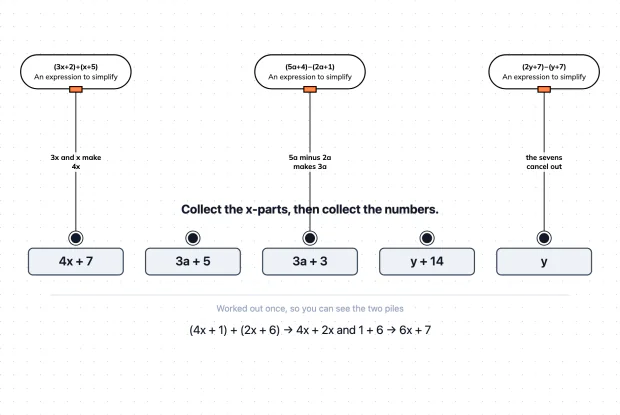
Brackets first, then collect — match each expression to its answer
What Happens When Two Expressions Meet?
Adding (3x + 2) and (x + 5) looks like it might need a new rule. It does not. Brackets joined by a plus sign can simply be dropped, which leaves 3x + 2 + x + 5, and from there it is the collecting job you already know: put the x terms together, put the numbers together, and do the arithmetic on each pile separately. You get 4x + 7.
Subtracting is where it gets interesting, and where most of the marks are lost. (5a + 4) − (2a + 1) does not mean subtract the 2a and then carry on cheerfully; the minus sign applies to everything inside that bracket, including the 1. Miss the second one and you get 3a + 5 instead of the correct 3a + 3, which is the single most common error in this whole topic.
The reliable method is the same every time. Deal with the brackets first, so every term has the right sign attached to it. Then sort into piles of like terms. Then add the coefficients pile by pile. In the playground below you will work three of these, and two of the offered answers are exactly what you get if the minus sign does not reach far enough.
How Do You Combine Two Expressions?
Why can you just drop a bracket after a plus?
Because adding a group of things is the same as adding each of them in turn. If you buy one bag with three pens and two erasers, and a second bag with one pen and five erasers, you have four pens and seven erasers — and you did not need the bags to work that out. So (3x + 2) + (x + 5) is just 3x + 2 + x + 5. The brackets were only ever grouping, and a plus sign in front of a group does not change any sign inside it. Watch the second bracket carefully though: the x there has an invisible coefficient of 1, so the x pile is 3x + 1x and comes to 4x, not 3x.
What does a minus in front of a bracket really do?
It changes the sign of every term inside, not just the first one. Subtracting a group means taking away all of it. If somebody removes a bag containing two apples and one orange, you have lost two apples and one orange, so both go down. That makes (5a + 4) − (2a + 1) into 5a + 4 − 2a − 1, which collects to 3a + 3. The classic error is to write 5a + 4 − 2a + 1 and land on 3a + 5, because the minus was allowed to reach the first term and then quietly stopped. A safe habit while learning is to rewrite the line with every sign flipped before you collect anything, so the flipping and the collecting are two separate jobs rather than one crowded one.
How do you keep track when there are several letters?
Sort before you calculate. Given 2a + 3b − a + b, do not work left to right; gather the a terms and the b terms into separate piles first, which gives 2a − a and 3b + b, and then do each pile on its own to get a + 4b. Working left to right is how terms get combined that should not have been. Some people find it helps to underline each kind differently on paper, or to rewrite the expression with like terms next to each other before touching the arithmetic. Whatever the method, the principle is the same: the sorting is the thinking, and the arithmetic afterwards is easy.
Real World Example
Where Does This Turn Up Outside a Textbook?
Adding and subtracting expressions is inventory arithmetic with the labels shortened:
Two deliveries arrive
(3x + 2) + (x + 5)
A stationery shop takes two deliveries. The first has three boxes of pens plus two loose pens; the second has one box plus five loose pens. Each box holds the same unknown number, x. The first delivery is 3x + 2 and the second is x + 5, and the total is their sum. Because both are being added, the brackets do nothing and can go: 3x + 2 + x + 5. Now sort into piles. Boxes with boxes gives 3x + x, which is 4x — remembering the invisible 1. Loose pens with loose pens gives 2 + 5, which is 7. The shop has 4x + 7 pens.
A customer returns some
(5a + 4) − (2a + 1)
Now a school returns part of a bulk order. The shop had five crates and four loose items; the school brings back two crates and one loose item. Written down, that is (5a + 4) − (2a + 1). The whole returned parcel is being taken away, which means both of its parts leave the shop, so the minus reaches the 1 as well as the 2a. The line becomes 5a + 4 − 2a − 1, and collecting gives 3a + 3. Had the minus stopped at the crates, the count would read 3a + 5, claiming the shop somehow gained a loose item by accepting a return.
When everything cancels
(2y + 7) − (y + 7)
One last case, because it looks wrong the first time. The shop has two pallets and seven spares; a delivery van takes away one pallet and seven spares. That is (2y + 7) − (y + 7), which becomes 2y + 7 − y − 7. The sevens cancel exactly, leaving y and nothing else. Beginners often want to write y + 0, or feel that an answer of a single letter is too small to be finished. It is finished: one pallet remains, and the spares balanced out to nothing. An answer being short is not evidence that you stopped too early.
FAQs
Final Words
Adding and subtracting expressions is a three-step routine that never changes. Deal with the brackets so every term carries its correct sign, sort the terms into piles of like terms, then do the arithmetic pile by pile. Nothing in it is new; it is collecting like terms with one extra step at the front.
Almost every wrong answer here comes from a minus sign that did not reach the end of its bracket, or from a bare letter treated as nothing instead of one. Rewrite the flipped line in full, write the invisible 1 in, and the errors stop. Next comes multiplication, where a bracket behaves quite differently.
Continue This Track
This concept is part 4 of Working With Expressions.
What Are Terms, Factors and Coefficients?
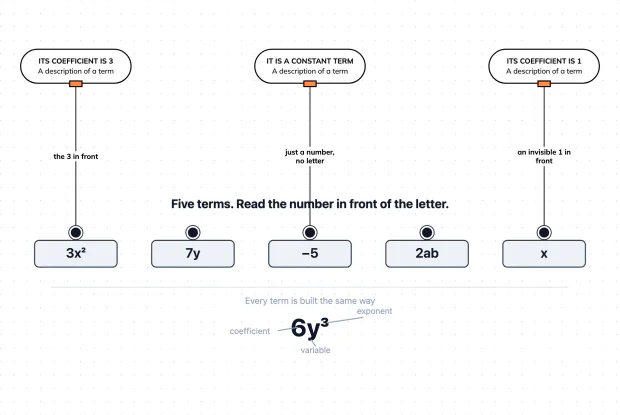
An expression is made of terms, and each term is a number multiplied by some letters. Learn the names for those pieces and read them off real terms in an interactive playground.
What Makes Two Terms Like Terms?
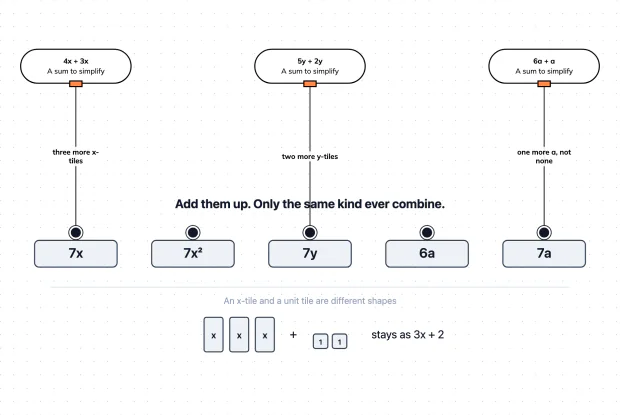
Only terms with exactly the same letter part can be added together. Learn the test for like terms and simplify three sums in an interactive playground.
Monomial, Binomial, Polynomial: What's the Difference?
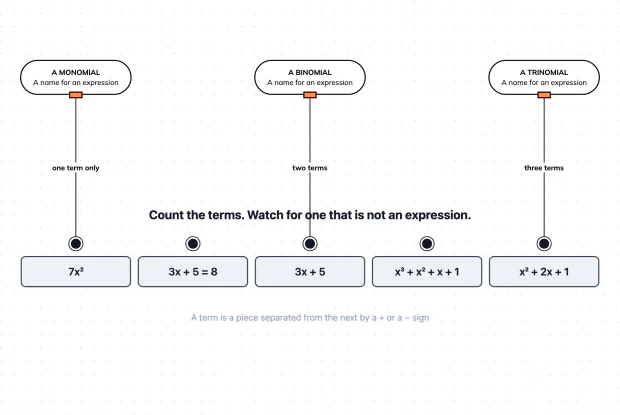
Expressions are named after how many terms they contain, and that is the whole rule. Learn the names and sort real expressions in an interactive playground.
How Do You Add and Subtract Algebraic Expressions?
Adding two expressions means collecting the terms that are alike. Subtracting means the same, with one trap. Work three of them in an interactive playground.
How Do You Multiply a Term Through a Bracket?
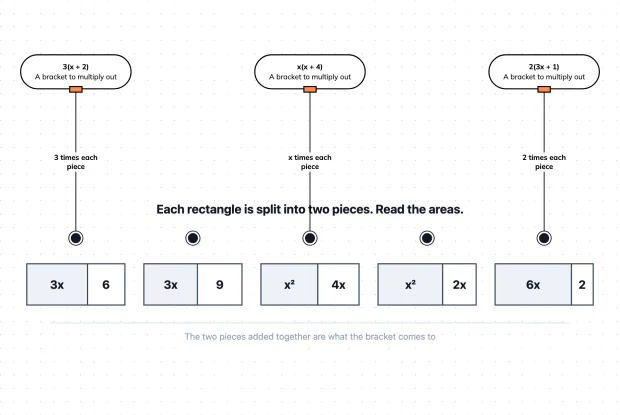
Multiplying out a bracket means the term in front reaches every term inside. See why on a rectangle's area, and match three brackets to their pieces in a playground.
How Do You Multiply Two Brackets Together?
Multiplying two brackets means every term in the first meets every term in the second. See the four pieces as areas and match three products in a playground.