What Are Terms, Factors and Coefficients?
Root Concept
A term is one chunk of an expression; its coefficient is the number in front, and an invisible 1 is still a coefficient.
CodePLU Goal
Upgrading Human Mental Models
Learn how to think in Workflows

Concept Development By codeplu.com
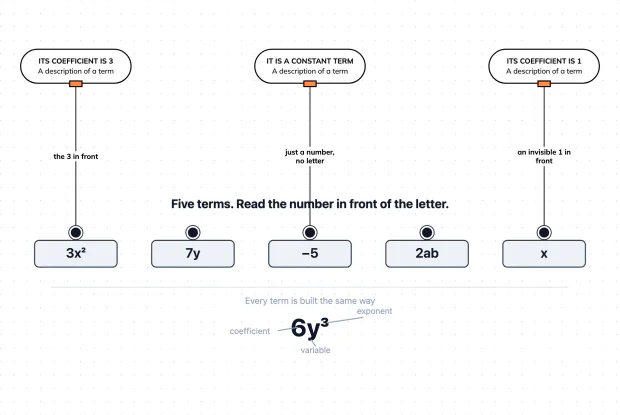
Five terms — match each description to the term it fits
What Is an Expression Actually Made Of?
Look at 5x² + 3x − 7 and it can seem like one long string of symbols with no obvious joints. It has joints. The plus and minus signs are where it comes apart, and the pieces between them are called terms. This one has three of them: 5x², then 3x, then −7.
Each term is itself built the same way — a number multiplied by some letters. In 5x² the number is 5 and the letter part is x². That number in front has a name, coefficient, and it is worth knowing because almost every instruction you will be given in algebra is really an instruction about coefficients: collect them, compare them, multiply them.
Two cases catch people out and both appear in the playground below. A term like x looks as though it has no coefficient, but it does — an invisible 1, because x means one lot of x. And a term like −5 has no letter at all, which makes it a constant: its value never changes no matter what the letters do. Read five terms and match three descriptions to the terms they fit.
What Are the Pieces Called?
Where does one term end and the next begin?
Terms are separated by plus and minus signs, and nothing else. In 4a + 7b − 2 there are three terms: 4a, 7b and −2. Notice that the minus belongs to the term after it, so the third term is negative two rather than positive two with a stray sign floating about. Multiplication and division do not split terms — 2ab is one term, not two, because a and b are multiplied together rather than added. That trips people up, because 2ab looks longer than 7b and feels like it ought to be more than one piece. Count the plus and minus signs instead of counting the symbols, and add one: that is how many terms you have.
What exactly is a coefficient?
The coefficient is the number multiplying the letters in a term. In 3x it is 3, in 2ab it is 2, and in −6y it is −6 — the sign is part of the coefficient, not separate from it. The most common mistake here is with a bare letter. In x, many beginners say the coefficient is zero or that there is not one, but x means one x, so the coefficient is 1. It is simply not written, in the same way nobody writes one apple as 1 apple. Getting this right matters as soon as you start collecting terms, because a + 3a is 4a and not 3a.
What makes a term a constant?
A constant term has no letter in it at all, so nothing about it can change. In 5x² + 3x − 7 the −7 is the constant: whatever value x takes, that piece stays stubbornly at negative seven. Everything else in the expression moves when x moves. This is why constants behave differently from the rest when you collect terms — they combine with other constants and with nothing else. A useful habit when you meet a long expression is to sort it into piles first: the x² terms together, the x terms together, the plain numbers together. Almost every simplification is that sorting job followed by some easy arithmetic.
Real World Example
Where Do These Names Earn Their Keep?
Give the pieces their proper names and a bill stops being a mystery and starts being something you can argue with:
The bill as an expression
2c + 1.5d + 199
A phone plan charges two rupees a minute for calls, one and a half rupees for each megabyte of data, and a fixed one hundred and ninety-nine rupees a month whatever you do. Write the monthly bill as 2c + 1.5d + 199, where c is minutes called and d is megabytes used. That is three terms, joined by plus signs. Before any names are attached, you can already see the shape of the thing: two parts that respond to how you use the phone, and one part that never moves. The names simply make it possible to talk about which is which.
Reading the coefficients
2 per minute, 1.5 per megabyte
The coefficients are 2 and 1.5, and each one is a rate — the price of one more unit of whatever its letter counts. That is what a coefficient usually means in a real situation, and it is why comparing coefficients is so often the useful thing to do. If a rival plan offers 2c + 0.8d + 199, the only thing that changed is one coefficient, and you can see immediately that it is cheaper for data and identical for calls. Comparing the whole expressions side by side would take much longer and tell you less.
The constant nobody escapes
199, whatever you do
The 199 is the constant term. It has no letter attached, so no amount of careful phone use reduces it. Spot that and you know something practical: if your bill last month was four hundred rupees, only about two hundred of it was actually under your control. It also explains why the plan looks expensive for a light user and good value for a heavy one — the fixed part is spread over more usage. Being able to point at one term and say that one never changes is a genuinely useful skill, and it is the whole idea of a constant.
FAQs
Final Words
An expression comes apart at its plus and minus signs, and the pieces are terms. Inside a term, the number in front is the coefficient and the letters are what it multiplies. A term with no letters at all is a constant, and its value never moves.
Two details do more damage than the rest when they are missed: the invisible 1 in front of a bare letter, and the fact that a minus sign belongs to the coefficient beside it. Get those two right and the next step — working out which terms are allowed to combine — becomes almost mechanical.
Continue This Track
This concept is part 1 of Working With Expressions.
What Are Terms, Factors and Coefficients?
An expression is made of terms, and each term is a number multiplied by some letters. Learn the names for those pieces and read them off real terms in an interactive playground.
What Makes Two Terms Like Terms?
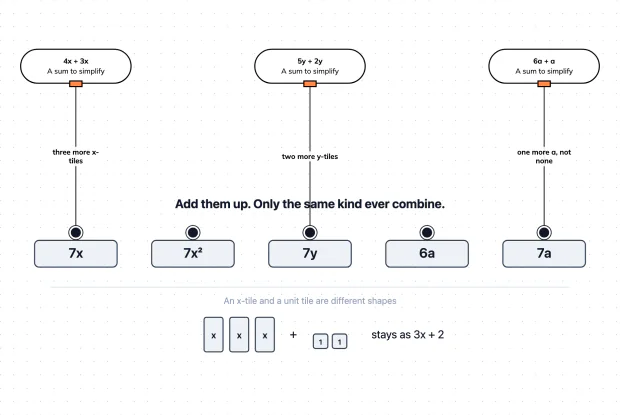
Only terms with exactly the same letter part can be added together. Learn the test for like terms and simplify three sums in an interactive playground.
Monomial, Binomial, Polynomial: What's the Difference?
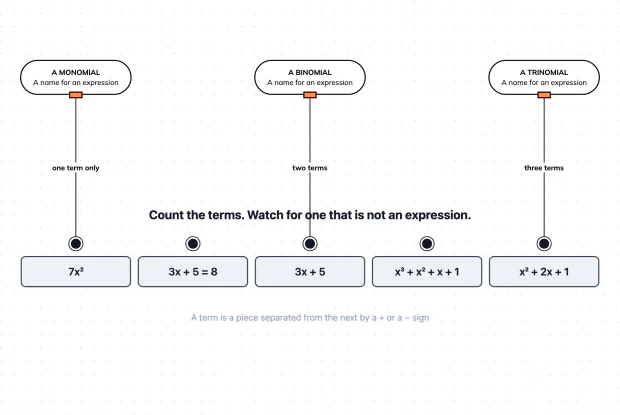
Expressions are named after how many terms they contain, and that is the whole rule. Learn the names and sort real expressions in an interactive playground.
How Do You Add and Subtract Algebraic Expressions?
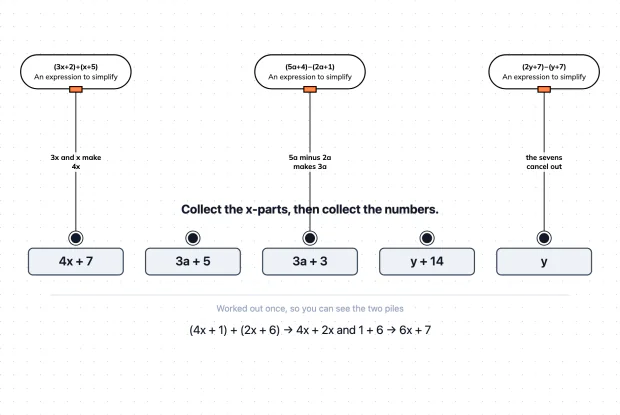
Adding two expressions means collecting the terms that are alike. Subtracting means the same, with one trap. Work three of them in an interactive playground.
How Do You Multiply a Term Through a Bracket?
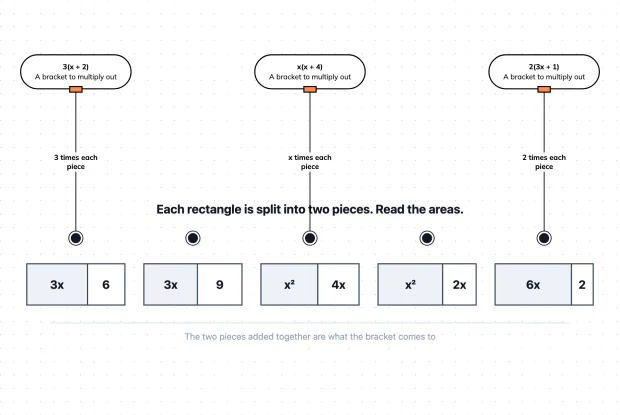
Multiplying out a bracket means the term in front reaches every term inside. See why on a rectangle's area, and match three brackets to their pieces in a playground.
How Do You Multiply Two Brackets Together?
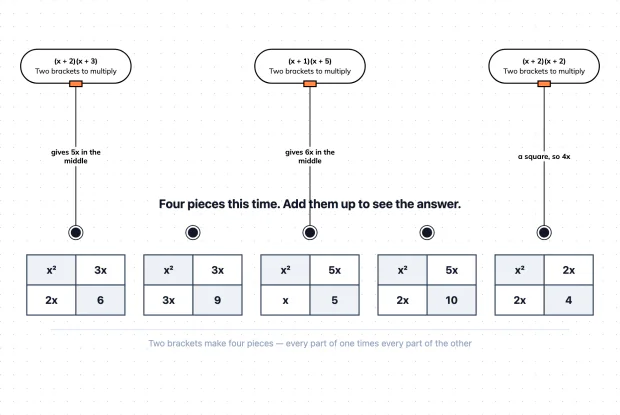
Multiplying two brackets means every term in the first meets every term in the second. See the four pieces as areas and match three products in a playground.