How Do You Multiply a Term Through a Bracket?
Root Concept
Multiplying out a bracket is splitting a rectangle: the outside term is the height, and each term inside is a strip of width whose areas add back together.
CodePLU Goal
Upgrading Human Mental Models
Learn how to think in Workflows

Concept Development By codeplu.com
Multiply out each bracket, then find the rectangle its pieces make
What Does a Bracket Really Ask You to Do?
3(x + 2) says take three lots of the whole thing in the bracket. Three lots of x is 3x, and three lots of 2 is 6, so the answer is 3x + 6. The rule people quote is that you multiply everything inside, and the word everything is carrying all the weight — writing 3x + 2, with the 2 left untouched, is the mistake this whole tutorial exists to prevent.
The reason becomes obvious as soon as you draw it. Make a rectangle three units tall and x + 2 units wide. Cut it where the x ends and the 2 begins, and you have two rectangles: one of area 3x, one of area 6. Together they are the original, so 3(x + 2) and 3x + 6 are the same amount of space described two ways.
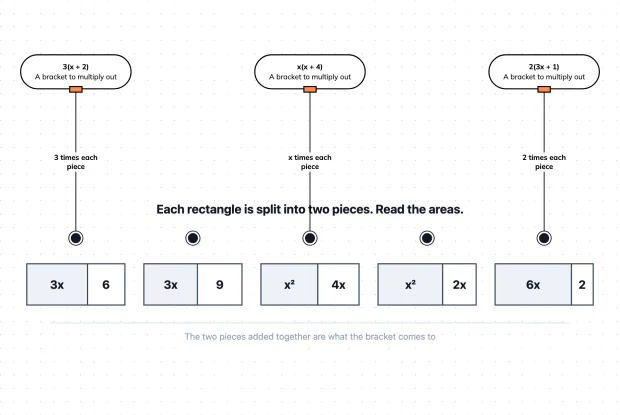
That picture also explains why nothing can be skipped: leaving the 2 out would mean throwing away a piece of the rectangle. In the playground below, five rectangles are drawn with only their two areas labelled. Work out what each bracket comes to and find the rectangle whose pieces match.
Why Does Everything Inside Get Multiplied?
What does the rectangle picture show?
Draw 3(x + 2) as a rectangle of height 3 and width x + 2. Split the width into a piece of length x and a piece of length 2, and the whole rectangle falls into two smaller ones. The first has area 3 times x, which is 3x. The second has area 3 times 2, which is 6. Nothing was added or lost by drawing the cut, so the two pieces together must equal the whole: 3(x + 2) = 3x + 6. This is worth doing on paper once, because it converts a rule you have to remember into a fact you can see. It also makes the common error visible — answering 3x + 2 means claiming that a rectangle three units tall and two units wide has an area of two.
What happens when the outside term has a letter?
Exactly the same thing, with one extra piece of arithmetic. For x(x + 4), the rectangle is x tall and x + 4 wide, so the pieces are x times x and x times 4. That gives x² + 4x. The step that catches people is x times x: it is x², because multiplying a quantity by itself is what squaring means, and not 2x, which would be x added to itself. Keep hold of the difference. Adding counts how many you have, so x + x is 2x; multiplying builds a square, so x times x is x². Both appear in the same line of working often enough that getting them confused is easy.
How do you handle a number and a letter inside?
Multiply the coefficients together and carry the letters along. For 2(3x + 1), the first piece is 2 times 3x. Two lots of three x is six x, so it is 6x — you multiply the numbers and the letter comes with them unchanged. The second piece is 2 times 1, which is 2, giving 6x + 2. Note what did not happen: the letter did not gain a power, because this is multiplication by a plain number rather than by another x. A quick way to check any expanded bracket is to substitute a small value. With x as 1, the original 2(3x + 1) gives 8, and 6x + 2 also gives 8, so the expansion holds.
Real World Example
Where Would You Actually Draw This?
A room that is not a plain rectangle is the everyday version of a bracket waiting to be multiplied out:
The room as one shape
3(x + 2) square metres
A room is three metres deep. Along its width it has a main section of x metres and an alcove of two metres, so the total width is x + 2 metres. The carpet needed is therefore 3(x + 2) square metres, and that is a complete and correct answer. A carpet fitter given the value of x could work it out in one step: measure the width, add two, multiply by three. Written this way the expression mirrors how somebody would actually measure the room, which is often why brackets appear in the first place.
The room as two pieces
3x + 6 square metres
Now suppose the carpet comes in two rolls and you want to know how much each part of the room needs. Cut the shape where the alcove begins. The main section is three by x, so it takes 3x square metres. The alcove is three by two, so it takes 6. Added together that is 3x + 6, and it must equal what you had before, because you have not changed the room — only the way you described it. This is the whole of multiplying out a bracket: the same area, counted in pieces instead of all at once.
The mistake, drawn
3x + 2 loses the alcove
Suppose somebody multiplies only the first term and writes 3x + 2. Draw what that claims. The main section is still three by x, fine. But the alcove is now being counted as two square metres rather than six, which would mean a piece of floor three metres deep and two metres wide somehow needing only two square metres of carpet. Put a number in and it is stark: with x as four, the real answer is eighteen square metres and the mistaken one is fourteen. Four square metres of floor would simply be bare, which is exactly what skipping a term does to an expression.
FAQs
Final Words
A bracket with a term in front means that term multiplies every single thing inside it. The rectangle picture is why: the outside term is the height, each term inside is a strip of the width, and the areas of the strips add back up to the whole. Skip a term and you are throwing away a piece of the shape.
Two details cause most of the errors. x times x is x² rather than 2x, and a minus inside the bracket travels with its term. Checking by substituting a small value catches both in seconds. Next, the same picture handles two brackets at once, which turns two pieces into four.
Continue This Track
This concept is part 5 of Working With Expressions.
What Are Terms, Factors and Coefficients?
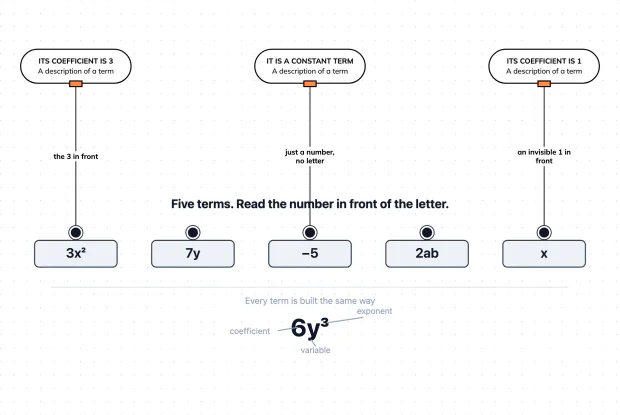
An expression is made of terms, and each term is a number multiplied by some letters. Learn the names for those pieces and read them off real terms in an interactive playground.
What Makes Two Terms Like Terms?
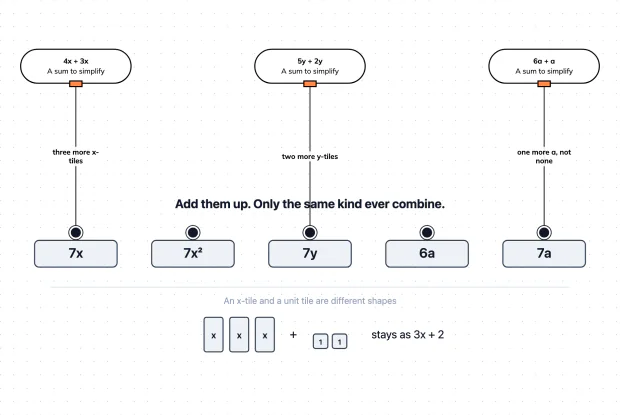
Only terms with exactly the same letter part can be added together. Learn the test for like terms and simplify three sums in an interactive playground.
Monomial, Binomial, Polynomial: What's the Difference?
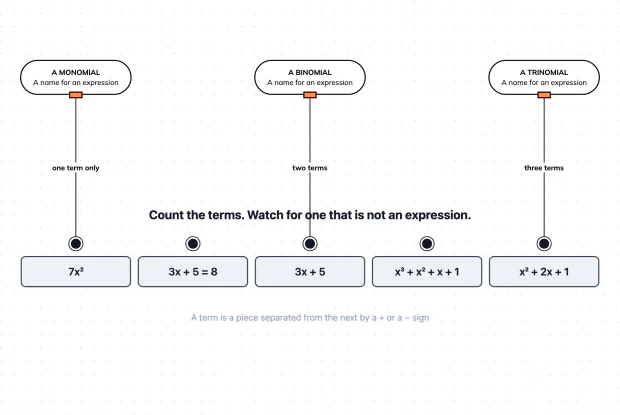
Expressions are named after how many terms they contain, and that is the whole rule. Learn the names and sort real expressions in an interactive playground.
How Do You Add and Subtract Algebraic Expressions?
Adding two expressions means collecting the terms that are alike. Subtracting means the same, with one trap. Work three of them in an interactive playground.
How Do You Multiply a Term Through a Bracket?
Multiplying out a bracket means the term in front reaches every term inside. See why on a rectangle's area, and match three brackets to their pieces in a playground.
How Do You Multiply Two Brackets Together?
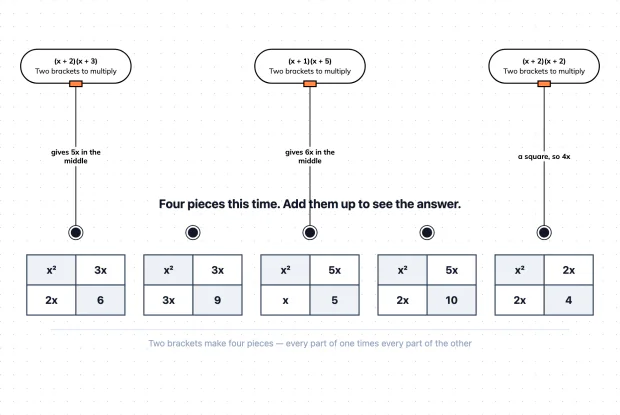
Multiplying two brackets means every term in the first meets every term in the second. See the four pieces as areas and match three products in a playground.