Working With Expressions
Once a letter stops being mysterious, the next question is what you are allowed to do with a whole expression. This series names the pieces an expression is built from, works out which of them may be combined and which may not, and then adds, subtracts and multiplies expressions out — the last two on a rectangle, where every step is an area you can point at.
CodePLU Goal
Upgrading Human Mental Models
Learn how to think in Workflows
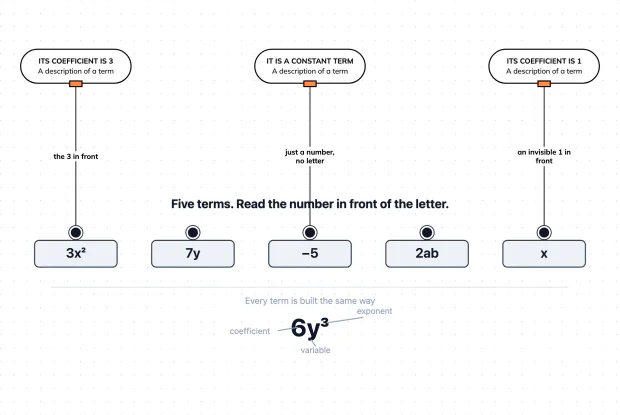
What Are Terms, Factors and Coefficients?
An expression is made of terms, and each term is a number multiplied by some letters. Learn the names for those pieces and read them off real terms in an interactive playground.
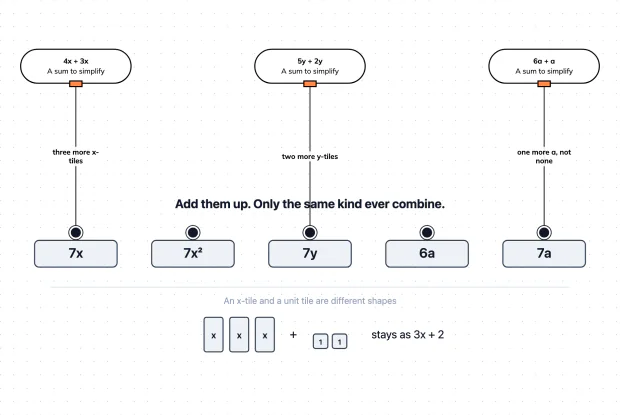
What Makes Two Terms Like Terms?
Only terms with exactly the same letter part can be added together. Learn the test for like terms and simplify three sums in an interactive playground.
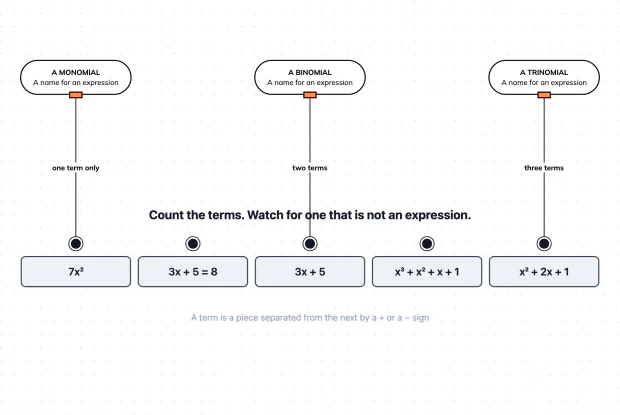
Monomial, Binomial, Polynomial: What's the Difference?
Expressions are named after how many terms they contain, and that is the whole rule. Learn the names and sort real expressions in an interactive playground.
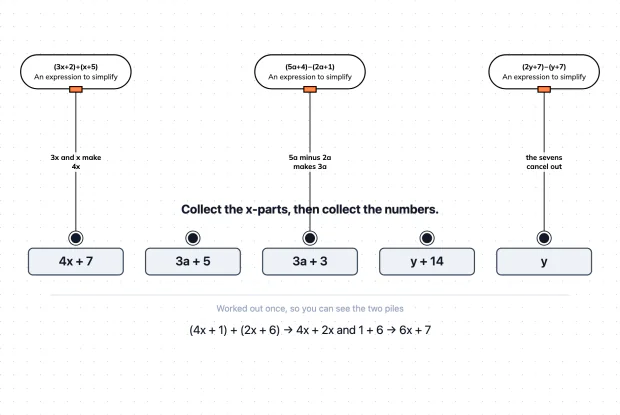
How Do You Add and Subtract Algebraic Expressions?
Adding two expressions means collecting the terms that are alike. Subtracting means the same, with one trap. Work three of them in an interactive playground.
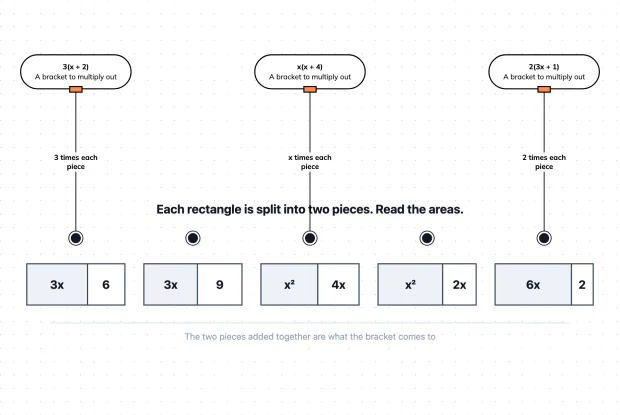
How Do You Multiply a Term Through a Bracket?
Multiplying out a bracket means the term in front reaches every term inside. See why on a rectangle's area, and match three brackets to their pieces in a playground.
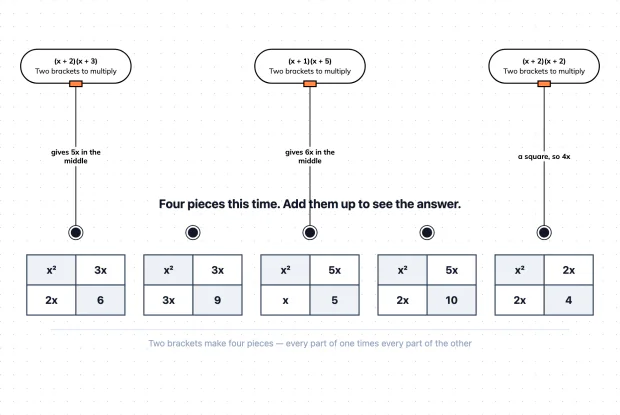
How Do You Multiply Two Brackets Together?
Multiplying two brackets means every term in the first meets every term in the second. See the four pieces as areas and match three products in a playground.