How Do You Find the Volume of a Prism?
Root Concept
The volume of a prism is the area of its cross-section multiplied by its length.
CodePLU Goal
Upgrading Human Mental Models
Learn how to think in Workflows

Concept Development By codeplu.com
A cuboid is just a prism whose cross-section is a rectangle. One rule covers both, and the cylinder too.
One Rule Instead of a Formula for Every Shape
The last tutorial found the volume of a cuboid by counting one layer of cubes and multiplying by the number of layers. That layer picture was worth keeping, because it turns out not to depend on the layer being a rectangle at all.
A prism is any solid that has the same cross-section all the way along: slice it anywhere perpendicular to its length and you get an identical shape every time. A chocolate bar with a triangular end, a length of guttering, a steel girder, a tin of beans — all prisms. And for every one of them the volume is the area of that cross-section multiplied by the length. The cuboid formula was only this rule in the special case where the cross-section is a rectangle.
That is the real payoff of this track. Instead of memorising a separate formula for each solid, you find the area of one flat shape — using whatever area rule it needs — and multiply by how far it runs. In the playground below there are triangles, a trapezium, an L-shape and a circle, and every one is solved the same way.
What Counts as a Prism, and How Far the Rule Stretches
How do you recognise a prism?
Look along it. If the shape you see at one end carries on unchanged all the way to the other end, it is a prism, and that shape is the cross-section. A tube of sweets is a prism; an ice cream cone is not, because the circle shrinks as you go along. A pyramid is not either, for the same reason. The test is whether the slices are identical, not whether the solid looks regular — the L-shaped prism in the playground is an awkward shape, but every slice through it is the same L, so the rule applies exactly as it does to the neat triangular one next to it.
Why does cross-section times length work?
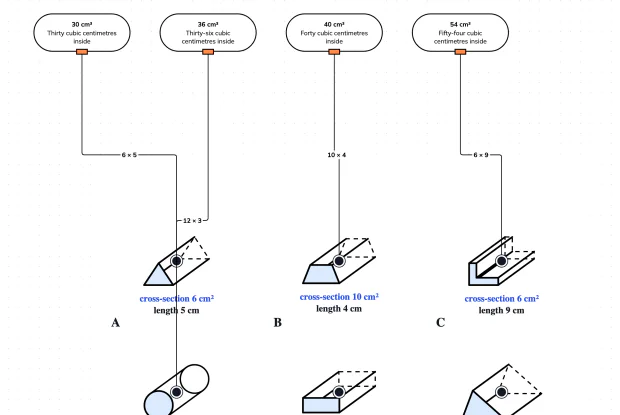
It is the layer argument again. Imagine slicing the prism into slabs one centimetre thick. Each slab has the same cross-section, so each one holds the same volume — a slab one centimetre thick on a cross-section of 6 square centimetres holds 6 cubic centimetres. A prism 5 centimetres long is 5 such slabs, so it holds 6 × 5 = 30 cubic centimetres. Nothing in that reasoning used the shape of the cross-section, which is exactly why one rule covers triangles, trapeziums, L-shapes and circles alike. The cuboid was the case where each slab was a flat rectangular layer of cubes. Prism C makes the point plainly: its cross-section is an awkward L, and it still holds 6 × 9 = 54 cubic centimetres.
Does it work for a cylinder?
Yes, and strictly a cylinder is not a prism, because a prism is usually defined as having flat faces and a polygon for its cross-section. The volume rule does not care. Every slice through a cylinder is the same circle, so the slab argument goes through unchanged and the volume is the area of the circle times the length. Since the area of a circle is πr², that gives the familiar πr²h, which is not a separate formula to learn but this same rule with the circle's area substituted in. Prism D in the playground is exactly this case: a circular cross-section of 12 square centimetres over a length of 3 centimetres holds 36 cubic centimetres, found the same way as every other panel.
What should you watch out for?
Two things. The first is picking the wrong face as the cross-section: it must be the one that repeats along the length, and a prism lying on its side can make a rectangular side face look like the obvious choice when it is not. Sketching the end you would see looking along the solid settles it. The second is units. The cross-section is an area in square units and the length is in linear units, so the product is in cubic units — and both measurements have to be in the same unit before you multiply, so a cross-section in square centimetres with a length in metres needs converting first.
Real World Example
Concrete for a Garden Path
A concrete path is a prism lying on the ground, and costing one shows why the cross-section is the number a builder actually works with.
Step 1
Find the shape of the end
A path 80 centimetres wide and 10 centimetres deep has a rectangular cross-section of 80 × 10 = 800 square centimetres, which is 0.08 square metres. That cross-section is the same at every point along the path, which is what makes the path a prism and lets one small calculation stand for the whole job. If the path were dug deeper at one end it would stop being a prism and the builder would have to work it out in sections. In practice they deliberately keep the depth constant, partly so the concrete cures evenly and partly so the quantity is this easy to predict.
Step 2
Multiply by how far it runs
If the path runs 12 metres, the volume of concrete is 0.08 × 12 = 0.96 cubic metres. Notice that the length was converted to metres to match the cross-section before multiplying — mixing centimetres and metres here would be out by a factor of a hundred, which on a real order is the difference between one lorry and none. Builders usually call a cubic metre a cube or a metre of concrete, and they order in quarter-metre steps, so 0.96 becomes an order for one cubic metre. The small awkward number at the start is what makes the final one easy, which is the whole reason the cross-section is worked out first and separately.
Step 3
The shape of the end can change without the method
A path with a shallow curved dip for drainage, or a kerb with a sloped face, has a cross-section that is no longer a rectangle. The builder works out that awkward area once — splitting it into a rectangle and a triangle, or reading it off a manufacturer's table — and then multiplies by the run exactly as before. This is why the cross-section is the number on the drawing: once you have it, any length of the same profile is a single multiplication. The same logic prices guttering, skirting board, steel beams and cable.
FAQs
Final Words
A prism is any solid whose cross-section stays the same along its whole length, and its volume is that cross-section area multiplied by the length. The reasoning is the layer picture from the cuboid, freed from the assumption that the layer is a rectangle: identical slabs, so the volume is one slab repeated. Triangles, trapeziums, L-shapes and circles are all handled the same way.
That closes the track. You can name the parts of a solid, unfold one into a net, work out how much material covers it and how much space it holds — and you have one rule for volume that absorbs the cuboid and the cylinder as special cases. The solids that fall outside it are the ones that taper, like pyramids and cones, where the cross-section changes as you go and a different rule takes over.
Continue This Track
This concept is part 5 of Solid Shapes, Measured.
What Are Faces, Edges and Vertices?
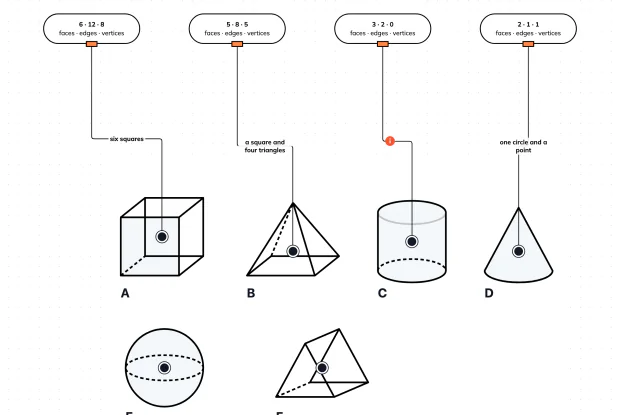
A solid shape is described by three counts: its flat surfaces, the lines where they meet, and the corners. Counting them is easy once you remember the ones hidden round the back. Match each set of counts to the solid it belongs to in an interactive playground.
What Is a Net of a Solid?
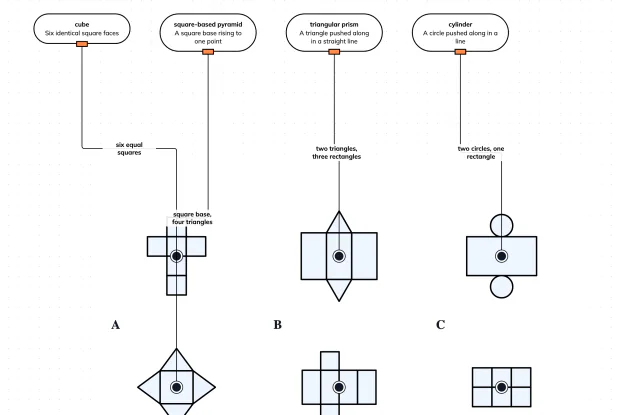
A net is a solid opened out flat, so every face lies in one plane. Counting the faces and checking their shapes identifies the solid. Match four nets to the solids they fold into in an interactive playground.
How Do You Find the Surface Area of a Cuboid?
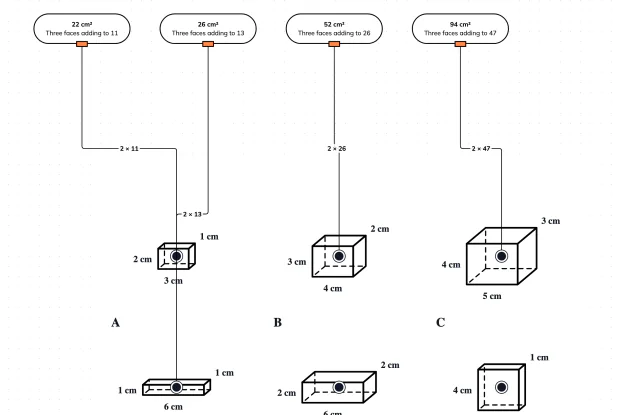
A cuboid has six faces in three matching pairs, so its surface area is the three different face areas added and doubled. Work out four surface areas in an interactive playground.
How Do You Find the Volume of a Cuboid?
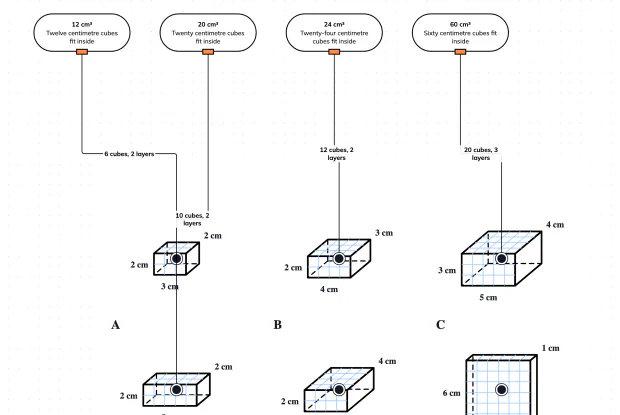
Volume counts how many unit cubes fit inside a solid. For a cuboid it is one layer of cubes multiplied by the number of layers, which is length times width times height. Practise on four boxes in an interactive playground.
How Do You Find the Volume of a Prism?
A prism has the same cross-section along its whole length, so its volume is the area of that cross-section times the length — whatever shape the cross-section is. Practise on four prisms in an interactive playground.
How Do You Find the Surface Area of a Cylinder?
A cylinder unrolls into a rectangle and two circles, so its surface area is 2πrh for the curved part plus 2πr² for the ends. Work out four of them in an interactive playground.