What Are Faces, Edges and Vertices?
Root Concept
A solid is described by three counts: faces are its surfaces, edges are the lines where two faces meet, and vertices are the points where edges meet — and the ones hidden behind the drawing count too.
CodePLU Goal
Upgrading Human Mental Models
Learn how to think in Workflows

Concept Development By codeplu.com
How Do You Describe a Shape That Comes Off the Page?
Everything so far has been flat — shapes you could draw on paper and measure with a ruler. Solids are the shapes that take up space: a box, a ball, a tin, a party hat. They need their own vocabulary, and it comes down to three things you can count.
A face is a surface of the solid — one of the flat panels on a box, or the circular ends of a tin. An edge is a line where two faces meet, like the lines you would run your finger along on a box. A vertex is a corner, a point where edges come together. The plural of vertex is vertices, which is worth knowing because it appears far more often than the singular.
Counting them takes one piece of discipline: the parts round the back count too. A cube drawn on paper shows nine of its twelve edges, and a learner who counts what is visible will confidently say nine. In the practice below every hidden edge is drawn dashed for exactly that reason — nothing is missing from the picture, so nothing should be missing from the count.
Three Counts, Including the Hidden Ones
What are faces, edges and vertices exactly?
A face is a surface of a solid. On a cube every face is a square and there are six of them, one for each direction you could look at it from. An edge is a line where two faces meet — pick up a box and the edges are the lines you can feel, the places the cardboard has been creased. A vertex is a point where edges meet, which on a box is a sharp corner you could prick a finger on. The three are connected rather than independent: faces meet at edges, and edges meet at vertices, so each one is defined by the one before it. That relationship is the reason the numbers are not arbitrary. There is even a rule tying them together — for any solid with flat faces, faces plus vertices always equals edges plus two. A cube gives six plus eight equals twelve plus two, and it holds for every such solid you can build.
Why do the hidden parts count?
Because a solid is an object, not a picture of one. The cube on the page is a flat drawing standing in for something with a back, and the back exists whether the drawing shows it or not. This causes more wrong answers than anything else in the topic: a cube drawn plainly shows nine edges, three faces and seven vertices, and every one of those numbers is wrong. The real answers are twelve, six and eight. The usual convention is to draw hidden edges as dashed lines, which is what the figure below does, and reading those dashes as part of the shape rather than as decoration is the skill. The reliable way to check yourself is to handle a real object. Pick up a matchbox and count edges with your finger, turning it as you go, and you will get twelve every time — the turning is what the dashed lines are standing in for.
How do curved solids work?
Less tidily, and it is worth being honest about that. A cylinder has two flat circular faces and one curved surface wrapped round between them, which is usually counted as three faces in total, with two edges where the curve meets each circle and no vertices at all. A cone has one flat circular face and one curved surface, so two faces, one edge round the bottom, and a single vertex at the point — often called the apex. A sphere is the extreme case: one continuous curved surface, no edges anywhere, and no vertices. Some textbooks prefer to say a cylinder has two faces and a curved surface rather than three faces, because a face is strictly flat. Both conventions are in use and neither is wrong, so if a book disagrees with the numbers here, this is almost certainly the reason. The counts for solids with flat faces are not in dispute at all.
What are nets, and why are they useful?
A net is a solid unfolded flat — the shape you would get by cutting along enough edges to lay the whole surface out on a table without anything overlapping. A cube's net is six squares joined in one of several arrangements, and a cereal box flattened for recycling is a net you have made yourself. Nets are useful for two reasons. They make the faces countable directly, because every face is lying separately in front of you, which is why a net is the easiest way to convince someone that a cube really has six. And they are how packaging is actually manufactured: boxes are printed and cut flat, then folded, so the net is the real object at the factory and the box is what it becomes. Working out which nets fold into which solid is a genuinely good puzzle, and a surprising number of arrangements of six squares do not fold into a cube at all.
Real World Example
Three Solids You Could Pick Up
Each of these is worth handling while you count, because the hidden parts stop being hidden:
A cardboard box
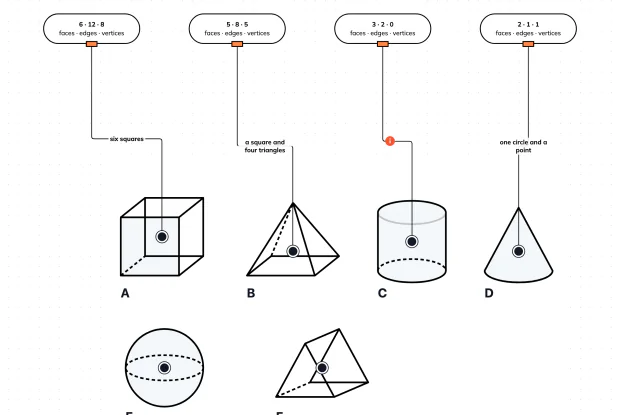
6 faces · 12 edges · 8 vertices
A box is the friendliest solid there is for counting, because you can turn it. Six panels, twelve creases, eight corners — and every one of them can be touched, which is the point. Flatten it for recycling and you have made its net, six rectangles joined in a strip with flaps, which is exactly how it was manufactured in the first place. Anyone who has counted nine edges from a drawing and twelve from the actual box has learnt the lesson of this tutorial in the most direct way available.
A tin of soup
3 faces · 2 edges · 0 vertices
A cylinder has a circle at each end and one curved surface wrapped between them. The two edges are the rims, where the curve meets each circle, and there are no corners anywhere — which is why a tin rolls and a box does not. The label peeled off a tin is a lovely thing to look at afterwards: it is a plain rectangle, because the curved surface unrolls flat. That is the net of a cylinder, a rectangle and two circles, and it explains why tin labels are printed on ordinary flat sheets.
An ice cream cone
2 faces · 1 edge · 1 vertex
A cone has one circular face at the top, one curved surface, one edge round the rim, and a single vertex at the point where the ice cream never quite reaches. It is the only common solid with exactly one vertex, which makes it easy to remember. Its net is a circle and a part-circle — a wedge that curls round into the cone — which is why a paper party hat is cut as a sector of a circle and then joined. The sector from the earlier tutorial turns out to have been the flat version of this all along.
FAQs
Final Words
Three counts describe a solid. Faces are the surfaces, edges are the lines where two faces meet, and vertices are the points where edges meet — each one defined by the one before it.
The discipline is counting what you cannot see. A cube shows nine edges on paper and has twelve, so read the dashed lines as part of the shape. If in doubt, pick the object up and turn it.
Curved solids are the untidy corner of the topic, and honestly so: a cylinder is usually called three faces, two edges and no vertices, though some books count the curved part separately. A sphere settles it by having nothing to count at all.
Continue This Track
This concept is part 1 of Solid Shapes, Measured.
What Are Faces, Edges and Vertices?
A solid shape is described by three counts: its flat surfaces, the lines where they meet, and the corners. Counting them is easy once you remember the ones hidden round the back. Match each set of counts to the solid it belongs to in an interactive playground.
What Is a Net of a Solid?
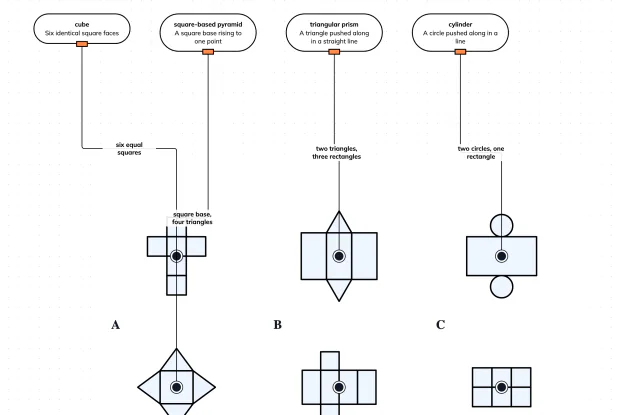
A net is a solid opened out flat, so every face lies in one plane. Counting the faces and checking their shapes identifies the solid. Match four nets to the solids they fold into in an interactive playground.
How Do You Find the Surface Area of a Cuboid?
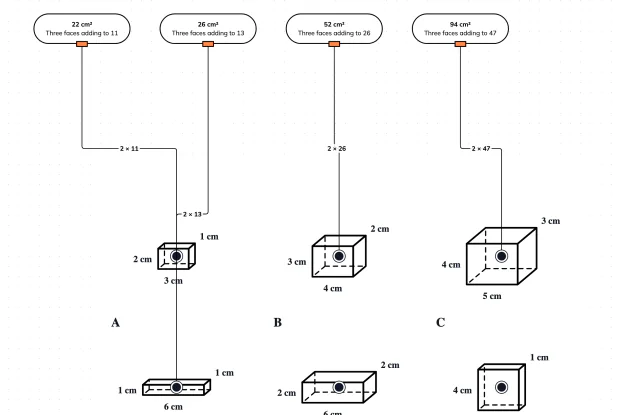
A cuboid has six faces in three matching pairs, so its surface area is the three different face areas added and doubled. Work out four surface areas in an interactive playground.
How Do You Find the Volume of a Cuboid?
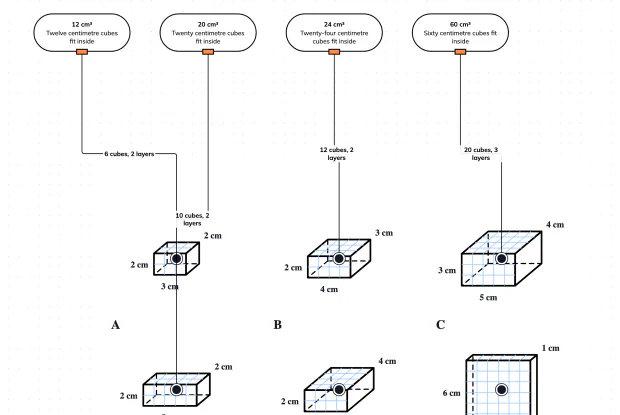
Volume counts how many unit cubes fit inside a solid. For a cuboid it is one layer of cubes multiplied by the number of layers, which is length times width times height. Practise on four boxes in an interactive playground.
How Do You Find the Volume of a Prism?
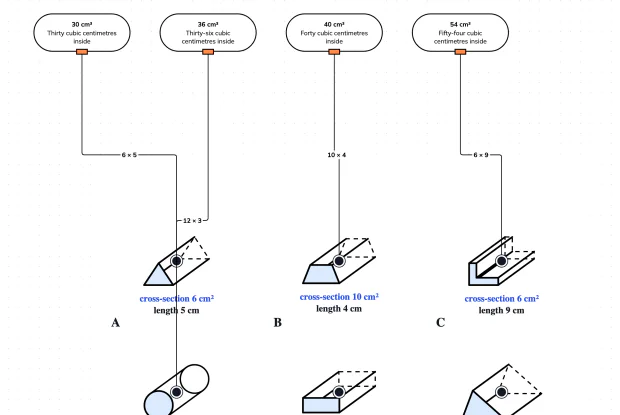
A prism has the same cross-section along its whole length, so its volume is the area of that cross-section times the length — whatever shape the cross-section is. Practise on four prisms in an interactive playground.
How Do You Find the Surface Area of a Cylinder?
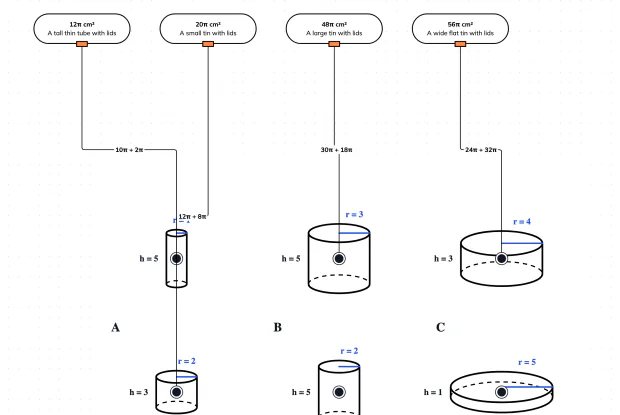
A cylinder unrolls into a rectangle and two circles, so its surface area is 2πrh for the curved part plus 2πr² for the ends. Work out four of them in an interactive playground.