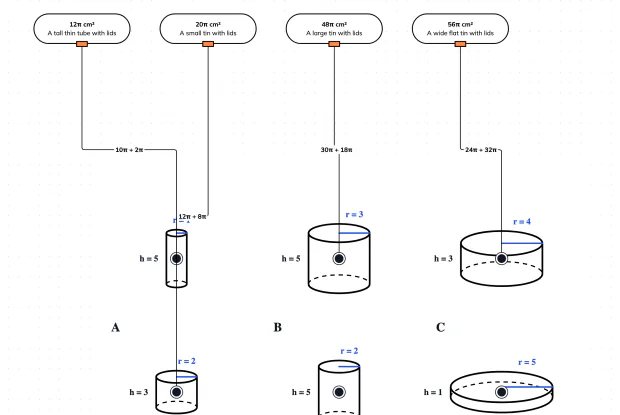
How Do You Find the Volume of a Cuboid?
Root Concept
The volume of a cuboid is length × width × height, which is one layer of unit cubes repeated for every layer.
CodePLU Goal
Upgrading Human Mental Models
Learn how to think in Workflows

Concept Development By codeplu.com
Volume is a count of cubes, not a measurement of the outside. That is why its units are cubic.
Not How Much It Takes to Cover — How Much It Holds
The last tutorial worked out the outside of a box: the card it takes to make it, the paint it takes to cover it. This one asks the opposite question. How much space is inside? That is the volume, and it is a completely different measurement with completely different units.
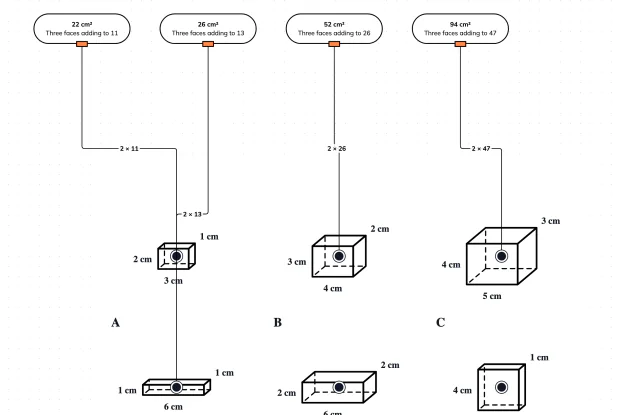
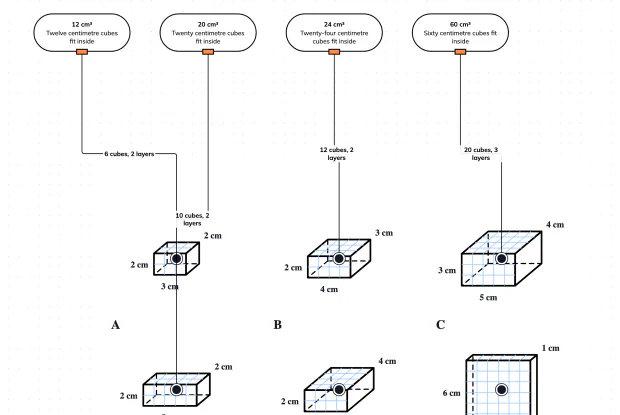
The clearest way to think about volume is as counting. Imagine filling the box with centimetre cubes, packed in neatly with no gaps. The volume is simply how many cubes you used. In the playground below each box has been ruled into exactly those cubes, so you can see them rather than take them on trust.
Counting them one at a time would be slow, and the shortcut is the whole point. Fill just the bottom layer and count it — that is the length times the width. Then notice that every layer above is identical, so you multiply by the number of layers, which is the height. Length times width times height is not a formula to memorise so much as a description of what you just did.
Counting Cubes, and the Three Ways It Goes Wrong
Why does length × width × height work?
Because it counts the cubes in two easy stages instead of one hard one. Take cuboid B in the playground, which is 4 by 3 by 2. The bottom layer is a rectangle of cubes 4 along and 3 back, so it holds 4 × 3 = 12 cubes. The box is 2 centimetres tall, so there are 2 such layers, and 12 × 2 = 24 cubes in total. That is the volume: 24 cubic centimetres. The familiar formula just runs those two steps together. Thinking in layers is worth keeping even once the formula is automatic, because it is the version that still works for the prisms in the next tutorial, where the layer is not a rectangle.
What if you stop after one layer?
You get the area of the base, not the volume of the box, and it is the most common mistake in the topic. For cuboid B the first stage gives 12, which is a perfectly good number — it is just the answer to a different question. The playground is built so that this half-finished answer is dangerous rather than obviously wrong: 12 really is the volume of cuboid A, and 20, the base of cuboid C, really is the volume of cuboid D. Two of the four boxes will accept a careless answer and look right. The protection is to ask yourself how many layers there are before you write anything down.
Why are the units cubic?
Because you are multiplying three lengths together, so the units multiply too: centimetres times centimetres times centimetres gives cubic centimetres, written cm³. It helps that this matches what you are counting — a cubic centimetre is literally one cube measuring a centimetre each way, so an answer of 24 cm³ means 24 of those cubes. Surface area multiplied two lengths and came out in square units; volume multiplies three and comes out in cubic ones. If your answer to a volume question is in cm², you have multiplied only two of the three measurements somewhere along the way. The unit on the end of your answer is a free check on the method you used to get it.
Does it matter which way up the box is?
Not at all. Turn a cuboid on its side and what you called the height becomes the length, but the three numbers being multiplied are the same three, and multiplication does not care about order. Cuboid F is 6 by 1 by 6 and holds 36 cubes whichever face you choose to stand it on. This is genuinely useful in questions, because it means you can pick whichever face is easiest to count as your layer and work upwards from there. It is also a good check: if turning a box round changed your answer, something has gone wrong. The same freedom does not apply to the shape itself: changing which numbers you multiply would change the box, not just the view of it.
Real World Example
Filling a Fish Tank
A fish tank turns a volume calculation into a weight, and the weight is the part that surprises people.
Step 1
Count the space inside
A tank 100 centimetres long, 40 deep and 50 tall has a volume of 100 × 40 × 50 = 200,000 cubic centimetres. Thinking in layers makes that easier to picture: the bottom layer is 100 × 40 = 4,000 cubic centimetres of water one centimetre deep, and there are 50 such layers stacked up. Every layer is identical, which is exactly why the multiplication works. Shop listings never quote cubic centimetres, though — they quote litres, and one litre is 1,000 cubic centimetres, so this tank is a 200-litre tank. The conversion is just a change of unit, not a change of calculation.
Step 2
Turn volume into weight
Water weighs about one kilogram per litre, so 200 litres is roughly 200 kilograms. The glass, the gravel and the rocks add perhaps another 40, so the filled tank weighs around a quarter of a tonne — more than three adults standing in the same spot. This is why aquarium guides are firm about putting large tanks against a load-bearing wall and across the floor joists rather than along a single one. None of that follows from the surface area of the tank, which is what you would calculate to buy glass; it follows from the volume, which is what you calculate to know what is inside.
Step 3
Do not fill it to the brim
In practice the water stops a few centimetres below the top, partly so it does not slop out and partly because fish need the surface to exchange gases. Leaving 5 centimetres means filling only 45 layers instead of 50, which is 100 × 40 × 45 = 180,000 cubic centimetres, or 180 litres. That is 20 litres and 20 kilograms less than the headline figure. It is a good illustration of why the layer picture is worth keeping: dropping the water level by 5 centimetres is simply removing 5 layers, and you can see straight away what it costs without redoing the whole sum.
FAQs
Final Words
Volume counts the unit cubes that fit inside a solid. For a cuboid you count one layer — that is the length times the width — and multiply by how many layers there are, which is the height. Length times width times height is just those two steps written as one, and the answer comes in cubic units because three lengths have been multiplied.
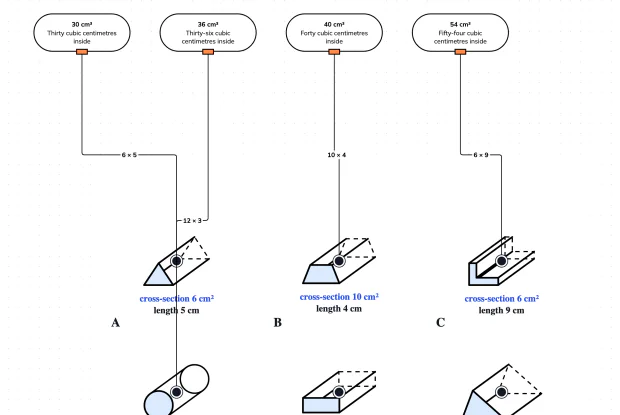
The mistake to guard against is stopping after the first layer, which gives the area of the base and looks like a reasonable answer. Keep the layer picture rather than only the formula, because the final tutorial in this track needs it: a prism is any solid with the same cross-section all the way through, and its volume is that cross-section repeated along its length, whatever shape it happens to be.
Continue This Track
This concept is part 4 of Solid Shapes, Measured.
What Are Faces, Edges and Vertices?
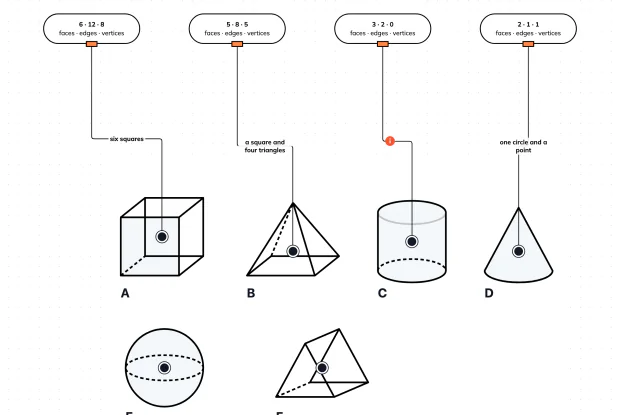
A solid shape is described by three counts: its flat surfaces, the lines where they meet, and the corners. Counting them is easy once you remember the ones hidden round the back. Match each set of counts to the solid it belongs to in an interactive playground.
What Is a Net of a Solid?
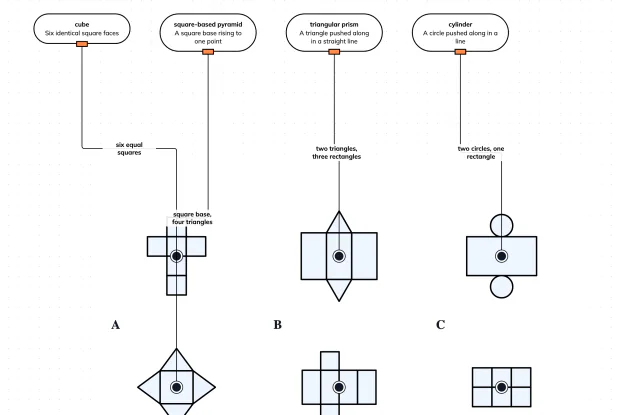
A net is a solid opened out flat, so every face lies in one plane. Counting the faces and checking their shapes identifies the solid. Match four nets to the solids they fold into in an interactive playground.
How Do You Find the Surface Area of a Cuboid?
A cuboid has six faces in three matching pairs, so its surface area is the three different face areas added and doubled. Work out four surface areas in an interactive playground.
How Do You Find the Volume of a Cuboid?
Volume counts how many unit cubes fit inside a solid. For a cuboid it is one layer of cubes multiplied by the number of layers, which is length times width times height. Practise on four boxes in an interactive playground.
How Do You Find the Volume of a Prism?
A prism has the same cross-section along its whole length, so its volume is the area of that cross-section times the length — whatever shape the cross-section is. Practise on four prisms in an interactive playground.
How Do You Find the Surface Area of a Cylinder?
A cylinder unrolls into a rectangle and two circles, so its surface area is 2πrh for the curved part plus 2πr² for the ends. Work out four of them in an interactive playground.