What Is a Net of a Solid?
Root Concept
A net is the flat arrangement of all a solid's faces, joined along edges so it folds up with no gaps or overlaps.
CodePLU Goal
Upgrading Human Mental Models
Learn how to think in Workflows

Concept Development By codeplu.com
Having the right number of faces is not enough. They must also be able to fold together without overlapping.
A Solid, Opened Out Flat
The first tutorial in this track named the parts of a solid: its faces, its edges and its vertices. Counting them meant imagining round the back of the shape, which is the hard part of working in three dimensions on a flat page. A net removes that difficulty entirely.
Cut a cardboard box along enough of its edges and press it flat and you have the box's net: every face lying side by side where you can see and measure all of them at once. Nothing is hidden, nothing is foreshortened. That is why nets matter beyond the classroom — every cardboard box, drinks carton and flat-pack shape started life as a net printed on a flat sheet.
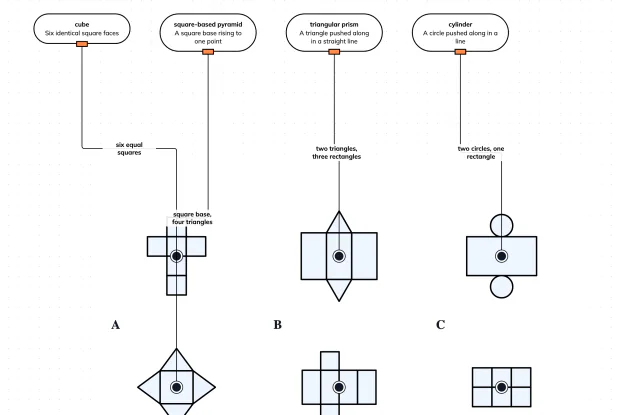
Reading a net backwards is the skill this tutorial builds. Given the flat shape, which solid does it fold into? Count the faces, check what shape each one is, and the answer usually falls out. In the playground below, four nets are waiting to be matched to their solids — and two more are there to catch a guess.
Reading a Net, and Why Counting Is Not Enough
How do you tell which solid a net makes?
Count the faces first, then look at their shapes. Six squares all the same size point to a cube. A square with four triangles attached to its sides points to a pyramid, because the triangles all fold up to meet at a single point above the square. Two triangles and three rectangles make a triangular prism: the triangles become the two ends and the rectangles wrap round between them. Two circles and a rectangle make a cylinder, with the rectangle curving round to join the circles at top and bottom. The number and the shapes together are usually enough to name the solid without folding anything. Do the counting before you look at the overall outline, because two nets can have very similar silhouettes and still be made of completely different faces.
Why is six squares not automatically a cube?
Because the squares also have to be arranged so they can fold without clashing. The six squares laid out as a two-by-three block in the playground are the right number and the right shape, and they still do not make a cube: fold them up and two faces land on top of each other while a gap is left open elsewhere. There are exactly eleven arrangements of six squares that do fold into a cube, and many more that do not. This is the most useful thing to know about nets, because it is the one a quick count will never tell you — the arrangement matters as much as the pieces.
Can one solid have more than one net?
Yes, usually a lot more than one. The eleven cube nets are all genuinely different flat shapes that all fold into the same cube, and they come about because you can choose which edges to cut when you open the solid out. A cardboard box maker picks the net that wastes the least material on the sheet, which is often not the tidy cross you would draw by hand. So a question asking "is this a net of a cube?" is fair, but "what is the net of a cube?" is not quite a sensible question, because there is no single answer. The same is true of every other solid here: the triangular prism and the pyramid each have several nets too.
What does a net tell you that a drawing does not?
True lengths and true areas. A solid drawn on paper has to fake depth, so its faces are squashed into parallelograms and its right angles stop looking like right angles. On a net nothing is distorted: every face is drawn full size and face on. That makes a net the natural place to work out surface area, which is simply the total area of the net, and it is why the next tutorial in this track reaches for a net the moment it needs to add up the outside of a cuboid. It is also why packaging designers work on the flat, measuring and printing on a sheet rather than on a finished box.
Real World Example
Designing a Cereal Box
A cardboard box is a net for almost all of its life. Following one through the factory shows why the flat form, not the folded one, is where the design happens.
Step 1
Draw it flat, with tabs
The designer starts with the cuboid net: four rectangles in a row for the front, side, back and other side, plus rectangles for the top and bottom. To that they add glue tabs, which are small extra flaps that have no equivalent in the mathematical net but are needed to stick the real thing together. Every measurement is taken on this flat drawing, because on the flat every face is its true size. The artwork — the logo, the ingredients, the nutrition panel — is positioned on the same flat drawing, so the printer and the cutter are working from one file.
Step 2
Fit as many as possible on a sheet
Cardboard arrives in large sheets and the factory wants as many boxes as it can get from each one. So the net is rotated and interlocked with copies of itself until the waste between them is as small as possible, a problem called nesting. This is the practical reason a solid having many possible nets matters: a net that tiles the sheet tightly is worth real money compared with one that leaves gaps. The tidy cross-shaped net that a textbook draws is often one of the worst choices, because crosses leave large empty corners that no second net can fill.
Step 3
Score, fold, glue
The sheet is cut round the outside of the net and pressed, not cut, along every fold line — that pressing is called scoring, and it is what makes cardboard fold cleanly in a straight line instead of bursting. The flat blank is then shipped to the food company and only folded and glued at the moment the box is filled, because flat blanks stack and take almost no lorry space while assembled boxes are mostly air. The box exists as a net right up until the last possible second, which is a good way to remember that the net is the real object and the solid is only what it becomes.
FAQs
Final Words
A net is a solid opened out flat, with every face joined to a neighbour and nothing hidden. Reading one back is a matter of counting the faces and checking their shapes: six equal squares suggest a cube, a square with four triangles makes a pyramid, two triangles with three rectangles make a triangular prism, and two circles with a rectangle make a cylinder.
The trap worth carrying forward is that the right pieces are not enough — they have to be arranged so they fold without overlapping, which is why six squares are sometimes a cube and sometimes nothing at all. The next tutorial puts nets to work. Because a net shows every face at its true size, adding up its area gives the surface area of the solid, starting with the cuboid.
Continue This Track
This concept is part 2 of Solid Shapes, Measured.
What Are Faces, Edges and Vertices?
A solid shape is described by three counts: its flat surfaces, the lines where they meet, and the corners. Counting them is easy once you remember the ones hidden round the back. Match each set of counts to the solid it belongs to in an interactive playground.
What Is a Net of a Solid?
A net is a solid opened out flat, so every face lies in one plane. Counting the faces and checking their shapes identifies the solid. Match four nets to the solids they fold into in an interactive playground.
How Do You Find the Surface Area of a Cuboid?
A cuboid has six faces in three matching pairs, so its surface area is the three different face areas added and doubled. Work out four surface areas in an interactive playground.
How Do You Find the Volume of a Cuboid?
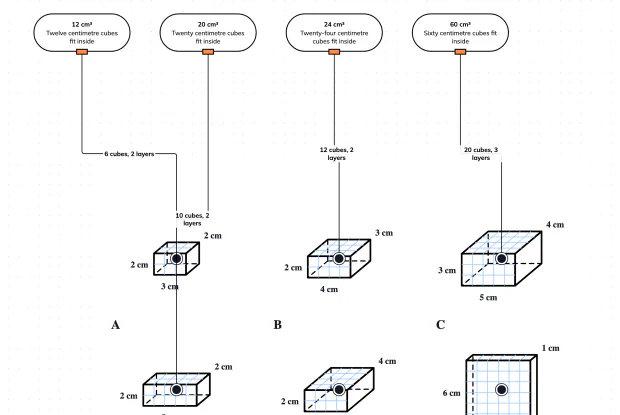
Volume counts how many unit cubes fit inside a solid. For a cuboid it is one layer of cubes multiplied by the number of layers, which is length times width times height. Practise on four boxes in an interactive playground.
How Do You Find the Volume of a Prism?
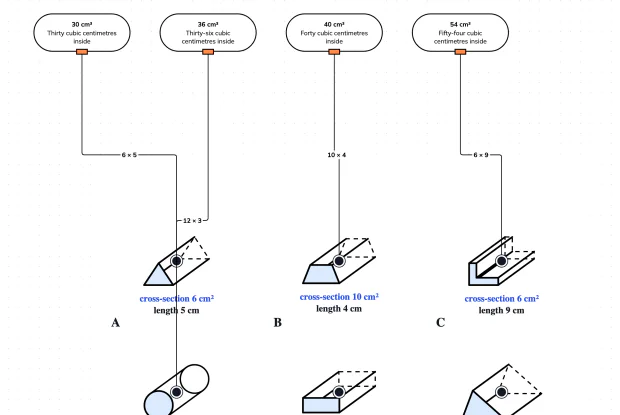
A prism has the same cross-section along its whole length, so its volume is the area of that cross-section times the length — whatever shape the cross-section is. Practise on four prisms in an interactive playground.
How Do You Find the Surface Area of a Cylinder?
A cylinder unrolls into a rectangle and two circles, so its surface area is 2πrh for the curved part plus 2πr² for the ends. Work out four of them in an interactive playground.