How Do You Find the Surface Area of a Cuboid?
Root Concept
The surface area of a cuboid is 2(lw + lh + wh), because its six faces form three identical pairs.
CodePLU Goal
Upgrading Human Mental Models
Learn how to think in Workflows

Concept Development By codeplu.com
Opposite faces of a cuboid are identical, so there are only ever three areas to work out — and then one doubling.
How Much Card Does a Box Take?
The previous tutorial opened solids out flat. That turns out to be exactly what you need here, because surface area is just the area of the net. Unfold the box, measure each flat piece, add them up, and you have the amount of card the box is made from.
A cuboid makes this easier than it sounds. It has six rectangular faces, but they come in three matching pairs: the front matches the back, the left matches the right, and the top matches the bottom. So there are only ever three different areas to work out, and then everything gets counted twice. That is the whole of the method, and it is where the standard formula 2(lw + lh + wh) comes from.
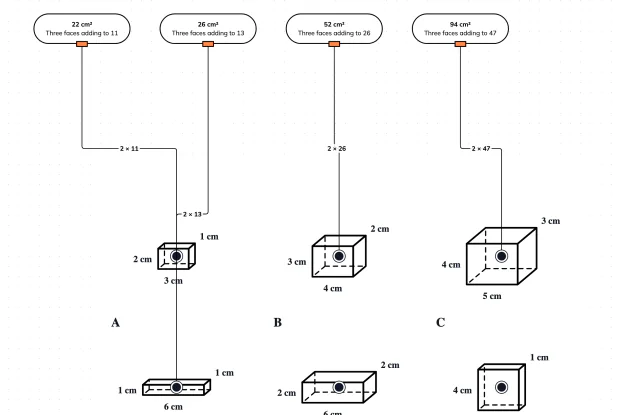
The step that goes missing is the doubling. It is easy to find the three areas, add them carefully, and hand in the total — which is exactly half the right answer. The playground below has been built so that this mistake does not simply give a wrong number: for one of the cuboids it gives a number that is genuinely the surface area of a different cuboid on the same board.
Three Pairs, One Formula, and the Step People Drop
Why are there only three areas to find?
Because opposite faces of a cuboid are identical. Stand a box on a table and the face against the table is the same rectangle as the face on top; the front is the same as the back; the two ends match each other. Each pair is made by two of the three measurements, so with a length, a width and a height you get the three combinations: length times width, length times height, and width times height. Cuboid A in the playground is 3 by 1 by 2, giving faces of 3, 6 and 2 square centimetres. Add those three and you get 11, which is half the box. Double it and the surface area is 22 square centimetres.
Where does 2(lw + lh + wh) come from?
It is that method written in symbols rather than words. The three different faces have areas lw, lh and wh; adding them gives half the box; multiplying by 2 counts each face's partner. The brackets matter, because the 2 applies to the whole sum and not just to the first term — writing 2lw + lh + wh would double one pair and leave the other four faces counted once. If you prefer, the same thing can be written as 2lw + 2lh + 2wh, which is longer but harder to get wrong. Both are correct, and the bracketed form is quicker because it needs one multiplication instead of three.
Why is forgetting to double so easy?
Because the hard work is finished before the doubling. You have identified three faces, multiplied three pairs of numbers and added them, and the answer feels done. Nothing about the number 26 announces that it is only half of cuboid B. This is why the playground contains cuboid D, whose surface area really is 26 square centimetres: the half-finished answer for B is a true answer for a different box, so the mistake does not feel like a mistake. The habit that protects you is to write the 2 down at the very start, before working out any face, rather than remembering it at the end. A quick sanity check also helps: the answer must be bigger than twice the largest single face.
Does surface area mean the same as area?
It is ordinary area, just applied to the outside of a solid rather than to a flat shape. That is why the units are square units — square centimetres here — and not cubic ones. This is worth being firm about, because the next tutorial works out volume for the same kind of box, and volume is measured in cubic centimetres. If an answer about how much card, paint or wrapping paper is needed comes out in cubic units, something has gone wrong, and the same is true in reverse for an answer about how much a box holds. Reading the units off your own answer is the fastest way to notice that you have solved the wrong problem, and it costs nothing to check.
Real World Example
Painting a Room
A room is a cuboid seen from the inside, and working out how much paint it needs is the same calculation with one honest adjustment.
Step 1
Measure three, get six
A decorator measures the length, the width and the height of a room — three numbers — and from those gets the areas of all six surfaces, because the opposite walls match each other exactly as the faces of a cuboid do. A room 5 metres by 4 metres by 2.5 metres has two walls of 5 by 2.5, two walls of 4 by 2.5, and a ceiling and floor of 5 by 4. That is 12.5, 10 and 20 square metres for the three different surfaces, so the full inside surface is 2 times 42.5, which is 85 square metres. The pairing is what makes three measurements enough.
Step 2
Take off what is not painted
The maths gives the whole surface, but a real room is not entirely painted. The floor is carpeted, so 20 square metres comes off straight away, and the door and windows come off the walls. Measuring a door at about 2 square metres and two windows at 1.5 each takes another 5 away. The decorator is now down from 85 to 60 square metres of actual paintable wall and ceiling. This subtraction step has no equivalent in the textbook formula, and it is why a real estimate always starts from the full surface area and then removes things rather than trying to measure each painted patch directly.
Step 3
Turn area into tins
Paint tins state a coverage, typically around 12 square metres per litre for emulsion. Sixty square metres therefore needs about 5 litres for one coat, and most jobs need two coats, so 10 litres. The decorator buys 12 to be safe, because running out mid-wall means a visible join. Notice that every number in this chain is in square metres until the very last step — surface area is an area throughout, which is the practical reason the units matter. A calculation that drifted into cubic metres would have been estimating how much air the room holds, not how much paint it takes.
FAQs
Final Words
The surface area of a cuboid is the area of its net, and a cuboid makes that easy because its six faces are three matching pairs. Find the three different face areas, add them, and double — which is all that 2(lw + lh + wh) says. Writing the 2 down before you start is the simplest guard against losing it at the end.
Keep hold of the units, too. Surface area is an area, so it is measured in square units, and it answers questions about covering a solid: card, paint, wrapping paper. The next tutorial asks the other question about the same box — not how much it takes to cover, but how much it holds — and that answer comes in cubic units instead.
Continue This Track
This concept is part 3 of Solid Shapes, Measured.
What Are Faces, Edges and Vertices?
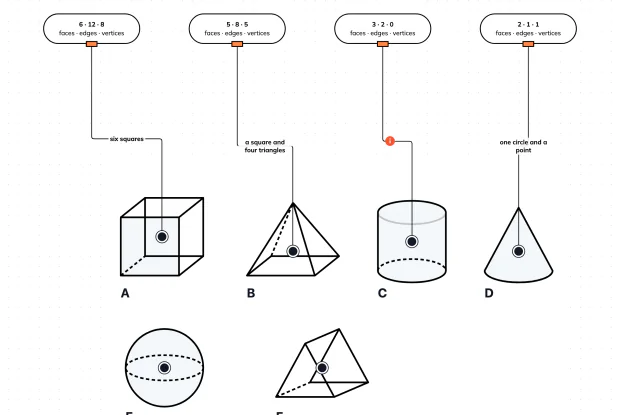
A solid shape is described by three counts: its flat surfaces, the lines where they meet, and the corners. Counting them is easy once you remember the ones hidden round the back. Match each set of counts to the solid it belongs to in an interactive playground.
What Is a Net of a Solid?
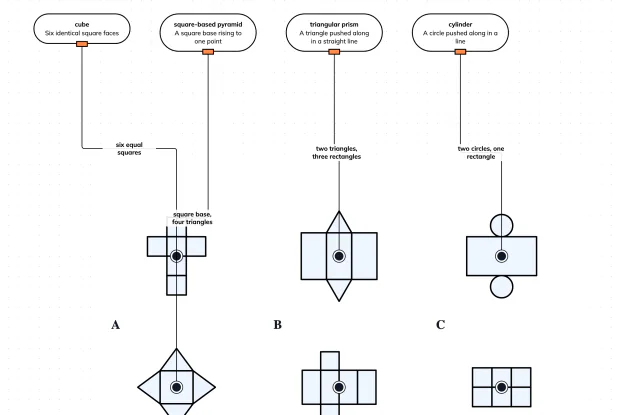
A net is a solid opened out flat, so every face lies in one plane. Counting the faces and checking their shapes identifies the solid. Match four nets to the solids they fold into in an interactive playground.
How Do You Find the Surface Area of a Cuboid?
A cuboid has six faces in three matching pairs, so its surface area is the three different face areas added and doubled. Work out four surface areas in an interactive playground.
How Do You Find the Volume of a Cuboid?
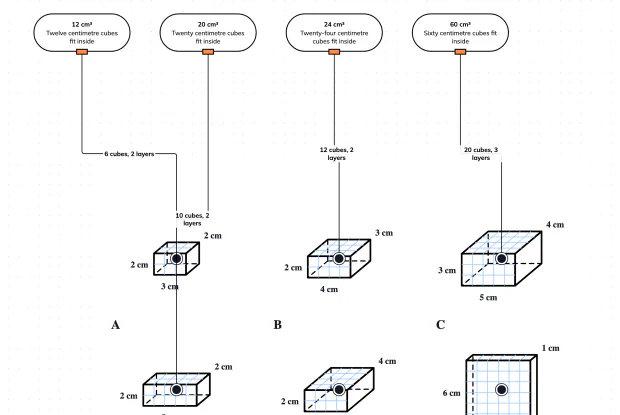
Volume counts how many unit cubes fit inside a solid. For a cuboid it is one layer of cubes multiplied by the number of layers, which is length times width times height. Practise on four boxes in an interactive playground.
How Do You Find the Volume of a Prism?
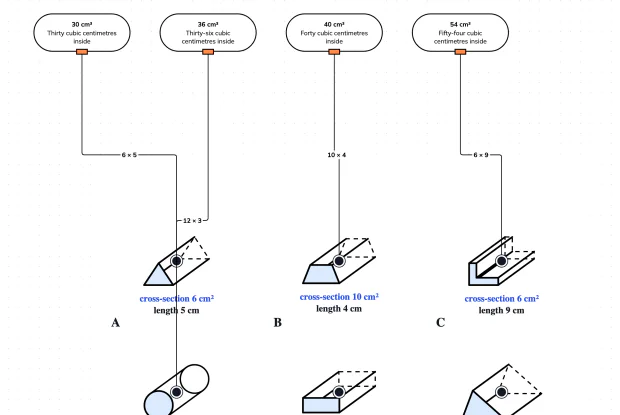
A prism has the same cross-section along its whole length, so its volume is the area of that cross-section times the length — whatever shape the cross-section is. Practise on four prisms in an interactive playground.
How Do You Find the Surface Area of a Cylinder?
A cylinder unrolls into a rectangle and two circles, so its surface area is 2πrh for the curved part plus 2πr² for the ends. Work out four of them in an interactive playground.