How Do You Find the Surface Area of a Cylinder?
Root Concept
The surface area of a cylinder is 2πrh for the curved surface plus 2πr² for the two circular ends.
CodePLU Goal
Upgrading Human Mental Models
Learn how to think in Workflows

Concept Development By codeplu.com
The curved surface is a rectangle whose width is the circumference. That one fact makes the rest arithmetic.
Peel the Label Off and Look at It
The cuboid was easy to cover because every face was flat and the net was obvious. A cylinder looks harder, because most of its surface is curved and curved things do not lie flat. But this one does, and the proof is in your kitchen: peel the label off a tin and it comes away as a perfectly ordinary rectangle.
That rectangle is the curved surface, and its size is fixed by two things. Its height is the height of the tin. Its width is the distance all the way round the circle, which is the circumference, 2πr. So the curved surface has area 2πr × h. Then there are the two ends, each a circle of area πr², making 2πr² between them.
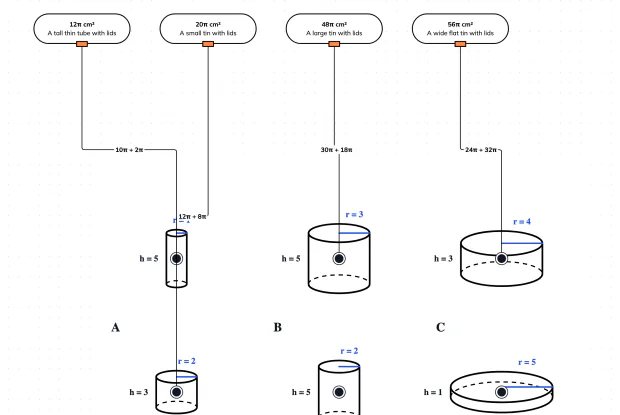
Put together, the surface area is 2πrh + 2πr². Answers are usually left in terms of π rather than turned into decimals, because π times a whole number is exact while 37.699 is not. In the playground below, four cylinders are waiting; work out the curved part and the ends separately, then add them.
Where Each Piece Comes From, and What Gets Dropped
Why is the curved surface a rectangle?
Because a cylinder is a prism, and a prism can be slit along its length and rolled out. Cut straight down the side of a tin and unroll it and nothing has to stretch or tear — every point of the curved surface lands flat. The height of the resulting rectangle is obviously the height of the tin. The width is less obvious until you picture rolling it back up: the rectangle has to wrap exactly once round the circle, so its width must be the circle's circumference, 2πr. That gives the curved surface area as 2πr × h, usually written 2πrh. Cylinder B in the playground has r = 3 and h = 5, so its curved surface is 2π × 3 × 5 = 30π.
Why 2πr² and not πr² for the ends?
Because there are two of them. A closed cylinder has a lid and a base, each a circle of radius r and therefore each of area πr². Two circles come to 2πr². For cylinder B that is 2π × 9 = 18π, so its total surface area is 30π + 18π = 48π square centimetres. It is worth noticing how different the two parts can be: cylinder F is wide and flat, so its ends come to 50π while its curved surface is only 10π. For a tall thin cylinder like A the balance is the other way round. Neither part can be ignored as small without checking which way a particular cylinder leans.
What if the cylinder is open at one end?
Then you count one circle instead of two, giving 2πrh + πr². A drinking glass, a bucket and a pipe are all cylinders with different numbers of ends: a glass and a bucket have one, a pipe has none, so a pipe's surface is just the curved part — twice over, in fact, if you want the inside as well as the outside. The formula in a textbook assumes a closed cylinder, and a question that describes a real object is often quietly telling you to drop a piece. Read what the object actually is before reaching for the formula. The playground uses closed cylinders throughout, so both ends count every time.
What gets dropped most often?
The ends. The curved surface is the part you can picture unrolling, so it is the part that gets calculated, and then the answer feels finished. The playground is built so that this does not simply give a wrong number: the curved surface of cylinder D is 12π, which really is the full surface area of cylinder A, and the curved surface of E is 20π, which really is the full area of D. A half-finished answer lands on a real one. The habit that protects you is to write the sum as two terms before working out either, so the second term exists on the page before you can forget it.
Real World Example
Making a Tin of Beans
A food tin is built from exactly the three pieces this formula counts, and they are made on different machines from different material.
Step 1
The body is a rolled rectangle
A standard tin has a radius of about 3.7 centimetres and a height of about 11, so its curved surface is 2π × 3.7 × 11, which is around 256 square centimetres. The factory does not cut that as a curve — it cuts a flat rectangle roughly 23 centimetres by 11 from a coil of steel and rolls it into a tube, welding the seam. The width of that rectangle is the circumference, exactly as the formula says, and it is why tin bodies are stamped out of flat sheet with almost no waste between them. Rectangles tile a coil perfectly.
Step 2
The ends are stamped separately
The two circular ends come to 2π × 3.7², about 86 square centimetres, and they are punched from sheet on a different machine, usually from thicker metal because the ends take the pressure when the tin is heated during cooking. Here the geometry works against the manufacturer: circles cannot tile a flat sheet, so punching them always leaves scrap between them. That scrap is recycled, but it still has to be handled, and it is one reason the ends cost more per square centimetre than the body does even though they are a much smaller area.
Step 3
The label is the curved surface again
The paper label is a second copy of the same rectangle, a little wider so it can overlap and glue to itself. Printers lay out the artwork on exactly that rectangle, which is why the design on a tin is drawn flat and only becomes curved when it is wrapped. Peeling a label off and flattening it is the quickest demonstration of the whole formula: the shape in your hand is the 2πrh term, and the two pieces of metal you cannot peel off are the 2πr². Nothing else is left, which is as direct a demonstration of a formula as you will find in a kitchen cupboard.
FAQs
Final Words
A cylinder's surface comes apart into three flat pieces: a rectangle and two circles. The rectangle's width is the circumference, so the curved surface is 2πrh, and the two ends add 2πr². Together that is 2πrh + 2πr², and answers are normally left in terms of π because that keeps them exact.
The term that goes missing is always the ends, so write the sum as two pieces before calculating either. And read the object before reaching for the formula — a cup has one end and a pipe has none, so the ends term shrinks or disappears. That closes this track: you can name a solid's parts, unfold it, cover it and fill it, for cuboids, prisms and cylinders alike.
Continue This Track
This concept is part 6 of Solid Shapes, Measured.
What Are Faces, Edges and Vertices?
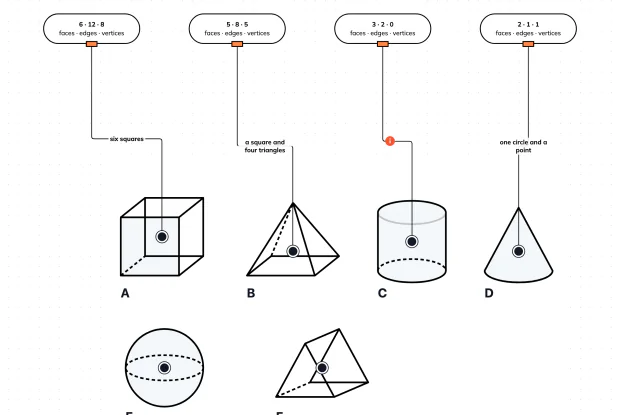
A solid shape is described by three counts: its flat surfaces, the lines where they meet, and the corners. Counting them is easy once you remember the ones hidden round the back. Match each set of counts to the solid it belongs to in an interactive playground.
What Is a Net of a Solid?
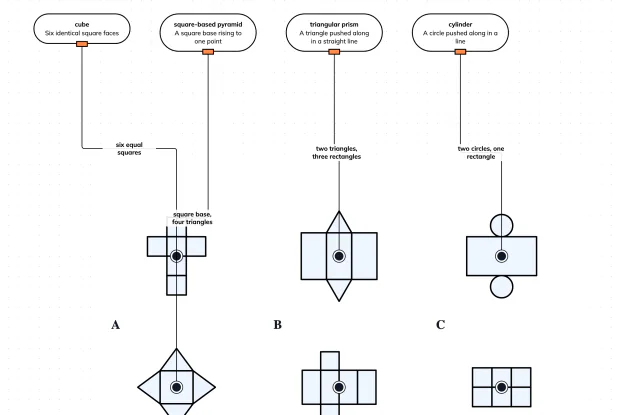
A net is a solid opened out flat, so every face lies in one plane. Counting the faces and checking their shapes identifies the solid. Match four nets to the solids they fold into in an interactive playground.
How Do You Find the Surface Area of a Cuboid?
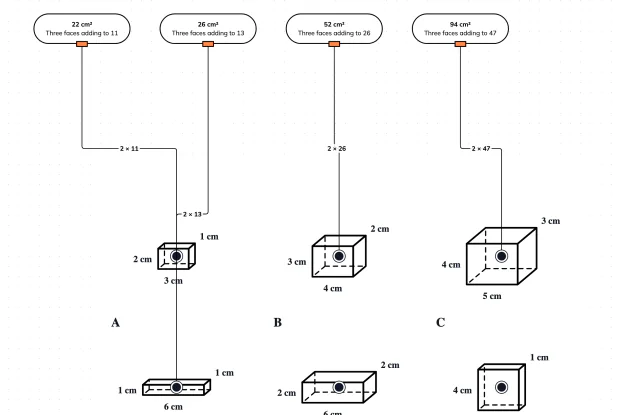
A cuboid has six faces in three matching pairs, so its surface area is the three different face areas added and doubled. Work out four surface areas in an interactive playground.
How Do You Find the Volume of a Cuboid?
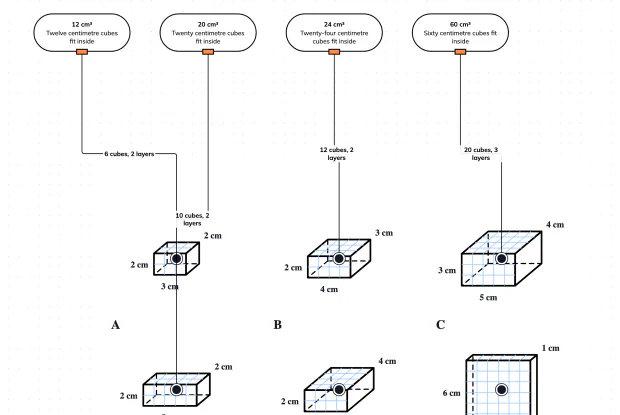
Volume counts how many unit cubes fit inside a solid. For a cuboid it is one layer of cubes multiplied by the number of layers, which is length times width times height. Practise on four boxes in an interactive playground.
How Do You Find the Volume of a Prism?
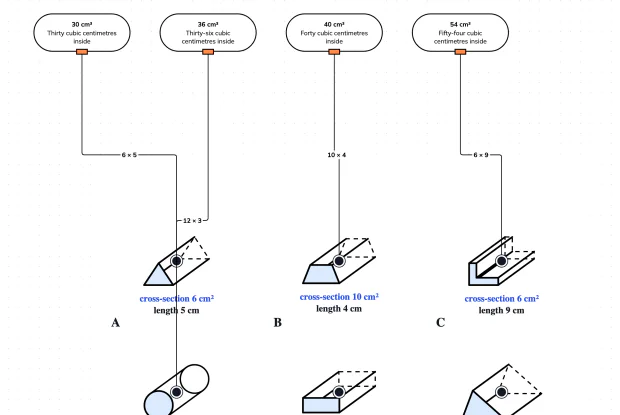
A prism has the same cross-section along its whole length, so its volume is the area of that cross-section times the length — whatever shape the cross-section is. Practise on four prisms in an interactive playground.
How Do You Find the Surface Area of a Cylinder?
A cylinder unrolls into a rectangle and two circles, so its surface area is 2πrh for the curved part plus 2πr² for the ends. Work out four of them in an interactive playground.