Solid Shapes, Measured
Everything so far in geometry has been flat. This track steps into three dimensions and measures what it finds there. It opens by naming the parts — faces, edges and vertices — which means learning to count the ones hidden round the back, the single hardest thing about drawing solids on a flat page. The net removes that difficulty entirely: cut a solid along enough edges, press it flat, and every face lies side by side at its true size with nothing foreshortened and nothing hidden. Reading a net backwards is a skill worth having, and it carries one warning that a quick count will never give you — six squares are sometimes a cube and sometimes nothing at all, because the arrangement has to fold without overlapping. From there the track asks the two questions you can ask about any solid, and keeps them firmly apart. Surface area is how much it takes to cover the thing, which is simply the area of its net; for a cuboid the six faces form three matching pairs, so three areas are added and doubled. Volume is how much it holds, counted in unit cubes: one layer, repeated for every layer. The track ends by generalising that layer picture. Any solid with the same cross-section all the way along is a prism, and its volume is that cross-section times its length — a single rule that absorbs the cuboid and the cylinder as special cases.
CodePLU Goal
Upgrading Human Mental Models
Learn how to think in Workflows
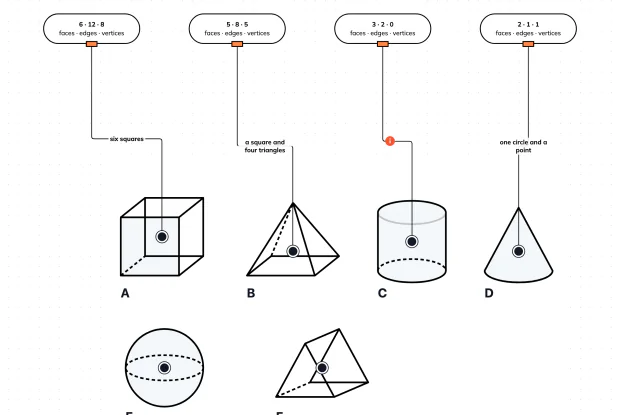
What Are Faces, Edges and Vertices?
A solid shape is described by three counts: its flat surfaces, the lines where they meet, and the corners. Counting them is easy once you remember the ones hidden round the back. Match each set of counts to the solid it belongs to in an interactive playground.
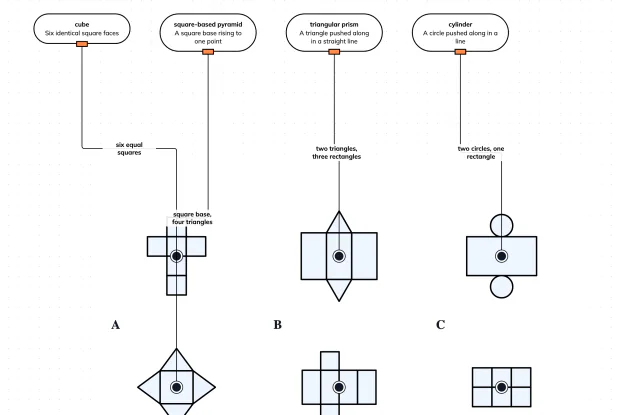
What Is a Net of a Solid?
A net is a solid opened out flat, so every face lies in one plane. Counting the faces and checking their shapes identifies the solid. Match four nets to the solids they fold into in an interactive playground.
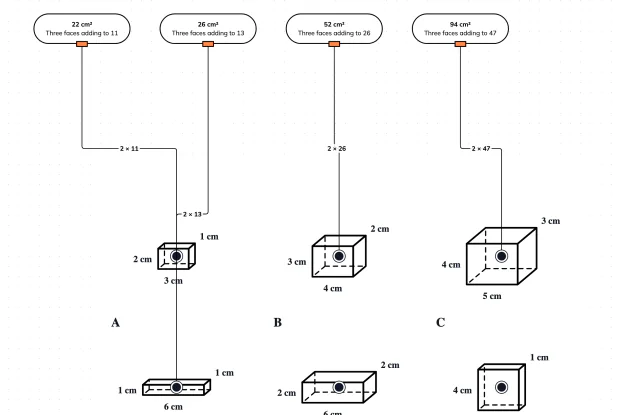
How Do You Find the Surface Area of a Cuboid?
A cuboid has six faces in three matching pairs, so its surface area is the three different face areas added and doubled. Work out four surface areas in an interactive playground.
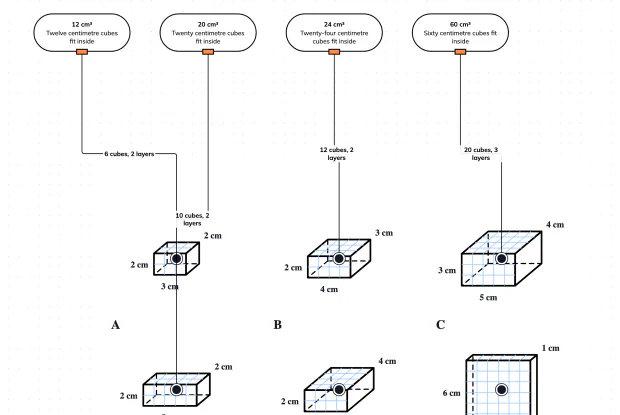
How Do You Find the Volume of a Cuboid?
Volume counts how many unit cubes fit inside a solid. For a cuboid it is one layer of cubes multiplied by the number of layers, which is length times width times height. Practise on four boxes in an interactive playground.
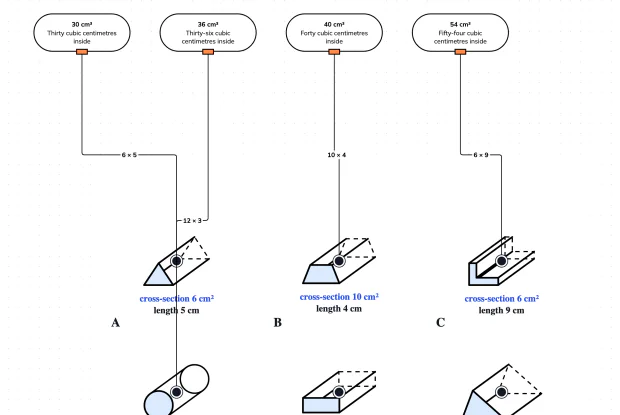
How Do You Find the Volume of a Prism?
A prism has the same cross-section along its whole length, so its volume is the area of that cross-section times the length — whatever shape the cross-section is. Practise on four prisms in an interactive playground.
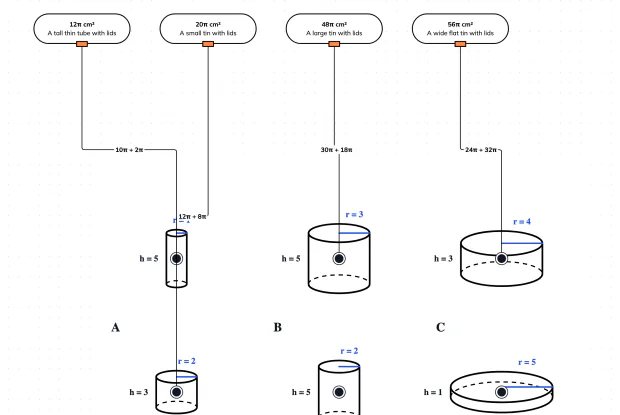
How Do You Find the Surface Area of a Cylinder?
A cylinder unrolls into a rectangle and two circles, so its surface area is 2πrh for the curved part plus 2πr² for the ends. Work out four of them in an interactive playground.