How Do You Translate a Shape?
Root Concept
A translation moves every point of a shape by the same amount across and the same amount up.
CodePLU Goal
Upgrading Human Mental Models
Learn how to think in Workflows

Concept Development By codeplu.com
A slide adds the same pair of numbers to every point, which is why one corner is enough to find the whole image.
The Movement With Nothing Clever About It
Reflection flipped a shape over. This movement does not flip it, does not turn it and does not resize it. It just slides it. Every point of the shape travels the same distance in the same direction, so the image comes out facing exactly the way the original faced, in a new place. The proper name for a slide is a translation.
Because every point makes the same journey, two numbers describe the whole thing: how far across, and how far up or down. "3 right, 2 up" tells you everything. There is no centre to find and no mirror to measure from, which makes translation the easiest of the three movements in this track and the one worth meeting before the harder ones.
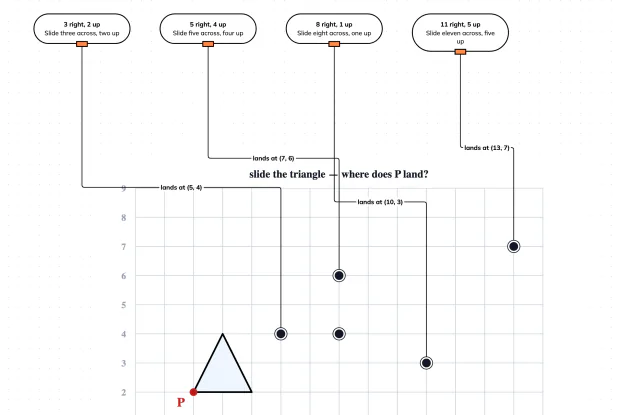
It also means you never have to translate a whole shape by hand. Move one corner correctly and the rest follow, because they are all making the identical trip. In the playground below a triangle sits with its corner P at (2, 2), and four different slides are offered. For each one, work out the coordinates P lands on.
Reading a Slide, and the Signs That Catch People Out
How do the two numbers work?
The first number is the journey across and the second is the journey up. Add each one to the matching coordinate of the point you are moving. P starts at (2, 2). Slide it 3 right and 2 up and the across coordinate becomes 2 + 3 = 5 while the up coordinate becomes 2 + 2 = 4, so P lands at (5, 4). Slide it 11 right and 5 up and you get (2 + 11, 2 + 5) = (13, 7). There is no geometry to do at all once the point has coordinates — translation is addition. That is why the grid in the playground has both of its axes numbered, so you can read the answer straight off rather than counting squares and hoping.
What happens when the movement is left or down?
The same addition, with a negative number. Going left is a negative across journey and going down is a negative up journey, so "4 left, 1 down" is written as −4 across and −1 up. A point at (6, 5) moved that way lands at (6 − 4, 5 − 1) = (2, 4). Mixing up the direction of the second number is the commonest mistake in the topic, and one of the spare positions in the playground is built from exactly that slip: it is where P would land if the first slide went 2 down instead of 2 up. The across journey is right, and the point is still wrong.
Why is one corner enough?
Because the slide does not treat any part of the shape differently. Every corner, every edge and every point inside is carried the same distance in the same direction, so once you know where one corner has gone you can redraw the shape around it unchanged. This is not true of the other movements: under a rotation, corners further from the centre travel further, and under a reflection, corners further from the mirror travel further. Translation is the only one of the three where every point makes an identical journey, and that is precisely what makes it the simplest. It is also why the playground only asks you to place P: once P is right, the other two corners of the triangle are already decided.
Does a translation change the shape?
Nothing about it. The side lengths are the same, the angles are the same, and unlike a reflection the handedness is the same too — walk round the corners of the image in order and you travel the same way round as on the original. The image is congruent to the object and also identically oriented, which means you could slide a tracing of the original straight onto the image without turning the tracing paper over or round. That is a useful way to check your work: if the image looks tilted or mirrored, what you have drawn is not a translation. Of the three movements in this track, translation is the only one that leaves both the shape and the way it faces completely alone.
Real World Example
Laying a Tiled Floor
A tiled floor is a translation repeated. Following how a tiler sets one out shows why the two numbers matter more than the tile itself.
Step 1
One tile, then the same move again
A tiler lays the first tile and then every other tile is that one slid. If the tiles are 30 centimetres square, the slide to the next tile along is 30 across and 0 up, and the slide to the row above is 0 across and 30 up. Those two pairs of numbers generate the whole floor: repeat them enough times and you reach every tile in the room. Nothing is turned and nothing is flipped, which is why a plain tile pattern looks calm and regular. The tiler never has to think about the tile's shape again after the first one, only about the two distances.
Step 2
Change one number, change the pattern
Offset the rows by half a tile and the upward slide becomes 15 across and 30 up instead of 0 across and 30 up. That single change turns a grid pattern into the brick-bond pattern you see on most walls, and it is a different pattern made from an identical tile. It is worth noticing that the tile did not change at all — only the translation did. This is why pattern designers talk about the repeat rather than the motif: the pair of slides carries as much of the design as the drawing does.
Step 3
Why errors multiply
If the tiler is two millimetres out on each slide, the error does not stay at two millimetres. The tenth tile is twenty millimetres out and the thirtieth is sixty, because every tile carries the whole accumulated journey. This is the practical reason floors are set out from measured lines across the room rather than tile by tile from one corner. The same thinking applies in the playground: work out each landing point from P's coordinates directly, rather than counting on from the previous answer, and a mistake stays a single mistake instead of spreading.
FAQs
Final Words
A translation is the plainest movement in geometry: two numbers, one for across and one for up, added to every point of the shape. Negatives handle left and down, one corner is enough to place the whole image because every point makes the identical journey, and nothing about the shape itself changes — not its lengths, not its angles, not even its handedness.
That makes it a good benchmark for the other two movements. A reflection reverses the handedness; a translation does not. A rotation needs a centre and moves distant points further; a translation needs no centre and moves everything equally. The last tutorial in this track takes on rotation, where the centre you turn about matters just as much as the angle you turn through.
Continue This Track
This concept is part 4 of Symmetry and Moving Shapes.
What Is a Line of Symmetry?
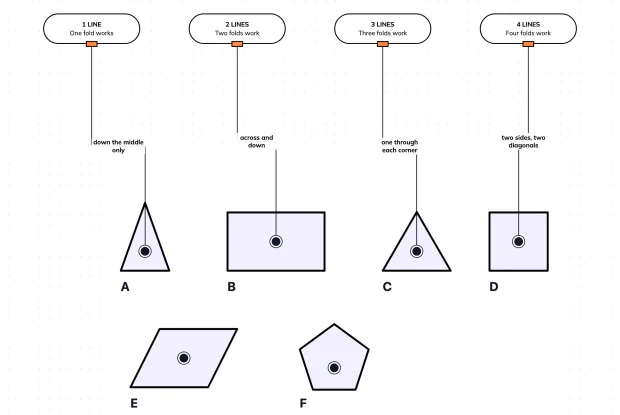
A line of symmetry is a fold that makes both halves land exactly on top of each other. Cutting a shape into two equal halves is not the same thing, which is why a parallelogram has no lines of symmetry at all. Count the folds on six shapes in an interactive playground.
What Is Rotational Symmetry?
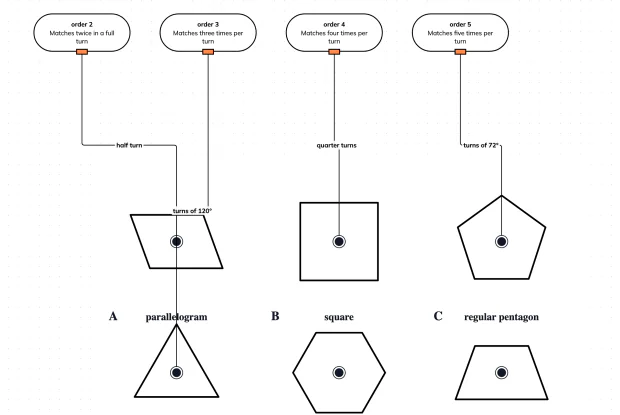
A shape has rotational symmetry when turning it about its centre lands it back on itself before a full turn is done. The order counts how many times that happens. Find the order of six shapes in an interactive playground.
How Do You Reflect a Shape in a Mirror Line?
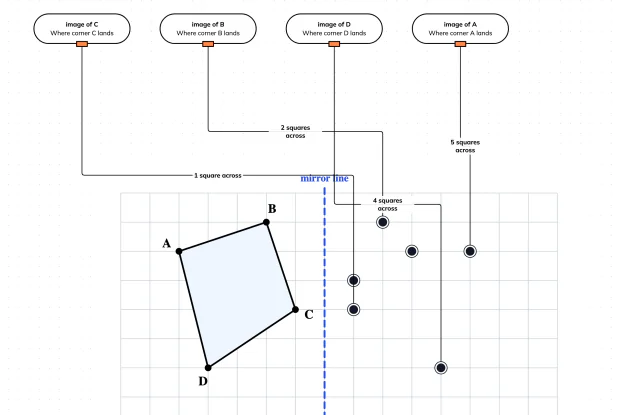
Reflecting a shape means sending every corner the same distance to the other side of a mirror line, along a path at right angles to it. Place all four corners of a quadrilateral in an interactive playground.
How Do You Translate a Shape?
A translation slides every point of a shape by the same amount across and the same amount up. Nothing turns and nothing flips. Work out where a marked corner lands under four different slides in an interactive playground.
How Do You Rotate a Shape?
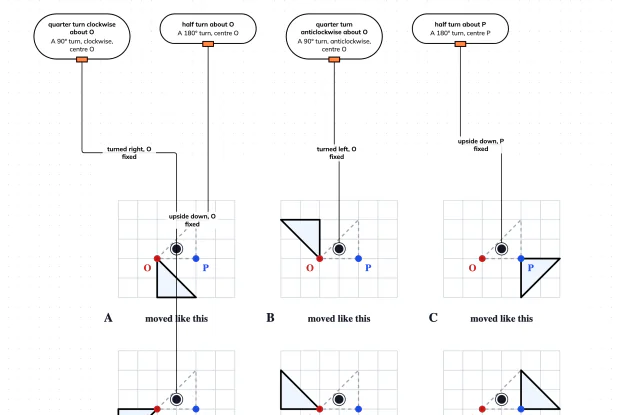
A rotation turns a shape about a fixed centre. Change the centre and the same angle sends the shape somewhere completely different. Match four turns to the pictures they produced in an interactive playground.
How Do You Enlarge a Shape from a Centre?
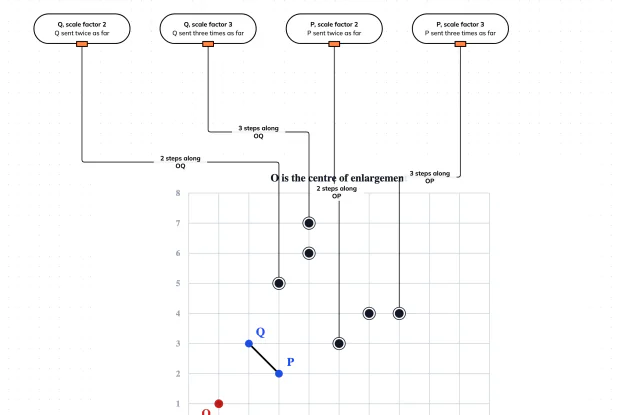
An enlargement multiplies every distance from a fixed centre by the same scale factor, so the shape changes size but not proportions. Place four enlarged points in an interactive playground.