How Do You Rotate a Shape?
Root Concept
A rotation is described by a centre, an angle and a direction; the centre is the only point that does not move.
CodePLU Goal
Upgrading Human Mental Models
Learn how to think in Workflows

Concept Development By codeplu.com
Find the point that did not move and you have found the centre. Everything else follows from it.
The Movement That Needs a Centre
Sliding a shape needed two numbers. Reflecting it needed a mirror line. Turning a shape needs a point to turn about, and that point does more work than beginners expect — change it and the same amount of turn leaves the shape somewhere else entirely.
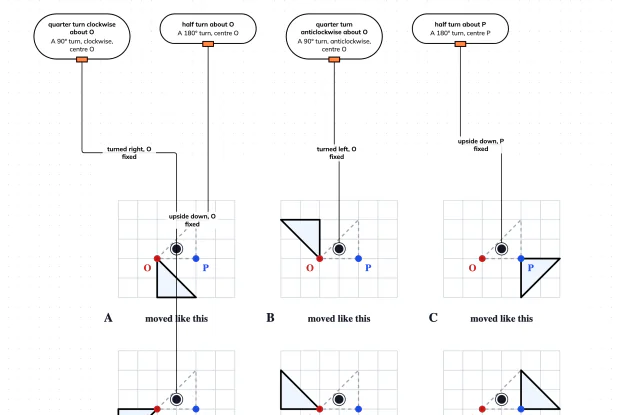
A rotation is described by three things: the centre, the angle, and the direction. Miss any one of them and you have not said enough to draw the image. "Turn it 90°" is not an instruction, because 90° clockwise and 90° anticlockwise give different answers, and both give different answers again if you move the centre. Two of the panels in the playground below differ only in which point was held fixed.
There is one feature of a rotation that makes checking easy. The centre is the only point that does not move. Everything else swings round it, and the further from the centre a point starts, the further it travels. So the quickest way to identify a rotation is to look for the point that stayed exactly where it was.
Centre, Angle, Direction — and How to Read Them Back
Why does the centre matter so much?
Because distance from the centre is preserved and nothing else is. A point two squares from the centre stays two squares from it after the turn; a point five squares away stays five squares away. Move the centre and every one of those distances changes, so the whole image lands differently. In the playground, two panels show a half turn — the same 180° — and they look nothing alike, because one was turned about O and the other about P. If a question gives you an angle and a direction but no centre, it has not told you enough to answer, and the commonest mistake in the topic is assuming the centre is the middle of the shape when it has been given somewhere else.
How do I find the centre from a picture?
Look for the point that has not moved. If the shape and its image share a corner, and that corner is in exactly the same place on both, it is almost certainly the centre — the one point a rotation leaves alone. In four of the six panels the triangle touches O or P, and whichever of the two it still touches in the same position tells you which centre was used. When no point is shared, the method is to join each corner to its image, draw the perpendicular bisector of each of those lines, and see where the bisectors meet. The centre does not have to be inside the shape, or even on it.
Which way is clockwise?
Clockwise is the direction the hands of a clock move: from twelve round to three, then six, then nine. Anticlockwise is the opposite, and some books call it counterclockwise, which means exactly the same thing. The direction only matters for turns that are not a half turn — a quarter turn clockwise and a quarter turn anticlockwise land in different places, but a half turn gets to the same place whichever way you go round, because 180° one way and 180° the other way both end up opposite. That is worth remembering, because it means a half turn can be described without naming a direction at all. For every other turn, leaving the direction out makes the instruction incomplete.
What does a rotation leave unchanged?
The side lengths, the angles, and the handedness. A rotation is a congruence like the other two movements, so the image is the same size and shape as the object. Unlike a reflection, it does not flip the shape over: walk round the corners of the image in order and you travel the same way round as on the original. This is how you tell a turn from a flip when a picture could be either. Two of the panels in the playground are there to make exactly that point — one is a reflection rather than a rotation, and one is a genuine quarter turn but about the wrong centre.
Real World Example
Opening a Door
A door is a rotation you use every day, and it shows plainly why the centre is the part of the description that does the most work.
Step 1
The hinge is the centre
When a door swings open, every part of it turns about the line of the hinges. The hinge edge barely moves at all, the middle of the door sweeps a comfortable arc, and the handle travels furthest of anything. That is the rotation rule made physical: distance from the centre is what decides how far a point travels, and the centre itself does not move. It is also why the handle is fitted on the far edge rather than near the hinge — a small turn of the door gives the handle a large movement, so your hand does not have to make a precise one.
Step 2
The angle is how far open
A door at 90° is a quarter turn from closed, and a door flat against the wall is near a half turn. Builders and architects use exactly this language, marking a quarter-circle arc on a floor plan to show the swing, because the arc records both the angle and the radius at once. The arc also shows what the door will hit: anything inside that quarter circle is in the way. This is the same information a rotation carries in maths, drawn rather than written down, and it is why a plan can settle an argument about whether a cupboard will fit behind the door.
Step 3
Move the hinge and everything changes
Rehang the same door on the opposite side of the frame and open it by the same 90°, and it ends up somewhere completely different — blocking a different part of the room, opening towards you instead of away. Nothing about the door or the angle has changed; only the centre has. Builders call this the handing of a door and they specify it carefully, because getting it wrong means a door that swings into a cupboard or across a corridor. It is the same lesson the two half-turn panels teach: identical angle, different centre, entirely different result.
FAQs
Final Words
A rotation takes three pieces of information — a centre, an angle and a direction — and the centre is the one people leave out. Hold the same shape and the same angle but move the centre, and the image goes somewhere else entirely, which is why two half turns in the playground look nothing like each other. Reading a rotation backwards is easier: find the point that did not move, and that is the centre.
That completes the three movements. A translation slides everything equally and needs no centre, a reflection flips the handedness across a mirror line, and a rotation swings everything about a fixed point. All three leave lengths and angles untouched, so every image is congruent to its object — the shape itself is never what changes, only where it is and which way it faces.
Continue This Track
This concept is part 5 of Symmetry and Moving Shapes.
What Is a Line of Symmetry?
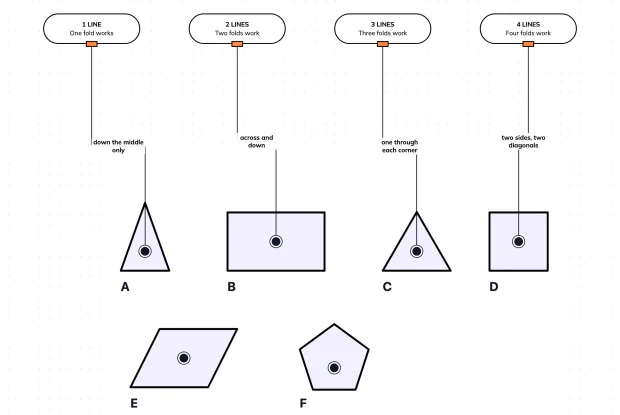
A line of symmetry is a fold that makes both halves land exactly on top of each other. Cutting a shape into two equal halves is not the same thing, which is why a parallelogram has no lines of symmetry at all. Count the folds on six shapes in an interactive playground.
What Is Rotational Symmetry?
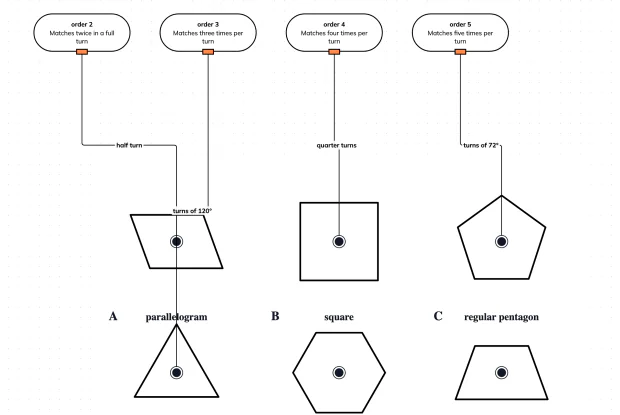
A shape has rotational symmetry when turning it about its centre lands it back on itself before a full turn is done. The order counts how many times that happens. Find the order of six shapes in an interactive playground.
How Do You Reflect a Shape in a Mirror Line?
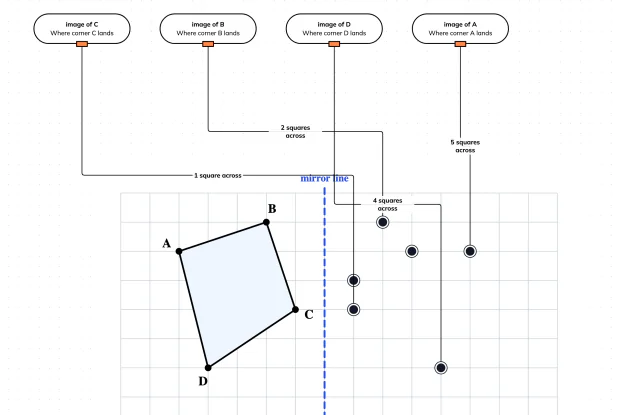
Reflecting a shape means sending every corner the same distance to the other side of a mirror line, along a path at right angles to it. Place all four corners of a quadrilateral in an interactive playground.
How Do You Translate a Shape?
A translation slides every point of a shape by the same amount across and the same amount up. Nothing turns and nothing flips. Work out where a marked corner lands under four different slides in an interactive playground.
How Do You Rotate a Shape?
A rotation turns a shape about a fixed centre. Change the centre and the same angle sends the shape somewhere completely different. Match four turns to the pictures they produced in an interactive playground.
How Do You Enlarge a Shape from a Centre?
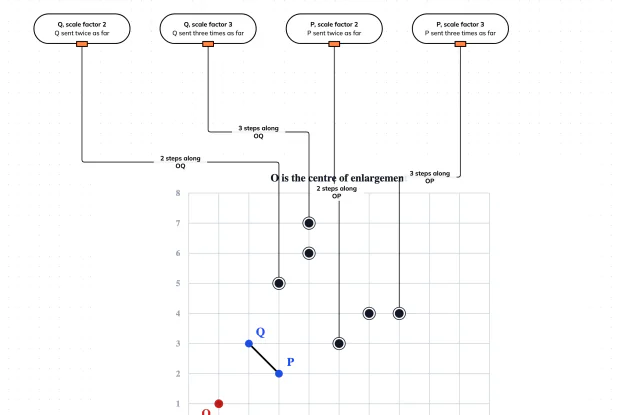
An enlargement multiplies every distance from a fixed centre by the same scale factor, so the shape changes size but not proportions. Place four enlarged points in an interactive playground.