Symmetry and Moving Shapes
A shape can match itself in two quite different ways, and this track separates them before putting them to work. Folding comes first: a line of symmetry is a crease that lands one half exactly on the other. Turning comes second, and the order of rotational symmetry counts how many times a shape falls back onto itself in one full turn — a count that is never zero, because every shape returns to itself after a complete turn. The two are genuinely independent, and the track leans on the pair that proves it: a parallelogram turns onto itself but has no fold line at all, while an isosceles trapezium folds but will not turn. Only the regular polygons give the same answer both ways. The second half stops describing symmetry a shape already has and starts moving shapes deliberately. Reflection sends every corner straight across a mirror line and the same distance beyond it. Translation slides everything by the same two numbers and needs no centre or mirror at all, which makes it the simplest of the three. Rotation needs a centre, an angle and a direction, and the centre is the part people leave out — the same half turn about two different points sends a shape to two quite different places. All three leave every length and every angle untouched, so the image is always congruent to the object; what separates them is what else they preserve. Only reflection reverses the handedness, which is the reliable test when a picture could be a flip or a turn.
CodePLU Goal
Upgrading Human Mental Models
Learn how to think in Workflows
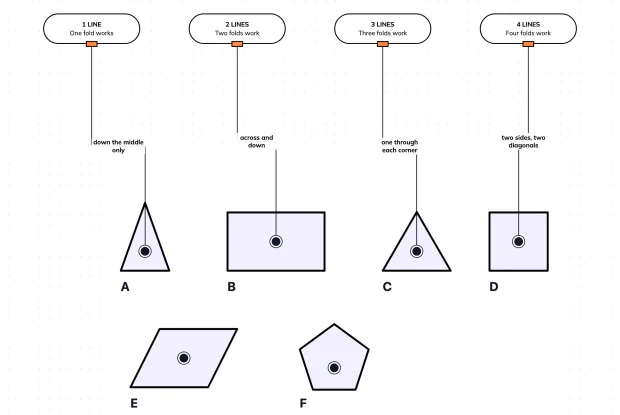
What Is a Line of Symmetry?
A line of symmetry is a fold that makes both halves land exactly on top of each other. Cutting a shape into two equal halves is not the same thing, which is why a parallelogram has no lines of symmetry at all. Count the folds on six shapes in an interactive playground.
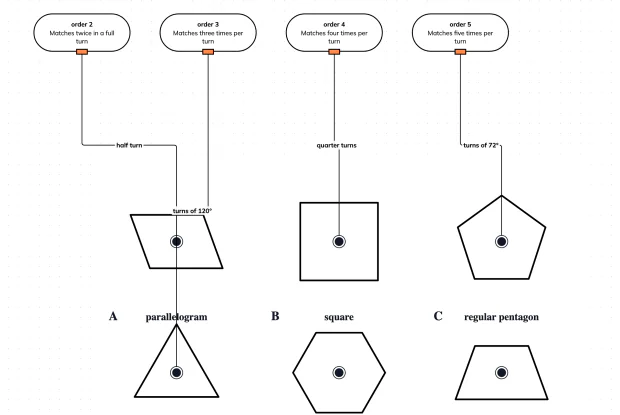
What Is Rotational Symmetry?
A shape has rotational symmetry when turning it about its centre lands it back on itself before a full turn is done. The order counts how many times that happens. Find the order of six shapes in an interactive playground.
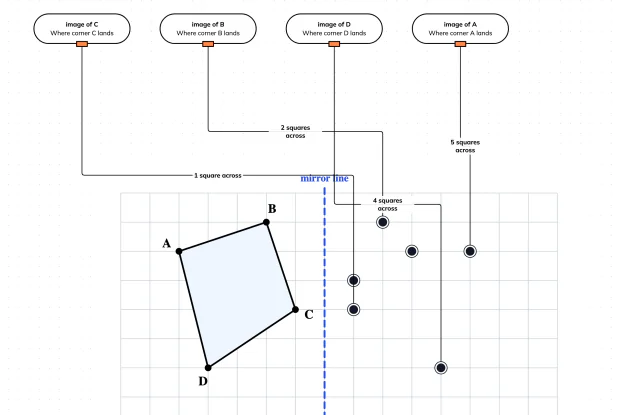
How Do You Reflect a Shape in a Mirror Line?
Reflecting a shape means sending every corner the same distance to the other side of a mirror line, along a path at right angles to it. Place all four corners of a quadrilateral in an interactive playground.
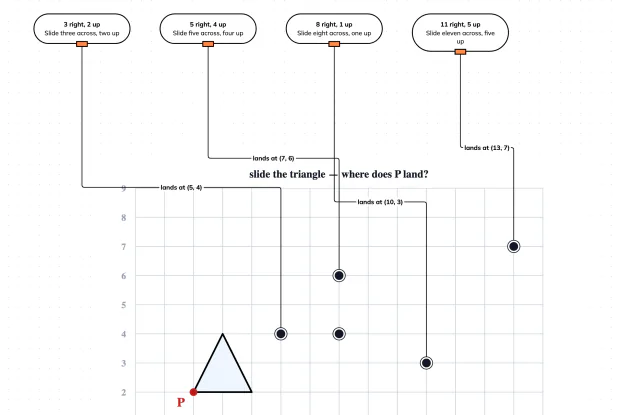
How Do You Translate a Shape?
A translation slides every point of a shape by the same amount across and the same amount up. Nothing turns and nothing flips. Work out where a marked corner lands under four different slides in an interactive playground.
How Do You Rotate a Shape?
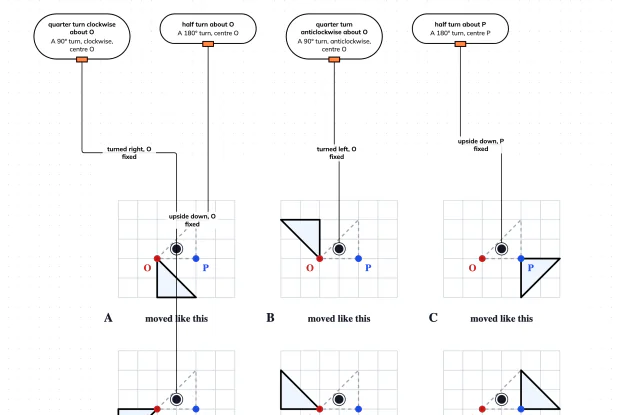
A rotation turns a shape about a fixed centre. Change the centre and the same angle sends the shape somewhere completely different. Match four turns to the pictures they produced in an interactive playground.
How Do You Enlarge a Shape from a Centre?
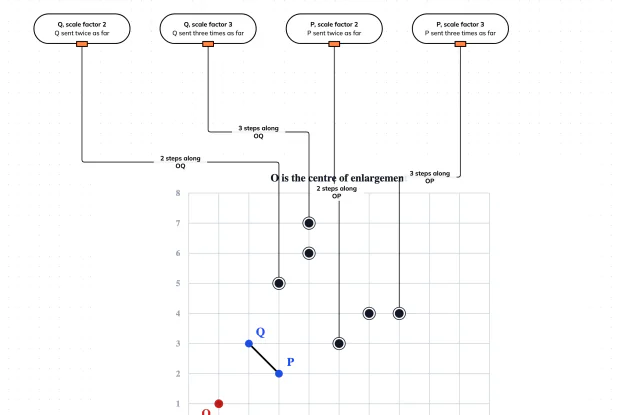
An enlargement multiplies every distance from a fixed centre by the same scale factor, so the shape changes size but not proportions. Place four enlarged points in an interactive playground.