What Is a Line of Symmetry?
Root Concept
A line of symmetry is a line you could fold a shape along so that the two halves land exactly on top of each other — which is a stronger condition than merely cutting the shape into two equal halves.
CodePLU Goal
Upgrading Human Mental Models
Learn how to think in Workflows

Concept Development By codeplu.com
What Makes a Fold Line Count?
Take a paper shape and fold it along some line. If the two halves land exactly on top of each other — every corner meeting a corner, every edge meeting an edge, nothing sticking out — then that fold line is a line of symmetry. If anything overhangs, it is not.
That is a stricter test than it first appears, and the strictness is the whole topic. A great many lines cut a shape into two halves of equal area without being lines of symmetry at all, because equal size is not the same as matching shape. The two halves have to be mirror images of one another, not merely the same amount of paper.
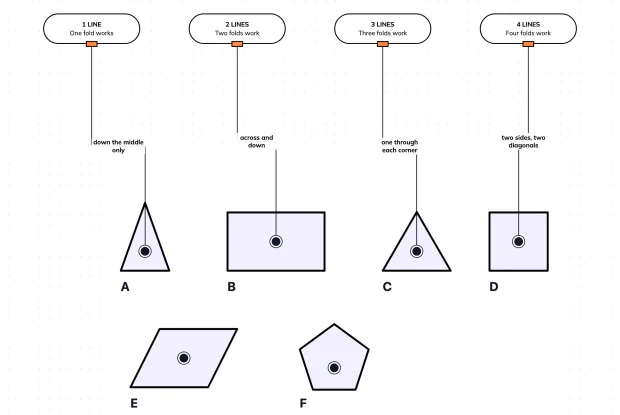
Shapes differ enormously in how many such folds they allow. A square has four, an equilateral triangle three, a rectangle two, an isosceles triangle one. And some shapes that look thoroughly regular have none whatsoever, which is the result most people find hardest to accept until they have tried the fold.
The Fold Test, and What It Rules Out
Why is cutting into equal halves not enough?
Because equal area and mirror image are different demands, and only the second one makes a line of symmetry. Draw any line through the centre of a parallelogram and it will cut the shape into two pieces of exactly equal area — that is true of the diagonals and of plenty of other lines besides. But fold along one and the halves do not land on each other: one piece leans left where the other leans right, and the corners miss. The area was never the question. The test is whether one half, reflected in the line, becomes the other half exactly. A useful way to picture it is to imagine the line as a mirror. Stand a mirror upright on the line and the reflection of the half in front of it should look precisely like the half hidden behind it. If the reflection shows you something the shape does not actually have, the line is not a line of symmetry.
Why does a parallelogram have none at all?
This is the result worth sitting with, because almost everybody guesses two. A parallelogram leans, and the lean is what breaks every candidate line. Try the horizontal line through the middle: fold, and the top half leans one way while the bottom half leans the other, so the slanted sides point in opposite directions and refuse to meet. Try the vertical: same failure. Try either diagonal, which feels like the strongest candidate because it cuts the shape into two identical triangles — and the two triangles genuinely are identical, but folding does not bring one onto the other. It would need a rotation, a half turn about the centre, which is a different kind of symmetry altogether. A parallelogram has rotational symmetry and no reflective symmetry, and the distinction is exactly what this tutorial is about. A rhombus, by contrast, has two lines, because its equal sides cancel the lean.
How many lines do the common shapes have?
A square has four: one through each pair of opposite sides, and one along each diagonal. A rectangle that is not a square has only two, through the middles of opposite sides — its diagonals fail, for the same reason the parallelogram's do, because the shape is longer one way than the other. An equilateral triangle has three, one from each corner to the middle of the opposite side. An isosceles triangle has exactly one, down the middle between its two equal sides, and a scalene triangle with three different sides has none. A circle is the extreme case: any line through its centre is a line of symmetry, so it has infinitely many. The pattern behind all of this is that a regular polygon with n sides has exactly n lines of symmetry, which is a satisfying rule and a good check on your counting.
Where does symmetry matter outside maths?
It is one of the few pieces of geometry that people respond to without being taught. Faces are roughly symmetrical and we notice when they are not; buildings are built symmetrical to look settled and deliberate; letters like A, H, M and T have a line of symmetry while F, G and J have none, which is why some words can be written to read the same in a mirror. In manufacturing it is practical rather than aesthetic. A symmetrical part can be fitted either way round, so it cannot be installed backwards and needs no left-handed and right-handed versions made separately. That is also why the stop sign in the earlier tutorial is a regular octagon: with eight lines of symmetry it looks identical however it is mounted, and no installer can get it wrong.
Real World Example
Three Things Built Around a Fold
Symmetry gets chosen for reasons that have nothing to do with looking pretty:
A butterfly's wings
1 line of symmetry
A butterfly has a single line of symmetry running down its body, with each wing the mirror image of the other. The symmetry is not decorative — it is what lets the insect fly straight, because unequal wings would push it into a permanent turn. It is also the classic demonstration of the fold test, since a butterfly painting made by folding wet paper is exactly how most people first meet the idea. One line and one only: there is no fold across the body that would make head and tail land on each other.
A capital letter H
2 lines of symmetry
H folds neatly both ways — a vertical fold swaps its two uprights, and a horizontal one swaps top for bottom. A, by contrast, has only the vertical, and F has none at all. This is why some words survive a mirror and others do not, and it is the whole basis of the ambulance lettering you see reversed on the front of the vehicle. Designers of logos care about it for a related reason: a symmetrical mark stays recognisable when it is flipped, reflected in glass or printed on the reverse of something transparent.
A Phillips screwdriver tip
4 lines of symmetry
The cross-shaped tip has four lines of symmetry, which means it fits the screw head in any of four orientations. That is the entire reason it beat the flat-head for assembly work — a worker does not have to line the tool up, they just push and turn. The same thinking runs through anything made to be fitted quickly: symmetrical parts cannot be put in the wrong way round, so they need no instructions and no mirror-image version manufactured alongside them.
FAQs
Final Words
Fold it. If the two halves land exactly on each other, with every corner on a corner and nothing hanging over, the line counts. If anything overhangs, it does not.
Equal halves are not the test, and the parallelogram is the proof. Its diagonals cut it into two identical triangles and still fail the fold, because bringing one onto the other needs a half turn rather than a reflection.
For the regular shapes there is a rule worth keeping: a regular polygon with n sides has exactly n lines of symmetry. Five for a pentagon, six for a hexagon, and infinitely many for a circle, where every line through the centre works.
Continue This Track
This concept is part 1 of Symmetry and Moving Shapes.
What Is a Line of Symmetry?
A line of symmetry is a fold that makes both halves land exactly on top of each other. Cutting a shape into two equal halves is not the same thing, which is why a parallelogram has no lines of symmetry at all. Count the folds on six shapes in an interactive playground.
What Is Rotational Symmetry?
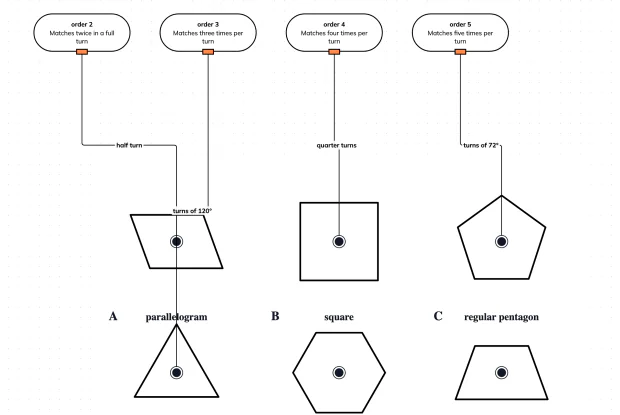
A shape has rotational symmetry when turning it about its centre lands it back on itself before a full turn is done. The order counts how many times that happens. Find the order of six shapes in an interactive playground.
How Do You Reflect a Shape in a Mirror Line?
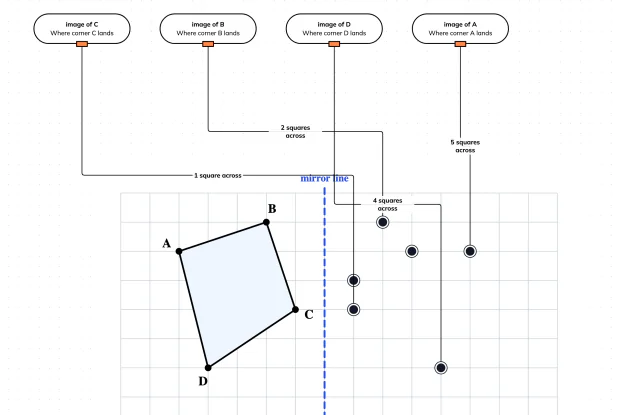
Reflecting a shape means sending every corner the same distance to the other side of a mirror line, along a path at right angles to it. Place all four corners of a quadrilateral in an interactive playground.
How Do You Translate a Shape?
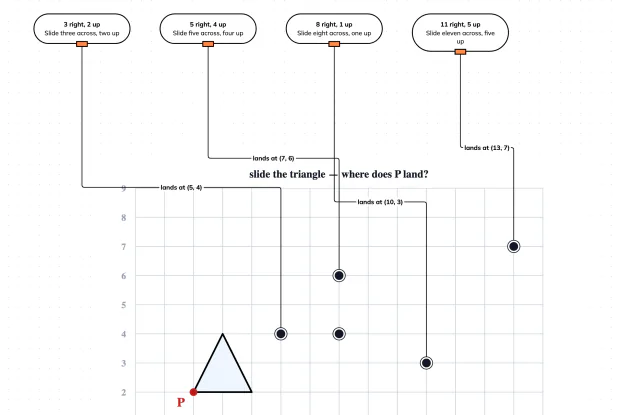
A translation slides every point of a shape by the same amount across and the same amount up. Nothing turns and nothing flips. Work out where a marked corner lands under four different slides in an interactive playground.
How Do You Rotate a Shape?
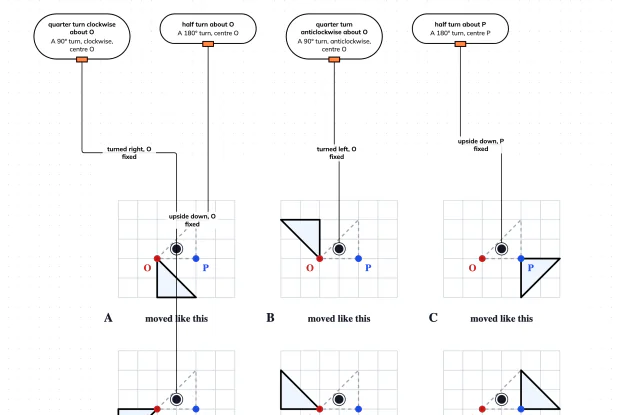
A rotation turns a shape about a fixed centre. Change the centre and the same angle sends the shape somewhere completely different. Match four turns to the pictures they produced in an interactive playground.
How Do You Enlarge a Shape from a Centre?
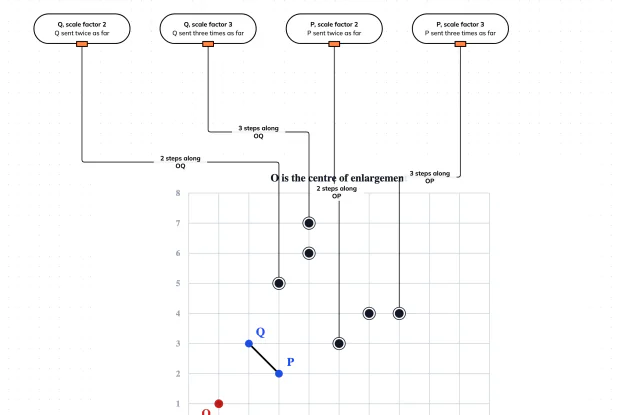
An enlargement multiplies every distance from a fixed centre by the same scale factor, so the shape changes size but not proportions. Place four enlarged points in an interactive playground.