What Is Rotational Symmetry?
Root Concept
A shape has rotational symmetry of order n when it lands on itself n times in one full turn.
CodePLU Goal
Upgrading Human Mental Models
Learn how to think in Workflows

Concept Development By codeplu.com
Every shape comes back to itself after a full turn, so order 1 is the floor, not a kind of symmetry.
What Happens If You Spin It?
The previous tutorial folded shapes. A line of symmetry is a fold line: crease along it and the two halves land exactly on top of each other. That is one way a shape can match itself, but it is not the only way.
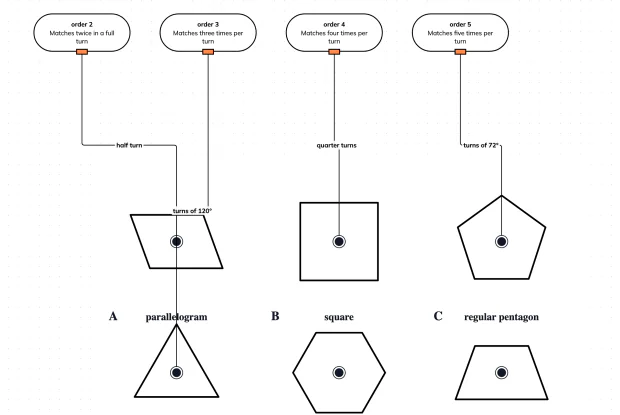
This one turns them instead. Pin a shape through its centre, turn it, and watch for the moments when it lands back in exactly the space it started in — same outline, same orientation, as though nothing had moved. A square does this four times in a full turn: at a quarter turn, a half turn, three quarters, and back at the start. That count is called the order of rotational symmetry, and for the square it is 4.
The two kinds of symmetry are genuinely different, and a shape can have one without the other. A parallelogram has no fold line at all, yet turn it half way round and it fits its own outline perfectly. In the playground below you will find the order of six shapes by turning each one about the red dot at its centre.
Counting the Order, and the Traps in It
What exactly are you counting?
Imagine drawing round the shape, then lifting it, turning it, and dropping it back into the outline. If it fits, that is a match. The order is the number of matches in one complete turn. Take the equilateral triangle: turn it 120° and it fits, 240° and it fits, 360° and it fits because you are back where you began. Three matches, so order 3. The angles are always a full turn shared equally, so order 3 means steps of 360 ÷ 3 = 120°, and order 5 means steps of 72°. Notice that the final match at 360° is always counted. That is a convention, and it is the reason the order of a shape is never zero.
Why does every shape have order at least 1?
Turn anything all the way round and it ends up exactly where it started. A scalene triangle, a random scribble, the letter R — every one of them matches itself after a full turn, so every one of them has at least one match. That is why order 1 is the smallest possible answer. It is also why order 1 is the way we say a shape has no rotational symmetry at all: the only match it has is the one every shape gets for free. This trips people up, because order 1 sounds like a little bit of symmetry rather than none. If a question asks whether a shape has rotational symmetry and the order is 1, the answer is no.
How do line symmetry and rotational symmetry differ?
They are independent, and the two shapes in the playground that no label asks for show it cleanly. A parallelogram has zero lines of symmetry — fold it any way you like and the halves never match — but it has order 2, because a half turn carries each corner onto the opposite one. An isosceles trapezium is the other way round: it has exactly one line of symmetry down the middle, and order 1, because no turn short of a full one brings it back. So you cannot read one from the other. Count the folds for line symmetry and count the turns for rotational symmetry, separately, every time.
Why do regular polygons make it easy?
A regular polygon has every side the same length and every angle the same size, so each corner is interchangeable with every other corner. Turn it by one corner-step and nothing has visibly changed. That means a regular polygon with n sides has rotational symmetry of order n: the pentagon is order 5, the hexagon order 6, the square order 4, and the equilateral triangle order 3. It also has n lines of symmetry, which is the one situation where the two counts agree — and agreeing here is what makes regular shapes feel so settled. The moment you break the regularity, as the parallelogram does, the two numbers part company again. That is also a quick check on your own work: if you have found a different order and a different number of lines for a shape you believe is regular, one of the two counts is wrong.
Real World Example
Why a Spinning Thing Must Match Itself
Rotational symmetry is not only decorative. Anything built to spin fast — a fan, a turbine, a car wheel, a drone propeller — has to be designed around it, and the order is one of the first numbers an engineer picks.
Step 1
Space the blades equally
A ceiling fan with four blades has them at 90° to each other, which gives the whole rotor rotational symmetry of order 4. That is not a style choice. Each blade has weight, and weight that is spread evenly around the centre pulls equally in every direction as the fan turns, so the pulls cancel out. Three blades at 120° would work just as well, giving order 3, and so would five at 72° for order 5. What matters is that the blades are identical and the angles between them are a full turn shared equally. The order of the design is exactly the number of blades, which is why you can read it off the ceiling without doing any maths at all.
Step 2
The order sets the smallest turn
With order 4, the fan looks identical after every quarter turn, so the forces it puts into its mounting repeat four times per revolution. Engineers care about that number because it tells them the frequency of the vibration the fan will produce: a fan spinning at 300 revolutions per minute with order 4 pushes on its bracket 1200 times a minute. They can then make sure that rate is nowhere near the rate at which the ceiling itself likes to wobble. A design with a higher order spreads the same work into smaller, more frequent pushes, which is one reason turbine rotors often carry a large number of small blades rather than a few big ones.
Step 3
Break the symmetry and it shakes
Chip one blade of a four-blade fan and the rotational symmetry is gone — the rotor no longer matches itself at a quarter turn, because one quarter is now lighter than the other three. The order drops from 4 to 1. The pulls stop cancelling, and what is left is a force that swings round once per revolution and shakes the whole fitting. You can feel the same thing in a washing machine when the load bunches to one side, and it is why a garage adds small weights to a car wheel: they are restoring the symmetry of the mass so that nothing is left over to rattle the steering at speed.
FAQs
Final Words
Rotational symmetry is the second way a shape can match itself: not by folding, but by turning about its centre. The order counts the matches in one full turn, the matching turns are always a full turn shared equally, and the count always includes the return to the start — which is why order 1 means no rotational symmetry rather than a little.
You also have a clean separation now. Folds and turns are counted apart, a parallelogram has turns without folds, a trapezium has a fold without turns, and only the regular polygons give the same answer both ways. Next the track stops describing symmetry a shape already has and starts moving shapes around: reflecting one across a mirror line, and finding exactly where each corner lands.
Continue This Track
This concept is part 2 of Symmetry and Moving Shapes.
What Is a Line of Symmetry?
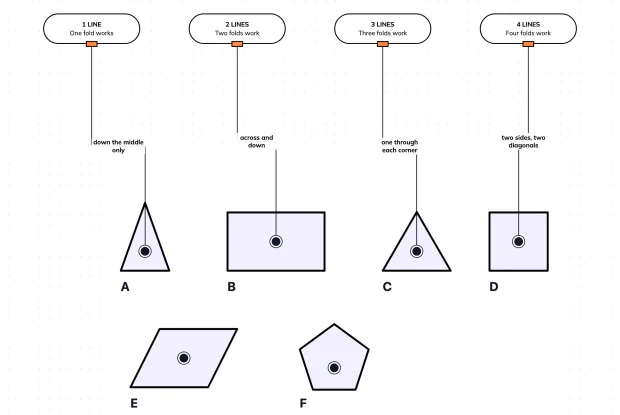
A line of symmetry is a fold that makes both halves land exactly on top of each other. Cutting a shape into two equal halves is not the same thing, which is why a parallelogram has no lines of symmetry at all. Count the folds on six shapes in an interactive playground.
What Is Rotational Symmetry?
A shape has rotational symmetry when turning it about its centre lands it back on itself before a full turn is done. The order counts how many times that happens. Find the order of six shapes in an interactive playground.
How Do You Reflect a Shape in a Mirror Line?
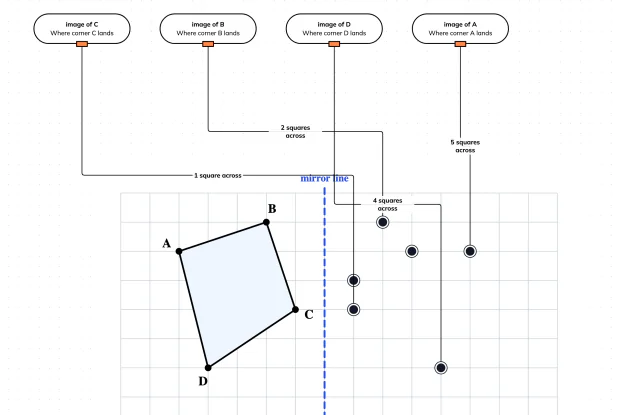
Reflecting a shape means sending every corner the same distance to the other side of a mirror line, along a path at right angles to it. Place all four corners of a quadrilateral in an interactive playground.
How Do You Translate a Shape?
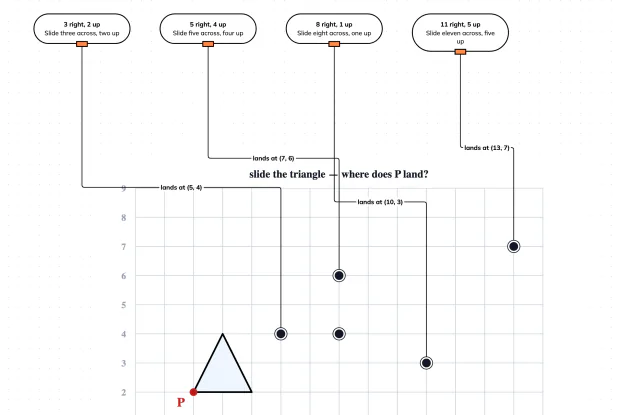
A translation slides every point of a shape by the same amount across and the same amount up. Nothing turns and nothing flips. Work out where a marked corner lands under four different slides in an interactive playground.
How Do You Rotate a Shape?
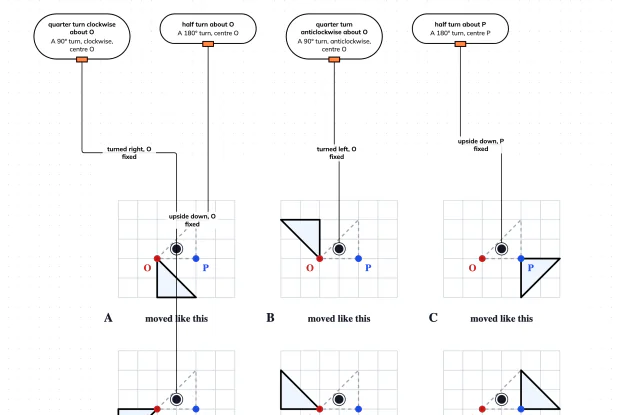
A rotation turns a shape about a fixed centre. Change the centre and the same angle sends the shape somewhere completely different. Match four turns to the pictures they produced in an interactive playground.
How Do You Enlarge a Shape from a Centre?
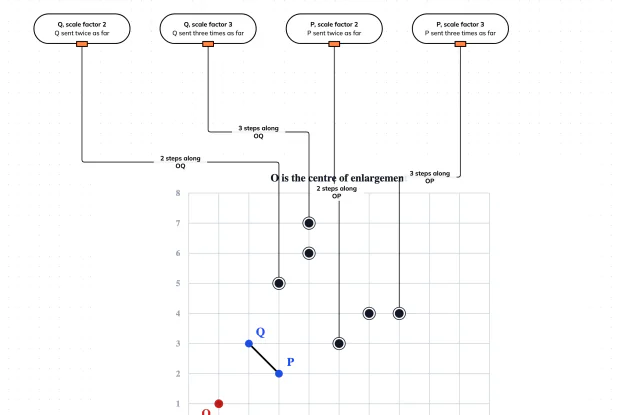
An enlargement multiplies every distance from a fixed centre by the same scale factor, so the shape changes size but not proportions. Place four enlarged points in an interactive playground.