How Do You Reflect a Shape in a Mirror Line?
Root Concept
The image of a point is the same distance from the mirror line, on the other side, at right angles.
CodePLU Goal
Upgrading Human Mental Models
Learn how to think in Workflows

Concept Development By codeplu.com
Reflect corner by corner, never shape by shape. Four correct corners draw the right image on their own.
From Symmetry a Shape Has to Symmetry You Make
The first two tutorials in this track asked what symmetry a shape already possesses: where it folds, and how it turns onto itself. This one changes the question. The shape no longer has to be symmetrical at all. Instead you are given a mirror line and asked to build the matching half yourself.
That is called reflecting the shape, and the result is its image. The rule is short enough to say in one sentence: every corner moves straight across the mirror and ends up the same distance away on the other side. Nothing else changes. The image is the same size and the same shape as the original — only turned about, as though you were reading it in a mirror.
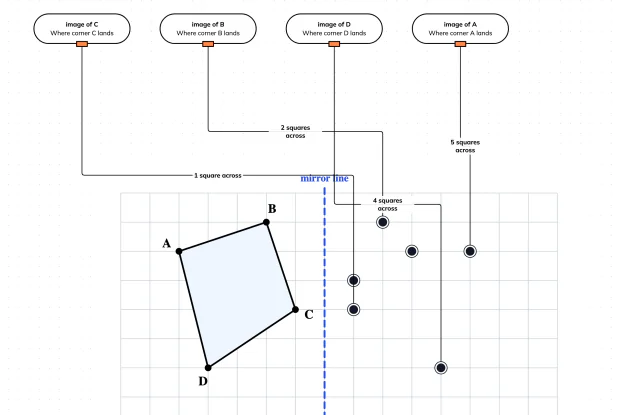
The important move is to stop thinking about the shape as a whole and work one corner at a time. Four corners placed correctly will draw the right quadrilateral between them without you having to picture the finished thing in advance. In the playground below you will place each of the four corners of a quadrilateral, counting squares to the mirror and the same number back out again.
The Rule, and the Three Places It Goes Wrong
What does "the same distance" actually mean?
Measure from the point to the mirror along the shortest path, which is the one that meets the mirror at a right angle. On squared paper with a vertical mirror that is simply counting squares straight across, staying in the same row. Corner C in the playground sits one square from the mirror, so its image sits one square the other side, in the same row. Corner A sits five squares away, so its image is five squares out. The point and its image are always a matched pair: if you drew the line joining them it would cross the mirror at a right angle and be cut exactly in half by it. That single sentence is the whole of reflection.
Why does the row never change?
Because the mirror here is vertical, and the journey across it is horizontal. Going straight across a vertical line moves you left or right and never up or down, so a corner in the third row has its image in the third row. This is the mistake worth watching for, because it is so easy to count the squares correctly and then let your finger drift a row while placing the dot. One of the tempting spare positions in the playground is exactly that: the right column for corner C, but one row out. If the mirror were horizontal instead, the rule would flip — the column would stay fixed and the row would change.
Is the image the same distance from the edge of the grid?
No, and this is the error the other spare position is built from. Distances are measured from the mirror, not from the edge of the paper or from the zero of any axis. Corner A sits five squares from the mirror, so its image is five squares past it. It is tempting instead to take A's position on the grid and count that many squares beyond the mirror, which gives a different point altogether. The two only agree when the mirror happens to sit on the axis itself. Get into the habit of asking "how far from the mirror?" rather than "where is it on the grid?", and the trap stops being a trap.
Does reflecting change the shape at all?
Not its size and not its angles. Every length in the image matches the corresponding length in the original, and every angle matches too, which is why reflection belongs to the family of transformations called congruences — the image is congruent to the object. What does change is the sense, or handedness. Walk round the original quadrilateral from A to B to C to D and you go one way round; walk round the image in the same order and you go the other way. It is the same difference as between your left and right hands, which are the same shape and still cannot be swapped. Reflection is the only one of the three movements in this track that does this.
Real World Example
Cutting a Paper Snowflake
Folding paper and cutting shapes out of the fold is reflection carried out physically. Following it through shows why the rule is about distance from the fold and nothing else.
Step 1
The fold is the mirror line
Fold a sheet of paper in half and the crease is a mirror line running across the sheet. Everything on one side now has a partner directly opposite it on the other, and the partner is exactly as far from the crease as the original is. That is not a coincidence of paper; it is the definition of reflection acting on every single point at once. A dot an inch from the crease meets a dot an inch from the crease on the other layer. If you pushed a pin through the folded sheet, the two holes it made would be a point and its image, and the line between them would cross the crease at a right angle.
Step 2
Cut once, get two
Now cut a notch into the folded edge. Your scissors pass through both layers at once, so the notch you remove from the top layer is removed from the bottom layer in the mirrored position. You did the work for one corner and the fold did the matching corner for free. This is the paper equivalent of what the playground asks you to do by hand: place a corner, and know its partner is determined. The difference is only that the paper cannot get it wrong, whereas counting squares can, which is why the counting is worth practising until it is automatic.
Step 3
Unfold and check the handedness
Open the paper and the two halves are identical but facing opposite ways. Trace round one half clockwise and the matching trace on the other half runs anticlockwise. Nothing has been stretched or shrunk — the halves are congruent — but they cannot be slid on top of each other without turning one over. That is the handedness change that separates a reflection from a slide or a turn, and it is why a single fold can never produce a shape that simply repeats. To get a repeat you need two folds, which is reflection done twice, and two reflections make a turn.
FAQs
Final Words
Reflection is the first of the three movements this track covers, and the rule behind it is a single sentence: each corner crosses the mirror at a right angle and lands the same distance away on the other side. Work corner by corner, keep the row fixed when the mirror is vertical, and measure from the mirror rather than from the edge of the grid, and the image draws itself.
You also know what reflection leaves alone and what it changes. Lengths and angles survive, so the image is congruent to the object, but the handedness reverses, which is what makes a reflection different from a turn. Next the track takes the simplest movement of the three — sliding a shape without turning or flipping it at all — and shows how two numbers describe the whole journey.
Continue This Track
This concept is part 3 of Symmetry and Moving Shapes.
What Is a Line of Symmetry?
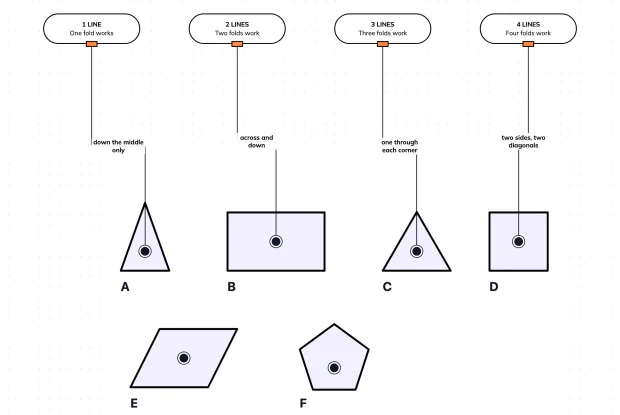
A line of symmetry is a fold that makes both halves land exactly on top of each other. Cutting a shape into two equal halves is not the same thing, which is why a parallelogram has no lines of symmetry at all. Count the folds on six shapes in an interactive playground.
What Is Rotational Symmetry?
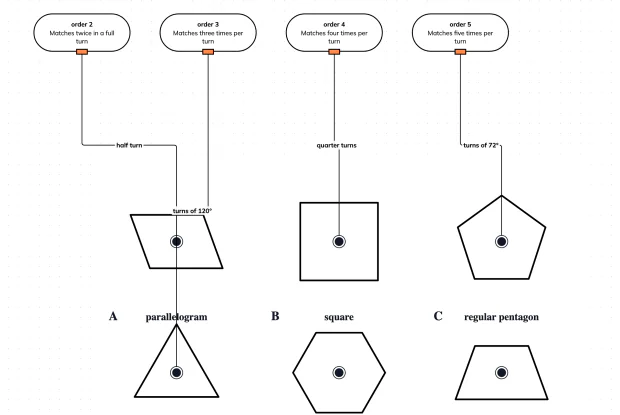
A shape has rotational symmetry when turning it about its centre lands it back on itself before a full turn is done. The order counts how many times that happens. Find the order of six shapes in an interactive playground.
How Do You Reflect a Shape in a Mirror Line?
Reflecting a shape means sending every corner the same distance to the other side of a mirror line, along a path at right angles to it. Place all four corners of a quadrilateral in an interactive playground.
How Do You Translate a Shape?
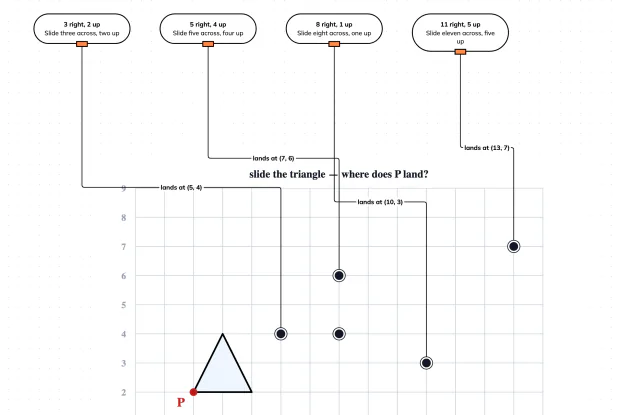
A translation slides every point of a shape by the same amount across and the same amount up. Nothing turns and nothing flips. Work out where a marked corner lands under four different slides in an interactive playground.
How Do You Rotate a Shape?
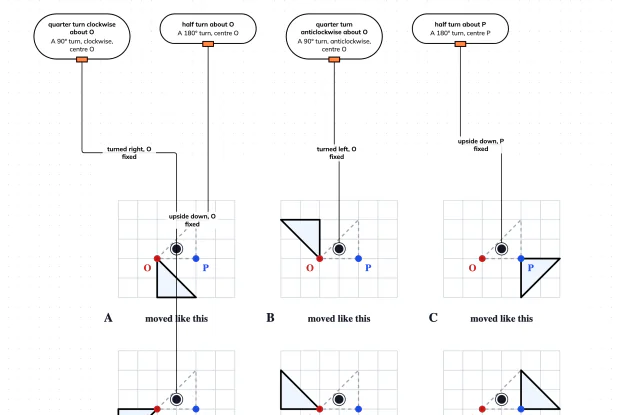
A rotation turns a shape about a fixed centre. Change the centre and the same angle sends the shape somewhere completely different. Match four turns to the pictures they produced in an interactive playground.
How Do You Enlarge a Shape from a Centre?
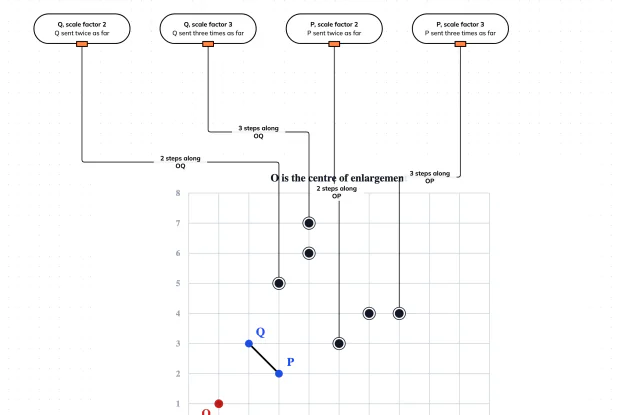
An enlargement multiplies every distance from a fixed centre by the same scale factor, so the shape changes size but not proportions. Place four enlarged points in an interactive playground.