How Do You Subtract a Negative Number?
Root Concept
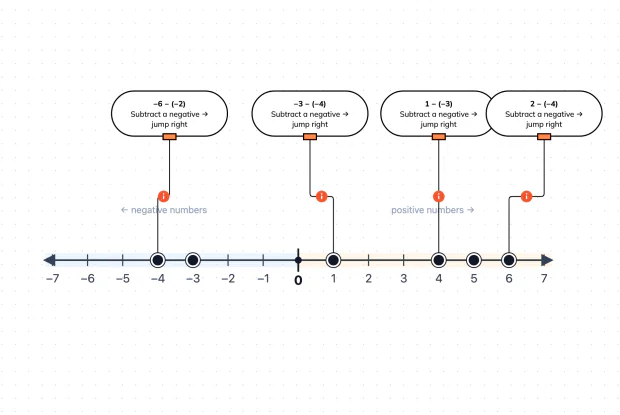
Subtracting a number is a jump along the number line in the opposite direction to adding. Subtracting a positive jumps left, and subtracting a negative jumps right — so a − (−b) lands in the same place as a + b. To solve one, start on the first number and jump right as many steps as the negative you are taking away.
CodePLU Goal
Upgrading Human Mental Models
Learn how to think in Workflows

Concept Development By codeplu.com
Subtracting a negative: start on the first number and jump right as many steps as the negative you are taking away — two minuses turn into a move the positive way.
What Does It Mean to Take Away a Number Below Zero?
Subtracting is the opposite of adding, and on the number line it is a jump the opposite way. Adding a positive stepped you to the right; subtracting a positive steps you back to the left. So 6 − 4 means 'start on 6 and step 4 to the left', landing on 2 — the answer you already know. Subtracting is a jump left, the mirror of adding.
So what happens when the thing you take away is itself a negative number, like in 6 − (−4)? Here is the surprise that catches everyone out: you jump to the right. Taking away a negative turns you around and sends you the positive way. The two minus signs — one for 'subtract' and one for 'negative' — team up and become a single jump to the right. That is the whole idea of this tutorial: subtracting a negative is the same as adding.
You can read the two signs as a little rule: minus a minus makes a plus. So 6 − (−4) is exactly the same as 6 + 4, which is 10. In the playground you will take four sums, each one taking away a negative, and solve them the same way every time: start on the first number, jump right, and connect the sum to the point where you land.
How Does Subtracting on the Number Line Work?
What does subtracting do on the number line?
Subtracting is a move along the number line, just like adding — but in the opposite direction. Where adding a number steps you towards it, subtracting steps you away. Take away a positive number and you move to the left: 5 − 3 means 'start on 5, step 3 left', landing on 2. This is the mirror of adding, and it works the same whether you start on a positive or a negative number. Start on −2 and subtract 3, and you step 3 further left to −5. The rule so far is simple: subtracting a positive number always jumps you to the left. The interesting question is what happens when the number you are taking away is a negative one — because then this rule flips around.
Why does subtracting a negative move you right?
A minus sign is a direction word: it means 'turn around and go the other way'. Subtracting already turns you around once, so you face left. But if the number you are taking away is negative, its own minus sign turns you around a second time — and two turns bring you back to facing right. That is why 'minus a minus makes a plus': two turnabouts cancel out. There is an everyday way to feel it too. Taking away something bad makes things better. If you owe £4 and someone cancels that debt — takes away the −4 — you are £4 better off, as if you had gained 4. So 6 − (−4) does not make 6 smaller; it makes it bigger, landing on 10, exactly where 6 + 4 lands.
How do you solve one, step by step?
Use the same steps every time. First, spot the two signs sitting together, like the − (− in 1 − (−3); read them as 'minus a minus makes a plus', so you know you will jump to the right. Second, put your finger on the first number — that is where you start. Third, count that many steps to the right, one tick at a time, going through zero if you reach it. Fourth, read where you stopped — that is the answer. Take 1 − (−3): the two minuses make a plus, so start on 1 and jump 3 to the right — 1, 2, 3, 4 — landing on 4, the same as 1 + 3. That is exactly what you do for each of the four cards in the playground.
Real World Example
When Does Taking Away a Negative Show Up in Real Life?
Subtracting a negative feels strange until you meet it in real situations, where 'take away something below zero' turns out to mean 'go up'. Here are three:
How much warmer is it now?
The gap up from a below-zero temperature
Last night it was −3°C, and this afternoon it is 4°C. How many degrees warmer is it? To find the gap between two numbers you subtract them: 4 − (−3). On the thermometer you start at −3 and count up to 4 — −3, −2, −1, 0, 1, 2, 3, 4 — which is 7 steps, so it is 7 degrees warmer. Notice you jumped to the right (upward) and the answer, 7, is bigger than either temperature. That is subtracting a negative in action: 4 − (−3) gives the same 7 as 4 + 3. Any time you measure how far it is up from something below zero, you are taking away a negative.
A debt gets cancelled
Removing money you owe makes you richer
Suppose your account is at −£4 — you are £4 overdrawn, owing the bank four pounds. Then the bank cancels the charge and removes that −£4. Taking away the −4 is written as a subtraction of a negative, and it leaves you £4 better off than before: your balance jumps right, up towards zero and beyond. If two such −£4 debts were both wiped, you would be £8 better off. This is the clearest real feeling for the rule 'minus a minus makes a plus': removing something that was dragging you down is the same as adding that amount. Getting rid of a negative is a gain.
A penalty gets taken back
Undoing a lost-points card lifts your score
Imagine a board game where you picked up a card that said 'lose 5 points', dropping your score by 5. A turn later you land on a square that cancels your last penalty — it takes back the −5. Taking away that −5 lifts your score by 5, jumping you to the right on the score line, exactly as if you had won 5 points. So 'subtract negative five' and 'add five' end in the same place. Games are full of these undo moments, and each one is a quiet lesson that removing a negative moves you in the positive direction.
FAQs
Final Words
Subtracting is a jump the opposite way to adding: take away a positive and you go left, but take away a negative and you turn right around and go right. The two minus signs — one for 'subtract' and one for the negative number — cancel into a single jump the positive way, which is why minus a minus makes a plus and why a − (−b) lands exactly where a + b does. To solve one, change the double minus to a plus, start on the first number, and count that many steps to the right.
You have now seen a minus sign play two roles: a direction on the line, and a label for a negative number. Adding and subtracting negatives are really about which way you jump. The next question is a different kind of minus altogether — what happens when you multiply negative numbers, and why does a negative times a negative come out positive?
Continue This Track
This concept is part 4 of Making Sense of Negative Numbers.
What Is a Negative Number?
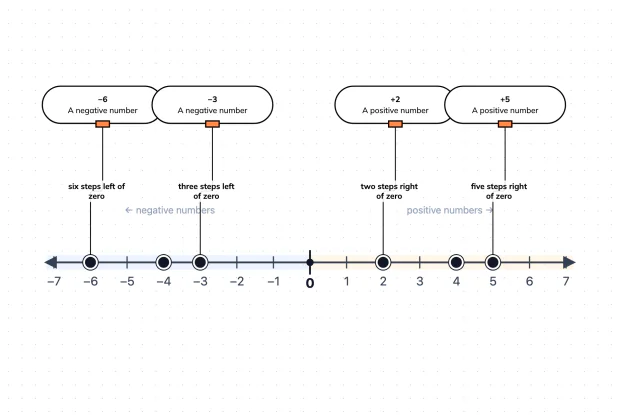
A negative number is a number to the left of zero on the number line. Meet the number line — zero in the middle, positives to the right, negatives to the left — and practise placing negative numbers by counting steps from zero, in an interactive playground.
What Is the Absolute Value of a Number?
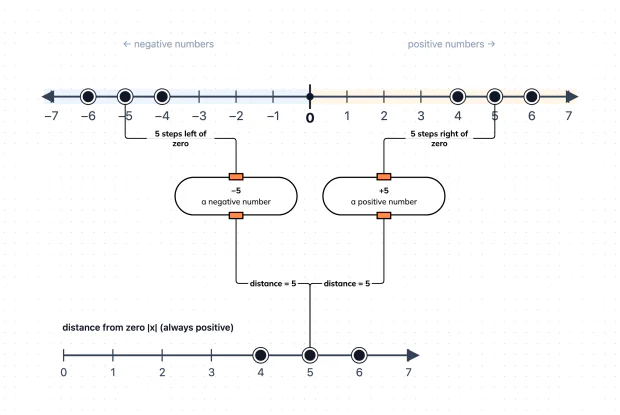
The absolute value of a number is its distance from zero, so it is never negative and −5 and +5 are both 5. Learn the fold-at-zero idea, then match each number to its distance in an interactive playground.
How Do You Add a Negative Number?
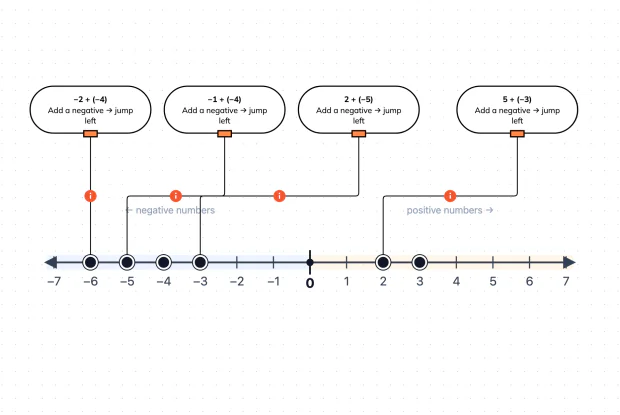
Adding a negative number moves you to the left on the number line. Learn the jump-left rule, then solve four sums by jumping to the answer in an interactive number-line playground.
How Do You Subtract a Negative Number?
Subtracting a negative number moves you to the right on the number line — two minuses make a plus. Learn the rule, then solve four sums by jumping to the answer in an interactive number-line playground.
Why Does a Negative Times a Negative Make a Positive?
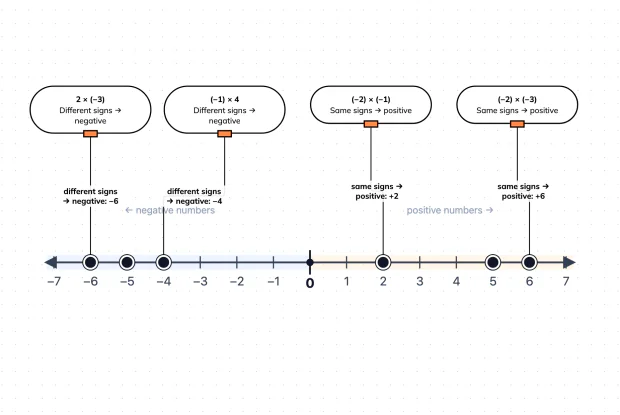
Multiplying negative numbers follows two sign rules: different signs make a negative, same signs make a positive. Learn why a negative times a negative comes out positive, then land four products on the number line.
How Do You Divide Negative Numbers?
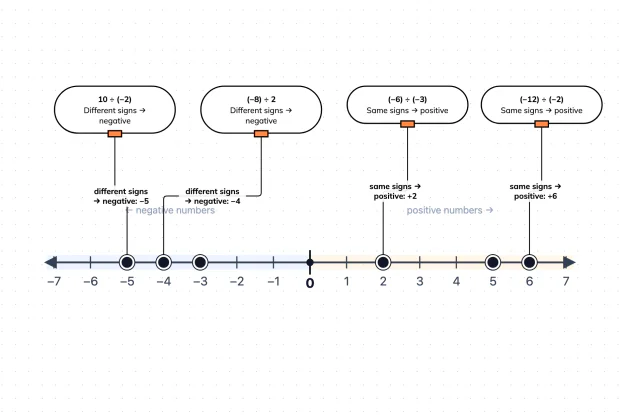
Dividing negative numbers uses the same two sign rules as multiplying: different signs make a negative answer, same signs make a positive one. Land four divisions on the number line to practise.
Order of Operations With Negative Numbers
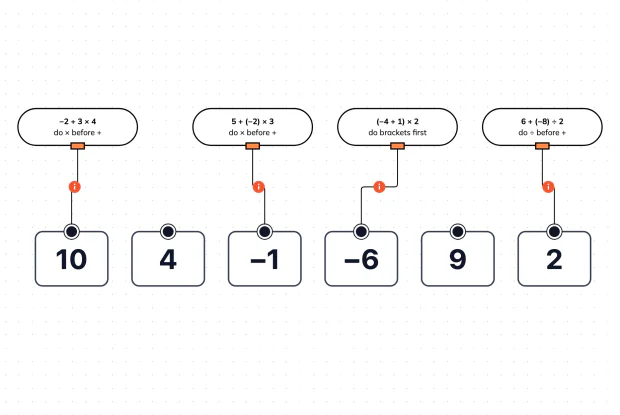
The order of operations does not change with negatives: brackets, then ×÷, then +−. Work out four expressions with negatives in the right order in an interactive playground.
Multiplying and Dividing Negative Fractions
Combine the fraction method with the sign rules: do the fraction, then set the sign (same signs positive, different signs negative). Practise four problems in an interactive playground.