How Do You Add a Negative Number?
Root Concept
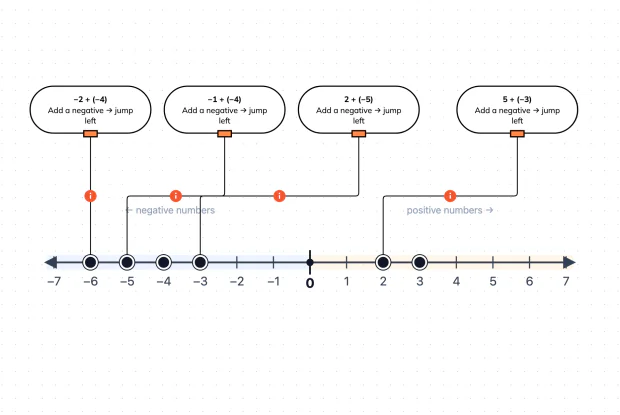
Adding a number is a jump along the number line: adding a positive jumps right, and adding a negative jumps left. To work out a sum like 2 + (−5), start on the first number and jump left as many steps as the number you are adding, then read where you land.
CodePLU Goal
Upgrading Human Mental Models
Learn how to think in Workflows

Concept Development By codeplu.com
Adding a negative: start on the first number and jump left as many steps as the number you are adding — then read where you land.
What Happens When You Add a Number That Is Below Zero?
You already know how to add when both numbers are the ones you count with: 3 + 2 is 5, and on the number line that is like standing on 3 and taking two steps to the right to land on 5. Adding always means moving along the line, and up to now you have only ever moved one way — to the right, because you were only adding positive numbers.
But numbers carry on to the left of zero too, and you are allowed to add those as well. When you add a negative number — like in 3 + (−2) — something surprising happens: instead of moving right, you move to the left. Adding a negative pulls you back down the line, towards zero and past it. That is the one idea this whole tutorial is about: a plus sign followed by a negative number means 'jump left'.
So the sign of the number you are adding is really a direction. Add a positive, step right; add a negative, step left. The size of the number tells you how many steps to take. In the playground you will take four sums, each with a negative in it, and solve them the same way every time: start on the first number, jump left, and connect the sum to the point where you land.
How Does Adding on the Number Line Work?
What does adding actually do on the number line?
Every addition is a move along the number line. You start standing on the first number, and the second number tells you how to move. If the second number is positive, you step to the right; if it is negative, you step to the left. The size of that number is how many steps you take. So 4 + 3 means 'start on 4, step 3 to the right', landing on 7 — the answer you already knew. Nothing about this changes when negatives join in; you use the exact same rule. The only new thing is that now the move can go the other way, to the left, and it can carry you down through zero into the negative side. Once you see adding as moving, negatives stop being scary — they are just a move in the opposite direction.
Why does adding a negative move you left?
Think about what a negative number is: it is a number on the left side of zero, and its minus sign is a label pointing left. When you add it, you are adding that leftward pull to where you already are. Adding +4 pushes you 4 to the right; adding −4 pushes you 4 to the left — the mirror move. This is why 5 + (−3) does not make things bigger. You start on 5 and get pulled 3 steps left, landing on 2. In fact, adding a negative always lands you in the same place as taking that many away: 5 + (−3) gives the same answer as 5 − 3. That is the secret hiding inside every 'add a negative' sum — it is a step backwards, so the total comes out smaller, not bigger.
How do you solve one, step by step?
Use the same four steps every single time. First, put your finger on the first number — that is where you start. Second, look at the number being added and find its minus sign; a minus means you will jump left. Third, count that many steps to the left, one tick at a time, going through zero if you reach it. Fourth, read the number where you stopped — that is your answer, and if you landed on the left of zero it is a negative answer. Take 2 + (−5): start on 2, jump 5 to the left — 2, 1, 0, −1, −2, −3 — and land on −3. That is the whole method, and it is exactly what you do in the playground for each of the four cards.
Real World Example
Where Do You Already Add Negative Numbers?
Adding a negative is not a strange classroom trick. It is what happens whenever a starting amount gets pulled down by something. Here are three everyday versions:
The temperature drops overnight
A start temperature plus a fall is a jump left
Imagine it is 3°C in the evening and the forecast says the temperature will fall by 5 degrees overnight. To find the morning temperature you add the change to the start: 3 + (−5), because a fall of 5 is a negative change. On a thermometer — which is just a number line stood upright — you begin at 3 and slide 5 marks down: 3, 2, 1, 0, −1, −2. You land on −2, so the morning is −2°C, two degrees below freezing. Nobody says 'add negative five' out loud; they say 'it dropped five degrees'. But a drop is exactly adding a negative, and the thermometer shows you the jump left, straight down through zero.
Going down in a lift
Your floor plus a downward move can land below ground
Suppose you are on floor 2 of a building and you take the lift down 5 floors to reach the lower car park. Your new floor is 2 + (−5), because going down is the negative direction. Starting at floor 2 and moving 5 down takes you through floor 1, the ground floor (0), and on into the basement levels −1, −2, −3 — so you arrive at floor −3. The lift buttons are a number line stood on end, with the ground floor as zero. Pressing a lower button and dropping past the ground is the real-world jump left, and the floor you step out on is your answer to the sum.
Points you can lose in a game
Your score plus a penalty can drop below zero
Lots of games let your score go below zero. Say you have 4 points and then you land on a square that costs you 6 points. Your new score is 4 + (−6), because losing 6 is adding a negative six. Start on 4 and jump 6 to the left: 4, 3, 2, 1, 0, −1, −2. You end on −2, so now you are 2 points 'in the hole' — a score of −2. This is the same idea as owing money: if you have £4 and you spend £6, you are £2 short, which we write as −£2. Every time a penalty or a cost is bigger than what you started with, adding it carries you left, straight past zero into the negatives.
FAQs
Final Words
Adding is moving along the number line, and the sign of the number you add is the direction: add a positive and you step right, add a negative and you step left. To solve any 'add a negative' sum, start on the first number, jump left as many steps as that number, cross zero if you reach it, and read where you land. That is why adding a negative always makes the total smaller — it is really a step backwards, the very same jump as taking that amount away.
You may have noticed the clue hiding in the last idea: 5 + (−3) landed in exactly the same place as 5 − 3. That is not a coincidence, and it is the door into the next question — what happens when you subtract a negative number? If adding a negative sends you left, subtracting one is about to send you the other way.
Continue This Track
This concept is part 3 of Making Sense of Negative Numbers.
What Is a Negative Number?
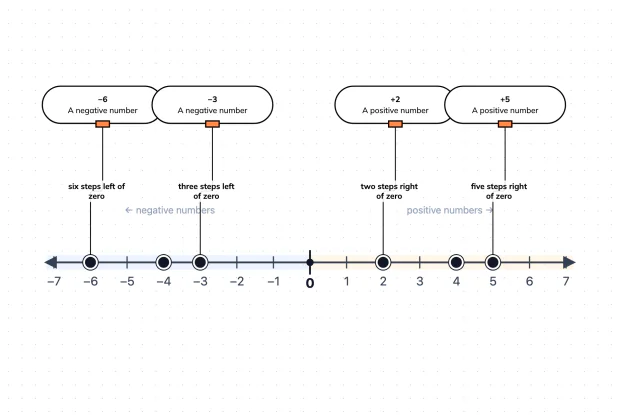
A negative number is a number to the left of zero on the number line. Meet the number line — zero in the middle, positives to the right, negatives to the left — and practise placing negative numbers by counting steps from zero, in an interactive playground.
What Is the Absolute Value of a Number?
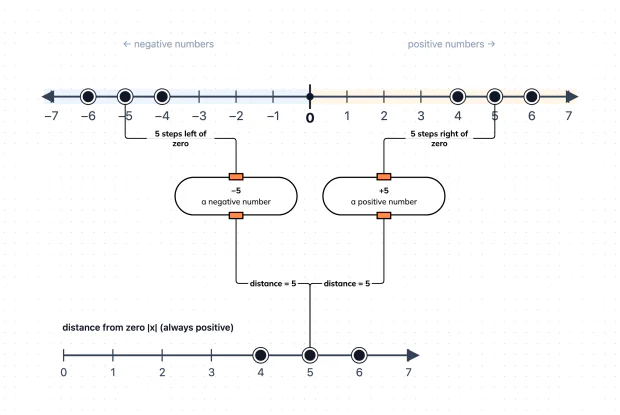
The absolute value of a number is its distance from zero, so it is never negative and −5 and +5 are both 5. Learn the fold-at-zero idea, then match each number to its distance in an interactive playground.
How Do You Add a Negative Number?
Adding a negative number moves you to the left on the number line. Learn the jump-left rule, then solve four sums by jumping to the answer in an interactive number-line playground.
How Do You Subtract a Negative Number?
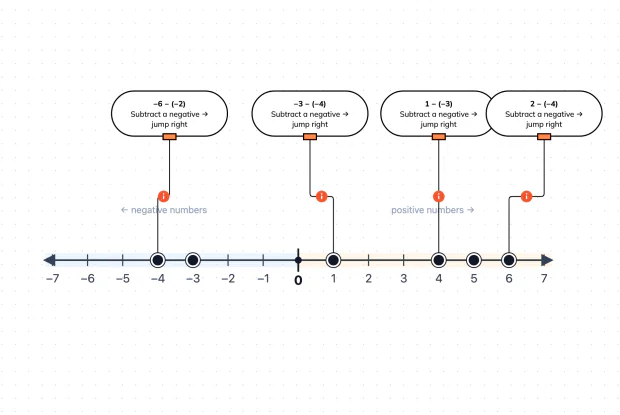
Subtracting a negative number moves you to the right on the number line — two minuses make a plus. Learn the rule, then solve four sums by jumping to the answer in an interactive number-line playground.
Why Does a Negative Times a Negative Make a Positive?
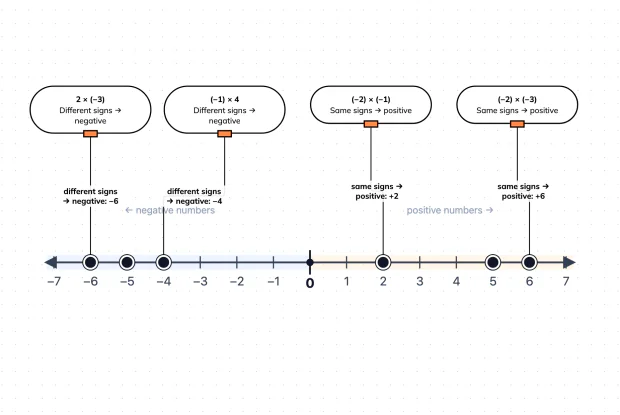
Multiplying negative numbers follows two sign rules: different signs make a negative, same signs make a positive. Learn why a negative times a negative comes out positive, then land four products on the number line.
How Do You Divide Negative Numbers?
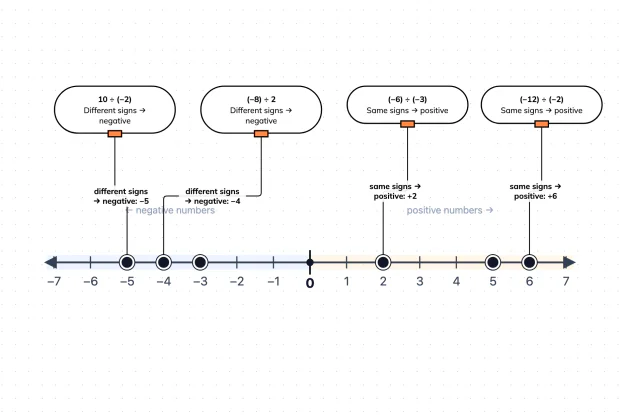
Dividing negative numbers uses the same two sign rules as multiplying: different signs make a negative answer, same signs make a positive one. Land four divisions on the number line to practise.
Order of Operations With Negative Numbers
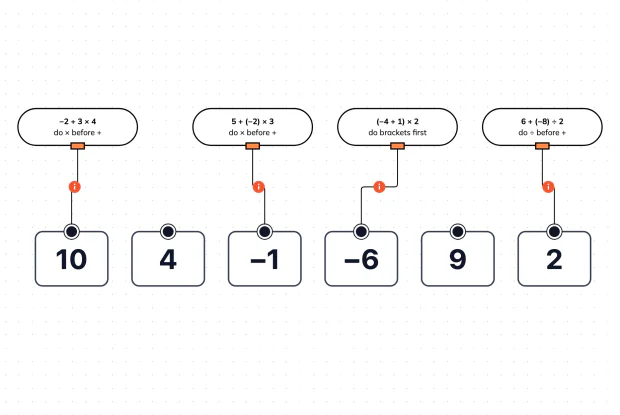
The order of operations does not change with negatives: brackets, then ×÷, then +−. Work out four expressions with negatives in the right order in an interactive playground.
Multiplying and Dividing Negative Fractions
Combine the fraction method with the sign rules: do the fraction, then set the sign (same signs positive, different signs negative). Practise four problems in an interactive playground.