What Is the Absolute Value of a Number?
Root Concept
The absolute value of a number, written with two bars as |x|, is its distance from zero on the number line. Distance has no direction, so absolute value is never negative: a number and its opposite have the same absolute value, and |−5| = |+5| = 5. To find it, drop the sign and count the steps from zero.
CodePLU Goal
Upgrading Human Mental Models
Learn how to think in Workflows

Concept Development By codeplu.com
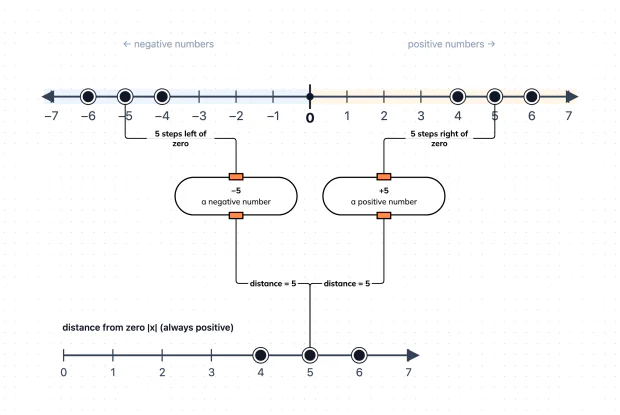
−5 and +5 sit on opposite sides of zero on the number line, yet both are 5 steps away — so both have absolute value 5.
Why Do −5 and 5 Have the Same Absolute Value?
Every number on the number line sits a certain number of steps away from zero. +5 is five steps to the right of zero, and −5 is five steps to the left. They point in opposite directions, but they are the same distance away — five steps either way. That distance from zero is what we call a number's absolute value.
Because absolute value only measures how far, not which way, the direction stops mattering. The steps to the left count exactly the same as the steps to the right. So −5 and +5 both have an absolute value of 5, and we write it with two straight bars around the number: |−5| = 5 and |+5| = 5. The bars mean 'how far is this from zero?'.
This also means absolute value can never be negative — a distance is never less than nothing. The smallest it can be is zero, which is only the absolute value of 0 itself. In the playground you will take just two numbers, −5 and +5, and for each one show two things: where it sits on the number line (which side of zero) and how far it is from zero on the distance scale. Both land on 5 — and that shared distance is the whole idea.
How Does Absolute Value Work?
What does absolute value measure?
Absolute value measures distance from zero, and nothing else. Pick any number, find it on the number line, and count how many steps it is away from zero — that count is its absolute value. The direction you counted in does not matter: left and right both add up the same way. We write absolute value by wrapping the number in two upright bars, like |−4| or |7|, which you can read as 'the distance of this number from zero'. So |−4| asks 'how far is −4 from zero?' — four steps — and the answer is 4. Notice the bars are not brackets for a calculation; they are an instruction to ignore the sign and report the distance. This is why absolute value turns a question about a signed number into a plain, everyday measure of how far away it is.
Why is it never negative?
A distance can never be negative. You would never say a friend lives '−3 streets away' or that the shop is 'minus five minutes' from home — distance is just a count of how far, and the smallest it can be is zero, when you have not moved at all. Absolute value works the same way. However negative the number inside the bars looks, its absolute value comes out zero or positive, because it is only reporting the distance. |−8| is 8, |−1| is 1, and |0| is 0, because zero is no distance from itself. This is the one rule people remember most about absolute value: the answer is never negative. The minus sign on the number tells you which side of zero it is on, and the bars simply throw that direction away and keep the size.
Same distance, opposite sides: −5 and +5
Look at the two numbers in the playground. On the number line, −5 sits five steps to the LEFT of zero and +5 sits five steps to the RIGHT — opposite sides, because their signs are opposite. That is what each number's connection to the number line shows: which side of zero it belongs on. But now measure how far each is from zero, and something changes: both are exactly 5 steps away. That is why both connect to the same 5 on the distance scale. The signs put them on opposite sides, yet the distance is identical, so |−5| and |+5| are both 5. A number and its opposite are always mirror images across zero: same distance out, different direction. Absolute value keeps the distance and drops the direction — which is exactly the difference between the top line and the bottom line in the playground.
Real World Example
Where Do You Already Measure 'How Far, Not Which Way'?
Absolute value is just the everyday idea of distance, where going one way or the opposite way counts the same. Here are two clear examples, one for a positive number and one for a negative:
+5: five blocks east of home
A positive position, five blocks away
Imagine your home is zero on a street that runs east and west, with east being the positive direction. A friend who lives 5 blocks east is at +5 on this line — five blocks to the right of home. If someone asks 'how far away do they live?', the answer is simply 5 blocks. The plus sign tells you which way to set off (east, the positive side), but the distance — the thing that decides how long the walk takes — is just 5. That distance, with no sign attached, is the absolute value: |+5| = 5. For a positive number this feels obvious, because the number is already positive; the absolute value is the number itself.
−5: five blocks west of home
A negative position, still five blocks away
Now a second friend lives 5 blocks the other way, to the west, which is the negative direction. Their position is −5 — five blocks to the left of home. But ask the same question, 'how far away do they live?', and the answer is again 5 blocks. The walk is exactly as long as the walk east; only the direction is different. So even though the position is −5, the distance is 5, and the absolute value is |−5| = 5 — the minus sign, which only told you to head west, is dropped. This is the key: −5 and +5 are on opposite sides of home, yet both are 5 blocks away, so both have the same absolute value. Distance never cares which way you went.
FAQs
Final Words
The absolute value of a number is simply its distance from zero, written with two bars as |x|. Distance has no direction, so absolute value is never negative, and a number and its opposite always share one — |−5| and |+5| are both 5, while |0| is 0. To find it, drop the sign and count the steps from zero. The playground made the two halves of this visible: the number line shows which side of zero a number is on, and the distance scale shows how far — and −5 and +5, on opposite sides, both reach 5.
Absolute value gives you a way to talk about the size of a number on its own, apart from its sign. That turns out to be exactly what you need for the next question about negatives: when you compare two of them, which one is really bigger? Knowing how far each is from zero is the key to seeing why −5 is smaller than −2, even though 5 is bigger than 2.
Continue This Track
This concept is part 2 of Making Sense of Negative Numbers.
What Is a Negative Number?
A negative number is a number to the left of zero on the number line. Meet the number line — zero in the middle, positives to the right, negatives to the left — and practise placing negative numbers by counting steps from zero, in an interactive playground.
What Is the Absolute Value of a Number?
The absolute value of a number is its distance from zero, so it is never negative and −5 and +5 are both 5. Learn the fold-at-zero idea, then match each number to its distance in an interactive playground.
How Do You Add a Negative Number?
Adding a negative number moves you to the left on the number line. Learn the jump-left rule, then solve four sums by jumping to the answer in an interactive number-line playground.
How Do You Subtract a Negative Number?
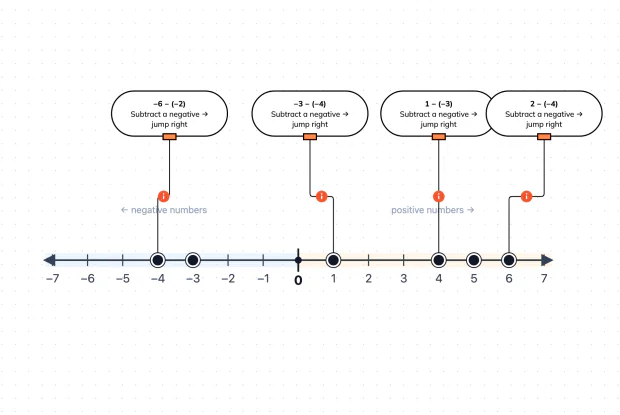
Subtracting a negative number moves you to the right on the number line — two minuses make a plus. Learn the rule, then solve four sums by jumping to the answer in an interactive number-line playground.
Why Does a Negative Times a Negative Make a Positive?
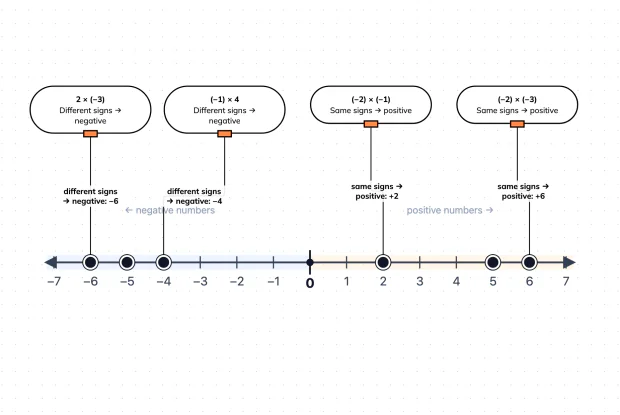
Multiplying negative numbers follows two sign rules: different signs make a negative, same signs make a positive. Learn why a negative times a negative comes out positive, then land four products on the number line.
How Do You Divide Negative Numbers?
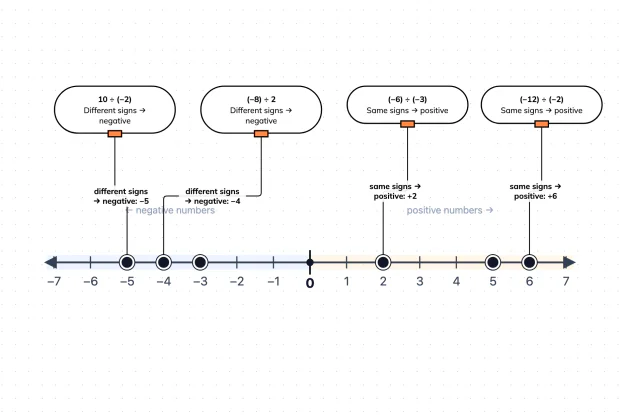
Dividing negative numbers uses the same two sign rules as multiplying: different signs make a negative answer, same signs make a positive one. Land four divisions on the number line to practise.
Order of Operations With Negative Numbers
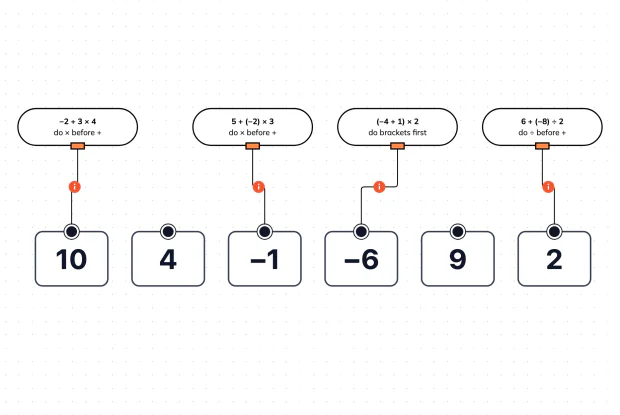
The order of operations does not change with negatives: brackets, then ×÷, then +−. Work out four expressions with negatives in the right order in an interactive playground.
Multiplying and Dividing Negative Fractions
Combine the fraction method with the sign rules: do the fraction, then set the sign (same signs positive, different signs negative). Practise four problems in an interactive playground.