Order of Operations With Negative Numbers
Root Concept
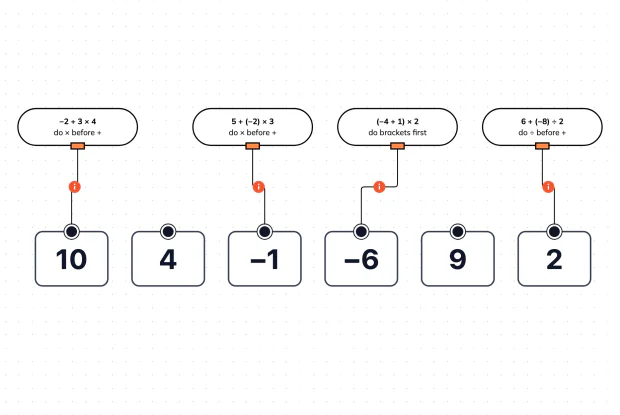
When negative numbers appear in an expression, the order of operations is exactly the same — brackets, then powers, then multiply and divide, then add and subtract — you just carry each number's sign carefully through every step. So in 5 + (−2) × 3 you multiply first: (−2) × 3 = −6, then 5 + (−6) = −1.
CodePLU Goal
Upgrading Human Mental Models
Learn how to think in Workflows

Concept Development By codeplu.com
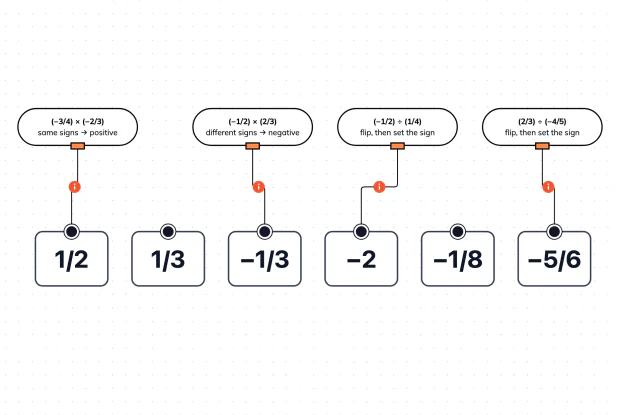
Four expressions with negatives, each worked out in the correct order — the tiles 4 and 9 are the wrong-order answers
Does the Order Change When Negative Numbers Show Up?
You already know the order of operations: work out brackets first, then powers, then multiplication and division, and finally addition and subtraction. It is the agreed order that makes sure everyone gets the same answer from the same expression. The good news is simple: that order does not change one bit when negative numbers appear.
A negative number does not get to jump the queue. In 5 + (−2) × 3, the multiplication still happens before the addition — you do (−2) × 3 first, which is −6, and only then add: 5 + (−6) = −1. The minus signs come along for the ride, but they do not change which operation you do first. So there is nothing new to learn about the order itself.
What you do have to do is keep track of the signs while you follow the order. Each step now needs two things right: the correct operation at the correct time, and the correct sign for the result. In the playground you will work out four expressions that contain negatives, each in the proper order, and land each on its value — while some tiles show the answer you would get by rushing and using the wrong order.
How Do You Handle the Order With Negatives?
The order stays exactly the same
The rule does not change: brackets first, then powers, then multiplication and division (working left to right), then addition and subtraction (left to right). Adding negative numbers into an expression does not alter this order at all. It is a common worry that a minus sign somehow changes the priorities, but it does not — a negative number is treated just like any other number when deciding what to do first. So in −2 + 3 × 4, the multiplication 3 × 4 is done before the addition, exactly as it would be without the negative: 3 × 4 = 12, then −2 + 12 = 10. If you already know the order of operations, you already know the order for negatives. The only extra care is with the signs, not the sequence.
Two things to get right: order and sign
With negatives, every step asks two questions: which operation comes next, and what sign does the result have? First follow the order to pick the operation. Then apply what you know about signs: for multiplying and dividing, different signs give a negative and same signs give a positive (so −2 × 3 = −6); for adding and subtracting, think of moving along the number line (adding a negative moves left, subtracting a negative moves right). Do these together, one step at a time. Take 5 + (−2) × 3: the order says multiply first, and the signs say −2 × 3 = −6, giving 5 + (−6); then the addition, 5 + (−6) = −1. Getting the answer right means getting both the order and the sign right at each step.
Work one step at a time
The safest way through any expression with negatives is to do exactly one operation at a time, rewriting the whole expression after each step so nothing gets lost. Take 6 + (−8) ÷ 2. Step one: the order says division before addition, so work out (−8) ÷ 2 = −4, and rewrite the expression as 6 + (−4). Step two: now only addition is left, so 6 + (−4) = 2. By replacing one piece at a time and keeping every sign attached to its number, you never have to juggle the whole thing in your head at once. Brackets get done first of all — in (−4 + 1) × 2 you finish the bracket, −4 + 1 = −3, before multiplying by 2 to get −6. Slow, tidy steps beat fast, messy ones every time when signs are involved.
Real World Example
Where Order and Negatives Meet in Real Life
Getting the order right with negatives is not just an exam skill; real situations depend on it. Here are three:
Money owed, several times over
Multiply the charge before adding the balance
Suppose you have £5 in an account, and three separate £2 charges are about to come out. Each charge is −£2, and there are 3 of them, so the change is 3 × (−2). To find your new balance you must handle that multiplication before adding it to your £5: 5 + 3 × (−2) = 5 + (−6) = −1, so you end up £1 overdrawn. If you rushed and added left to right — (5 + 3) × (−2) — you would get −16, a completely wrong and alarming figure. Banks, of course, apply the charges (the multiplication) first and then combine with your balance. The order of operations is what turns a jumble of pluses and minuses into the one correct balance.
Temperature changes at a rate
Work out the total drop before combining
Imagine it is 6°C now, and the temperature will fall 8 degrees over the next 2 hours steadily — but you want the change per hour combined with the start in one expression like 6 + (−8) ÷ 2. The order of operations tells you to do the division first: (−8) ÷ 2 = −4 degrees, the change per hour, and then 6 + (−4) = 2°C after one hour. Doing the division before the addition is not optional; adding first would mix an hourly rate with a starting temperature and give nonsense. Whenever a rate (a division) and a starting value are combined in one expression, the order of operations makes sure the rate is worked out before it is applied — keeping the negative sign correct all the way through.
Scores with penalties
Apply grouped penalties before the running total
In many games your score combines a running total with penalties that are grouped or repeated. Say you are on −4 and 1 bonus point is added, then that result is doubled by a special square: (−4 + 1) × 2. The brackets tell you to settle the inside first — −4 + 1 = −3 — before doubling: −3 × 2 = −6. Ignore the brackets and you would wrongly double only part of it. This is the order of operations protecting the meaning of the expression: the brackets say 'these belong together, finish them first', and the negative simply travels through the steps. Games, spreadsheets and calculators all follow exactly this order so that a score built from bonuses and penalties always comes out the same.
FAQs
Final Words
When negative numbers appear, the order of operations does not change at all: brackets first, then powers, then multiplication and division, then addition and subtraction. A minus sign never lets a number jump the queue. The only extra job is to carry each sign carefully — so every step needs both the right operation and the right sign, using the sign rules for × and ÷ and number-line thinking for + and −.
Work one operation at a time, rewriting the whole expression after each step, and even a mix of brackets, negatives and different operations comes out right. This is the same order that keeps bank balances, temperature sums and game scores correct in real life. Master the order first, then apply it with steady attention to signs, and negatives lose all their power to trip you up.
Continue This Track
This concept is part 7 of Making Sense of Negative Numbers.
What Is a Negative Number?
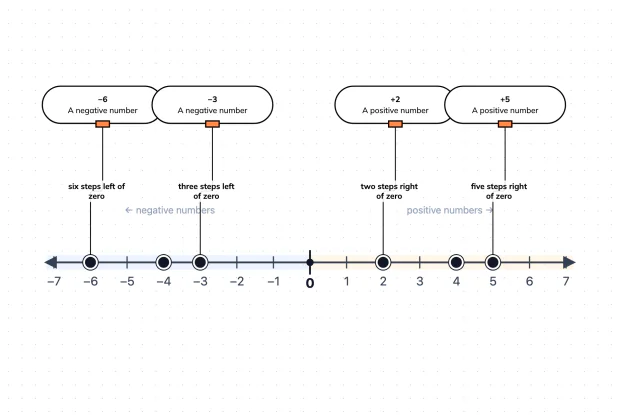
A negative number is a number to the left of zero on the number line. Meet the number line — zero in the middle, positives to the right, negatives to the left — and practise placing negative numbers by counting steps from zero, in an interactive playground.
What Is the Absolute Value of a Number?
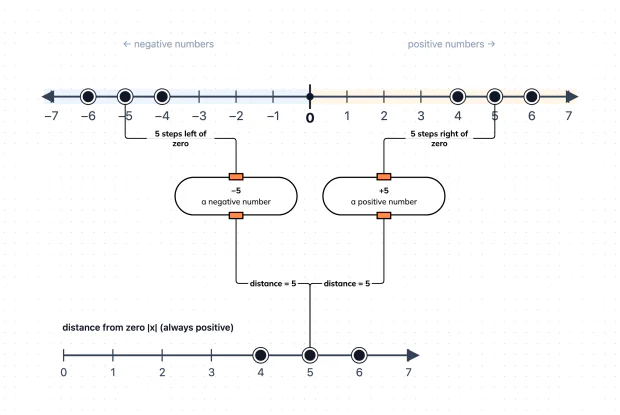
The absolute value of a number is its distance from zero, so it is never negative and −5 and +5 are both 5. Learn the fold-at-zero idea, then match each number to its distance in an interactive playground.
How Do You Add a Negative Number?
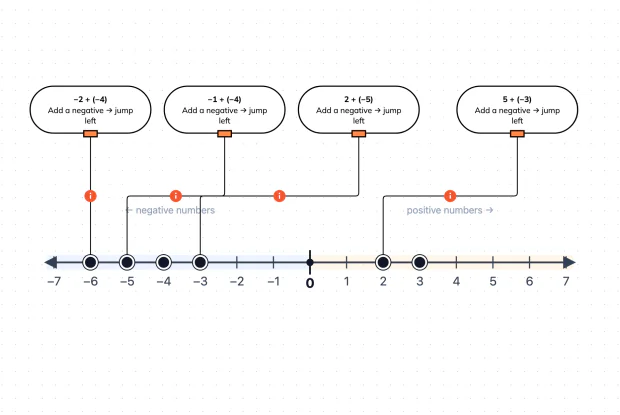
Adding a negative number moves you to the left on the number line. Learn the jump-left rule, then solve four sums by jumping to the answer in an interactive number-line playground.
How Do You Subtract a Negative Number?
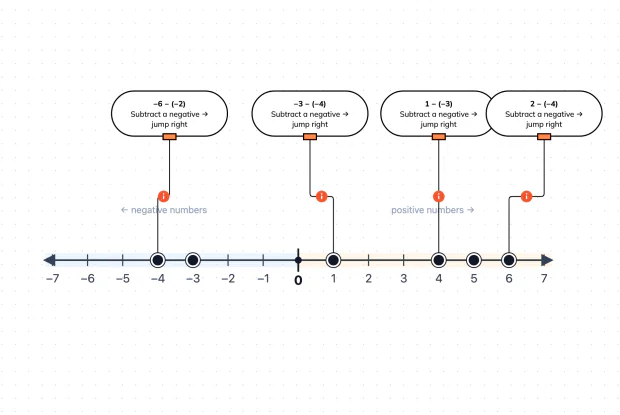
Subtracting a negative number moves you to the right on the number line — two minuses make a plus. Learn the rule, then solve four sums by jumping to the answer in an interactive number-line playground.
Why Does a Negative Times a Negative Make a Positive?
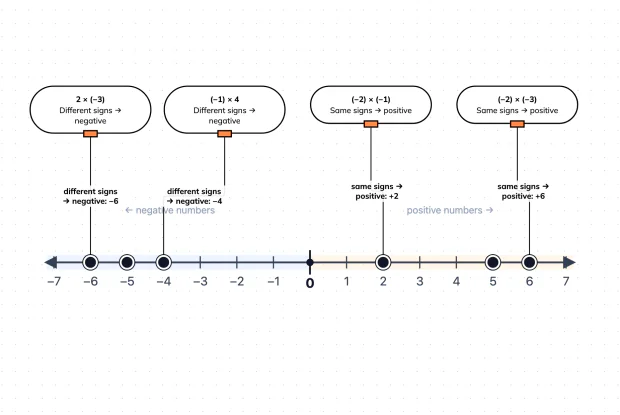
Multiplying negative numbers follows two sign rules: different signs make a negative, same signs make a positive. Learn why a negative times a negative comes out positive, then land four products on the number line.
How Do You Divide Negative Numbers?
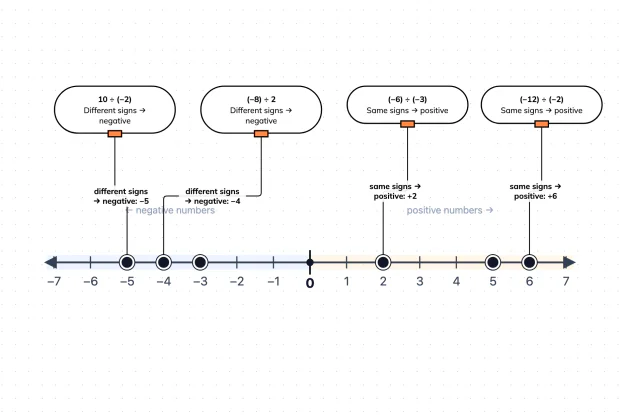
Dividing negative numbers uses the same two sign rules as multiplying: different signs make a negative answer, same signs make a positive one. Land four divisions on the number line to practise.
Order of Operations With Negative Numbers
The order of operations does not change with negatives: brackets, then ×÷, then +−. Work out four expressions with negatives in the right order in an interactive playground.
Multiplying and Dividing Negative Fractions
Combine the fraction method with the sign rules: do the fraction, then set the sign (same signs positive, different signs negative). Practise four problems in an interactive playground.