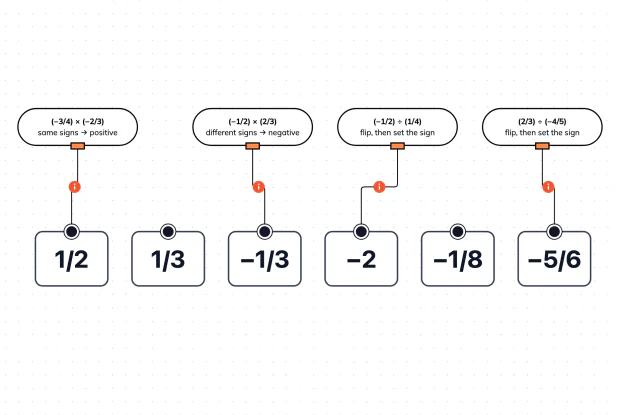
Why Does a Negative Times a Negative Make a Positive?
Root Concept
When you multiply, the signs decide whether the answer lands left of zero (negative) or right of zero (positive): different signs make a negative product, and same signs make a positive product. So a positive times a negative is negative, and a negative times a negative is positive. The size of the answer is just the two digits multiplied as normal.
CodePLU Goal
Upgrading Human Mental Models
Learn how to think in Workflows

Concept Development By codeplu.com
Multiplying: the signs decide the side of zero — different signs land left (negative), same signs land right (positive). The size is just the two digits multiplied.
Why Do Two Minus Signs Turn Into a Plus When You Multiply?
Multiplying is a fast way of adding the same number again and again. 3 × 4 means 'four, three times over' — 4 + 4 + 4 = 12. That idea still works when one number is negative. 3 × (−2) means '−2, three times over': (−2) + (−2) + (−2). Each one is a jump of 2 to the left, so three of them land you on −6. A positive times a negative comes out negative.
It also does not matter which way round you write them: (−2) × 3 gives the same −6 as 3 × (−2). So whenever the two numbers have different signs — one positive, one negative — the answer is negative, sitting to the left of zero. That is the first sign rule, and the number line shows it as a landing on the left.
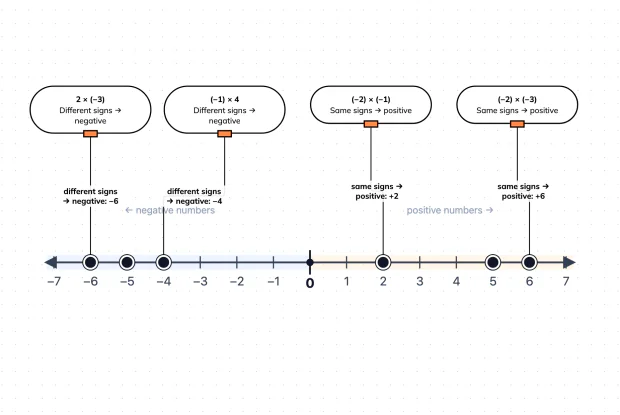
The rule that surprises everyone is the other one: a negative times a negative comes out positive. (−2) × (−3) is not −6, it is +6, over on the right of zero. There is a real reason for it, which this tutorial shows two ways, and then a shortcut you can trust: same signs make a positive, different signs make a negative. In the playground you will land four products on the line and watch which side of zero each one falls.
How Do the Signs Work When You Multiply?
What does multiplying by a negative do?
Start with multiplying as repeated adding. 3 × (−2) means add −2 three times: (−2) + (−2) + (−2). Every −2 is a jump of two steps to the left on the number line, and three jumps left from zero land you on −6. So a positive times a negative is negative. Because the order of a multiplication never changes the answer, (−2) × 3 is the same −6. The pattern to hold on to is this: when the two numbers you multiply have different signs — one positive and one negative — the product lands to the left of zero, so it is negative. The two digits, 2 and 3, still just multiply to 6 as usual; the signs only decide which side of zero that 6 sits on.
Why does a negative times a negative come out positive?
Here is the pattern that proves it. Look at what happens to 'times −2' as the first number counts down: 3 × (−2) = −6, then 2 × (−2) = −4, then 1 × (−2) = −2, then 0 × (−2) = 0. Each time the first number drops by one, the answer goes UP by 2: −6, −4, −2, 0. Now just keep the pattern going below zero: the next first number is −1, so (−1) × (−2) must be the next step up, which is +2; and (−2) × (−2) is +4. The answers have crossed to the right of zero and turned positive. Multiplying by a negative flips the direction, so multiplying by two negatives flips it twice — back to positive. It is the same 'minus a minus makes a plus' idea you met with subtracting, now inside a multiplication.
How do you get the sign right, every time?
You do not have to reason it out each time — there is a shortcut that always works. First multiply the two numbers as if they had no signs at all, to get the size of the answer: for (−2) × (−3), that is 2 × 3 = 6. Then decide the sign by looking at the two signs together. If the signs are the SAME (both positive, or both negative), the answer is positive. If the signs are DIFFERENT (one of each), the answer is negative. So (−2) × (−3): same signs, so +6. And 2 × (−3): different signs, so −6. Same size, opposite sides of zero. That single check — same or different — is all you need, and it is exactly what you decide for each card in the playground before you land it.
Real World Example
Where Does Multiplying Negatives Actually Happen?
Multiplying negatives sounds abstract, but it turns up whenever the same negative change repeats — and, for two negatives, whenever you undo such a change or look back in time. Here are three:
The same loss, several times over
A repeated deduction is a positive times a negative
Suppose a game charges you 3 points every round, and you play 4 rounds. Losing 3 points is a change of −3, and it happens 4 times, so the total change is 4 × (−3). Adding −3 four times — (−3) + (−3) + (−3) + (−3) — jumps you 3 to the left four times over, landing on −12. So you are 12 points down. This is a positive number of rounds times a negative change, and because the signs are different the answer is negative, just as the rule promises. Any time one fixed loss repeats a whole number of times, you are multiplying a positive by a negative and landing to the left of zero.
Rewinding a steady drop
Looking back in time flips a negative into a positive
Say the temperature is falling by 2 degrees every hour, a change we write as −2 per hour. Time going forward is positive, so 3 hours from now the change is 3 × (−2) = −6: six degrees colder. But what about 3 hours in the PAST? Going back in time is the negative direction, −3 hours, so the change since then is (−3) × (−2). Both numbers are negative — a backward look at a downward change — and the answer is +6: three hours ago it was six degrees WARMER than now. That is a negative times a negative giving a positive, and it makes plain sense: if things are getting colder, then earlier they were warmer.
Cancelling the same debt again and again
Removing several debts is a negative times a negative
Imagine you have several IOUs, each one recording a £2 debt, so each is worth −£2 to you. Now suppose 3 of those debts are cancelled — taken away. Taking away is negative, and you are taking away 3 lots of −£2, which is (−3) × (−£2). Removing debt makes you richer, so the result is +£6: you are six pounds better off. Two negatives — removing (negative) a debt (negative) — combine into a positive gain. It is the repeated version of 'minus a minus makes a plus': each cancelled debt lifts you by £2, and three of them lift you by £6, over to the right of zero.
FAQs
Final Words
Multiplying is repeated adding, so a positive times a negative is just the same leftward jump made several times, landing on a negative. Multiplying by a negative flips the direction, which is why a negative times a negative flips twice and lands back on a positive. You never have to puzzle it out in the moment: multiply the digits for the size, then use one check for the sign — same signs make a positive, different signs make a negative.
Division is the mirror of multiplication, so you can already guess what is coming. The very same two sign rules are about to do the same job for sharing and splitting — different signs give a negative answer, same signs give a positive one — which is the last piece of doing arithmetic with negative numbers.
Continue This Track
This concept is part 5 of Making Sense of Negative Numbers.
What Is a Negative Number?
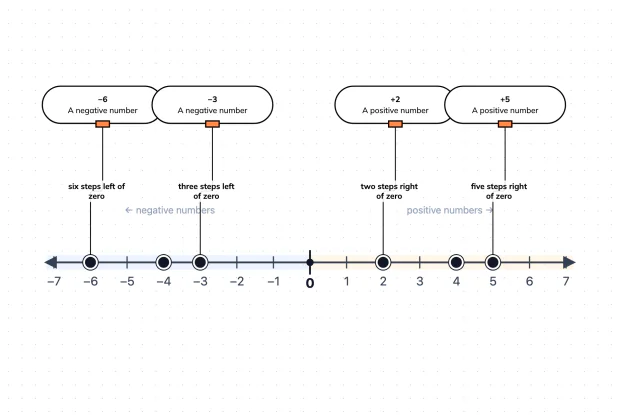
A negative number is a number to the left of zero on the number line. Meet the number line — zero in the middle, positives to the right, negatives to the left — and practise placing negative numbers by counting steps from zero, in an interactive playground.
What Is the Absolute Value of a Number?
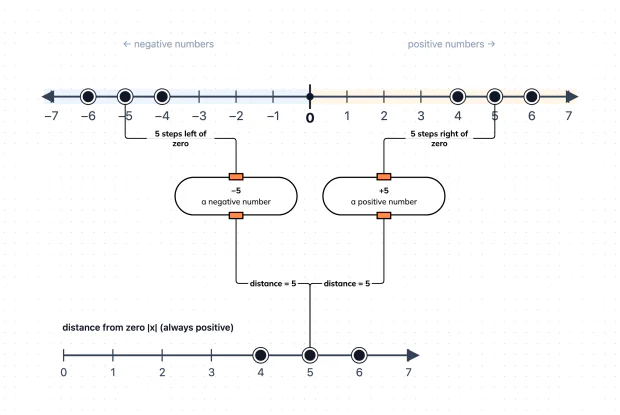
The absolute value of a number is its distance from zero, so it is never negative and −5 and +5 are both 5. Learn the fold-at-zero idea, then match each number to its distance in an interactive playground.
How Do You Add a Negative Number?
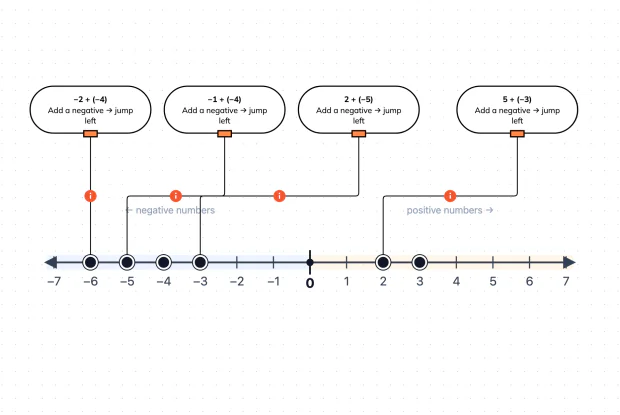
Adding a negative number moves you to the left on the number line. Learn the jump-left rule, then solve four sums by jumping to the answer in an interactive number-line playground.
How Do You Subtract a Negative Number?
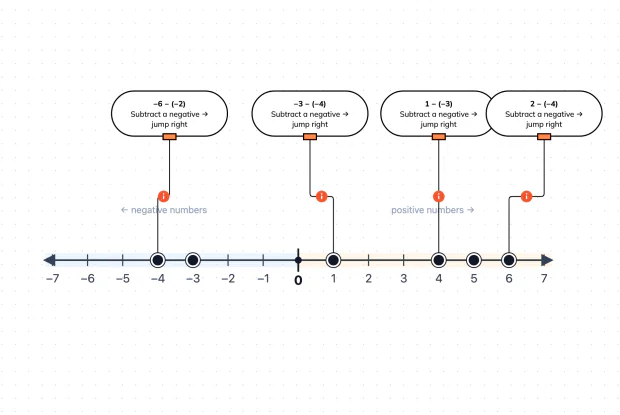
Subtracting a negative number moves you to the right on the number line — two minuses make a plus. Learn the rule, then solve four sums by jumping to the answer in an interactive number-line playground.
Why Does a Negative Times a Negative Make a Positive?
Multiplying negative numbers follows two sign rules: different signs make a negative, same signs make a positive. Learn why a negative times a negative comes out positive, then land four products on the number line.
How Do You Divide Negative Numbers?
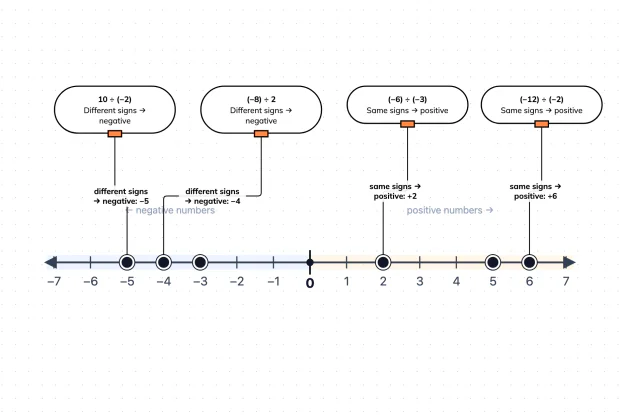
Dividing negative numbers uses the same two sign rules as multiplying: different signs make a negative answer, same signs make a positive one. Land four divisions on the number line to practise.
Order of Operations With Negative Numbers
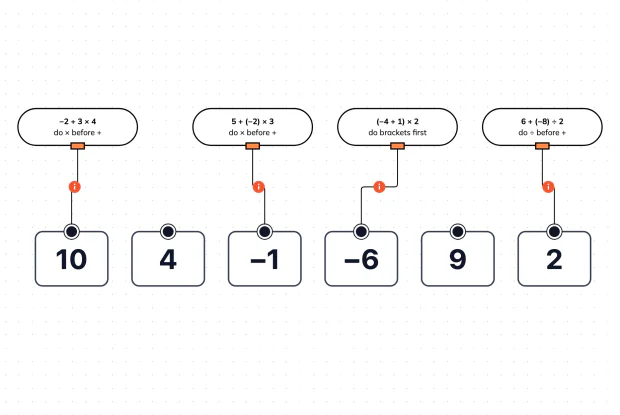
The order of operations does not change with negatives: brackets, then ×÷, then +−. Work out four expressions with negatives in the right order in an interactive playground.
Multiplying and Dividing Negative Fractions
Combine the fraction method with the sign rules: do the fraction, then set the sign (same signs positive, different signs negative). Practise four problems in an interactive playground.