Multiplying and Dividing Negative Fractions
Root Concept
To multiply or divide negative fractions, do the fraction part as usual — multiply straight across, or flip and multiply to divide — and then set the sign with the same rule as for whole numbers: same signs give a positive answer, different signs give a negative. So (−1/2) × (2/3) = −1/3, and (−3/4) × (−2/3) = +1/2.
CodePLU Goal
Upgrading Human Mental Models
Learn how to think in Workflows

Concept Development By codeplu.com
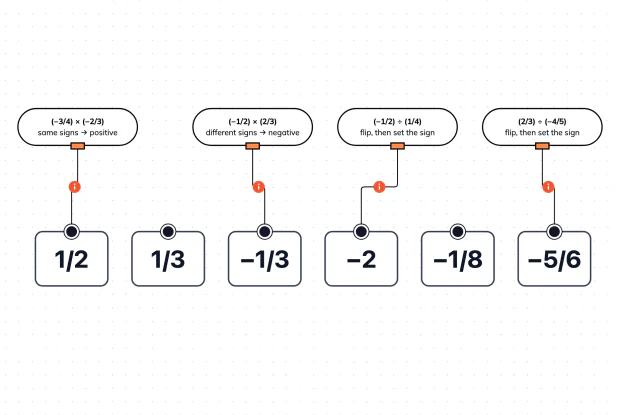
Four negative-fraction problems, each landed on its value — the tiles 1/3 (missed the minus) and −1/8 (didn't flip) are the classic mistakes
What Happens When Fractions Are Negative Too?
You already know two things separately: how to multiply and divide fractions, and how the signs work when you multiply and divide negatives. Multiplying and dividing negative fractions is simply doing both at once — and the trick is to keep them as two separate steps, so neither one trips you up.
The method is: first do the fraction part exactly as usual, ignoring the signs for a moment — multiply straight across, or flip and multiply to divide. Then set the sign of the answer using the rule you already know: if the two signs are the same, the answer is positive; if they are different, the answer is negative. So (−1/2) × (2/3): the fraction part is 2/6 = 1/3, and the signs are different, so the answer is −1/3.
That is the whole idea — do the fraction, then decide the sign. In the playground you will work out four problems with negative fractions, and some tiles show the answers you would get by forgetting the minus sign or by dividing without flipping, so doing both steps carefully is the only way to land each one.
How Do You Handle Negative Fractions?
Two steps: the fraction, then the sign
The safest way to multiply or divide negative fractions is to split the job in two. Step one: ignore the signs and do the fraction part with the numbers, using the rules you know — for multiplying, go straight across; for dividing, flip the second fraction and multiply. Step two: look at the two original signs and set the sign of the answer. This keeps two different kinds of thinking apart, so you are never juggling flipping and sign rules in the same instant. Take (−1/2) × (2/3): first the fractions, 1/2 × 2/3 = 2/6 = 1/3; then the signs, one negative and one positive are different, so the result is negative, giving −1/3. Fraction first, sign second — every time.
The sign rule is exactly the same
The sign rule for fractions is identical to the one for whole numbers, because a negative fraction is just a negative number that happens to be written as a fraction. Same signs make a positive answer; different signs make a negative answer. So two negatives multiply to a positive: (−3/4) × (−2/3) gives +1/2, because the fraction part is 6/12 = 1/2 and the two minus signs make a plus. A negative divided by a positive is negative: (−1/2) ÷ (1/4) flips to (−1/2) × 4 = −2. A positive divided by a negative is also negative: (2/3) ÷ (−4/5) = −5/6. Nothing about the sign rule changes just because fractions are involved — you count the signs the very same way.
Watch both mistakes at once
With negative fractions there are now two classic slips to avoid, one from each skill. From the fraction side: dividing without flipping — turning (−1/2) ÷ (1/4) into (−1/2) × (1/4) = −1/8 instead of flipping to get −2. From the sign side: forgetting the minus altogether — writing (−1/2) × (2/3) as +1/3 instead of −1/3. Doing the two steps in order guards against both: flip (if dividing) and do the fraction first, then deliberately decide the sign before you write the answer. In the playground, the wrong tiles are exactly these two mistakes — a missed flip and a dropped sign — so careful two-step working is what lands each problem correctly.
Real World Example
Where Negative Fractions Turn Up
Negative fractions appear whenever a fractional amount is also a loss or a downward change. Here are three:
Sharing a fractional debt
Half of a −2/3 loss is a negative fraction
Suppose a small loss of 2/3 of a pound is written as −2/3, and two people share it equally — each takes half. Each person's share is 1/2 × (−2/3). Do the fraction first: 1/2 × 2/3 = 2/6 = 1/3. Then the sign: a positive (the half) times a negative (the debt) is different signs, so negative — each person's share is −1/3 of a pound, a small debt. This is exactly a negative fraction times a positive fraction. Whenever a fractional loss is split into parts, you multiply a negative fraction, and the answer stays negative because part of a debt is still a debt.
Two negatives cancelling
Removing a fractional discount raises the price back
Imagine a price change written as a fraction, and you undo a downward change. Taking away a −3/4 change, repeated over −2/3 of the way... more simply: (−3/4) × (−2/3) shows two negatives multiplying. Do the fraction: 3/4 × 2/3 = 6/12 = 1/2. Then the sign: two negatives are the same sign, so the answer is positive, +1/2. This mirrors the whole-number rule that a negative times a negative is positive — it does not change just because the numbers are fractions. In money terms, cancelling a fractional reduction twice over pushes the value back up, which is why two negative fractions multiply to a positive one.
A fractional rate going down
Dividing by a negative fraction flips the sign
Rates of change are often fractions, and a falling rate is negative. If a quantity changed by 2/3 and each step was a −4/5 portion, the number of steps is (2/3) ÷ (−4/5). Flip and multiply: 2/3 × 5/4 = 10/12 = 5/6 for the fraction part; then the signs are different (positive over negative), so the answer is −5/6. Dividing by a negative fraction uses both tools at once — flip to divide, then apply the different-signs rule for the minus. It shows how naturally the two skills combine: the fraction method handles the numbers, and the sign rule handles the direction, giving one clean negative-fraction answer.
FAQs
Final Words
Multiplying and dividing negative fractions is just two skills you already have, used together: do the fraction part as usual — multiply straight across, or flip and multiply to divide — and then set the sign with the familiar rule, same signs positive and different signs negative. So (−1/2) × (2/3) = −1/3 and (−3/4) × (−2/3) = +1/2. Keeping the fraction step and the sign step separate is what makes it reliable.
The only new thing is that there are now two classic mistakes to dodge at once — dividing without flipping, and dropping the minus sign — and doing the steps in order guards against both. With this, the negative-numbers arithmetic is complete: from whole numbers to fractions, adding, subtracting, multiplying and dividing all follow the same signs you have practised throughout.
Continue This Track
This concept is part 8 of Making Sense of Negative Numbers.
What Is a Negative Number?
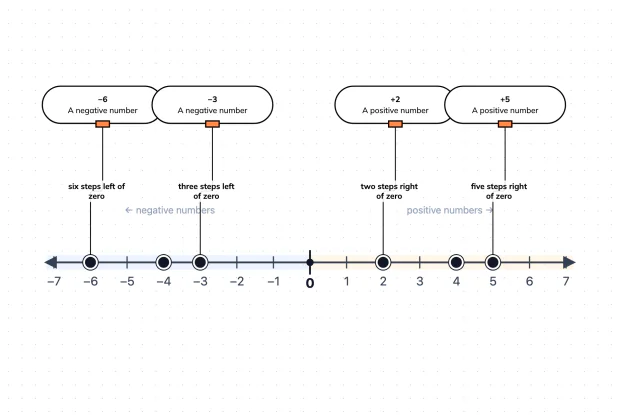
A negative number is a number to the left of zero on the number line. Meet the number line — zero in the middle, positives to the right, negatives to the left — and practise placing negative numbers by counting steps from zero, in an interactive playground.
What Is the Absolute Value of a Number?
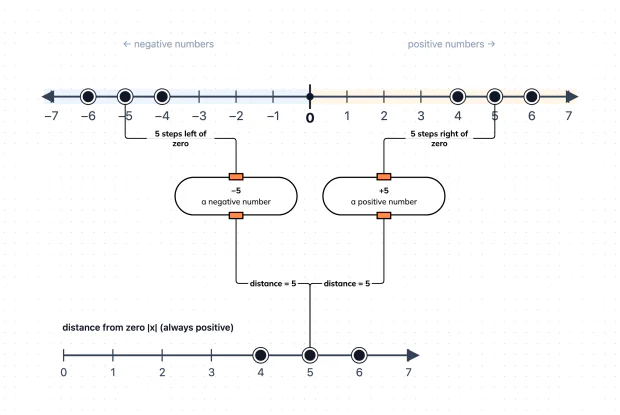
The absolute value of a number is its distance from zero, so it is never negative and −5 and +5 are both 5. Learn the fold-at-zero idea, then match each number to its distance in an interactive playground.
How Do You Add a Negative Number?
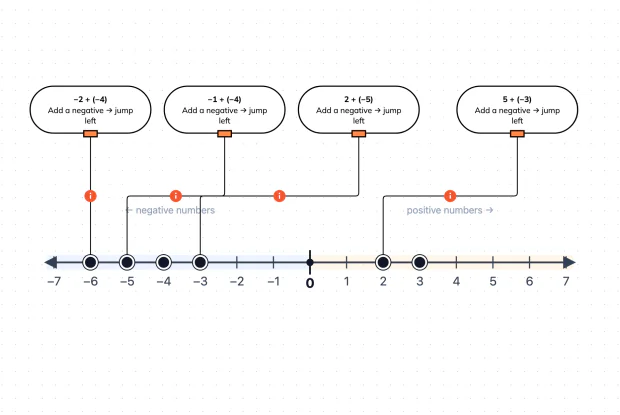
Adding a negative number moves you to the left on the number line. Learn the jump-left rule, then solve four sums by jumping to the answer in an interactive number-line playground.
How Do You Subtract a Negative Number?
Subtracting a negative number moves you to the right on the number line — two minuses make a plus. Learn the rule, then solve four sums by jumping to the answer in an interactive number-line playground.
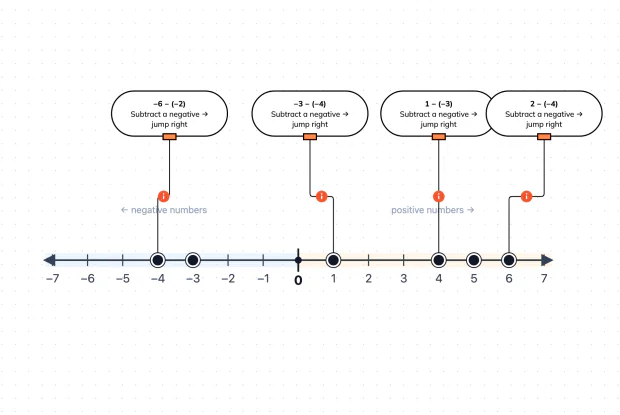
Why Does a Negative Times a Negative Make a Positive?
Multiplying negative numbers follows two sign rules: different signs make a negative, same signs make a positive. Learn why a negative times a negative comes out positive, then land four products on the number line.
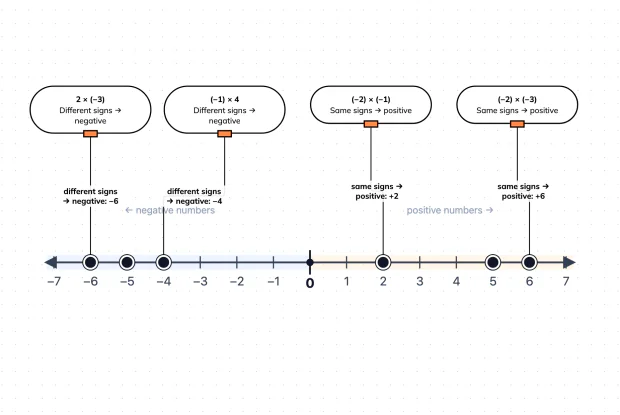
How Do You Divide Negative Numbers?
Dividing negative numbers uses the same two sign rules as multiplying: different signs make a negative answer, same signs make a positive one. Land four divisions on the number line to practise.
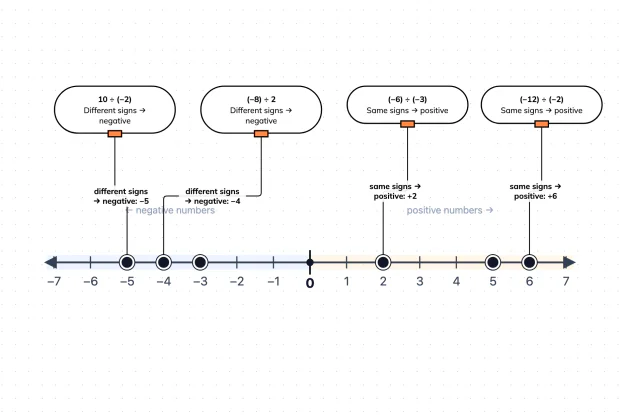
Order of Operations With Negative Numbers
The order of operations does not change with negatives: brackets, then ×÷, then +−. Work out four expressions with negatives in the right order in an interactive playground.
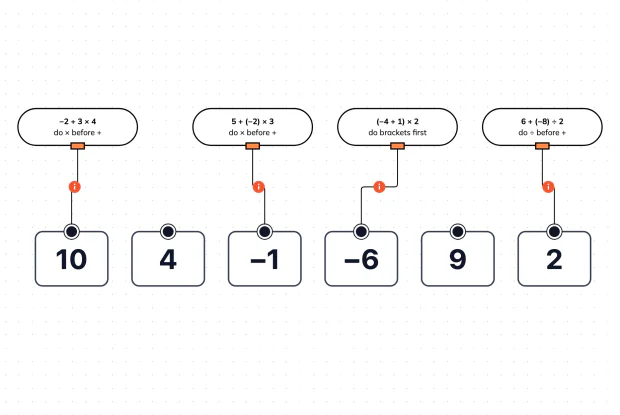
Multiplying and Dividing Negative Fractions
Combine the fraction method with the sign rules: do the fraction, then set the sign (same signs positive, different signs negative). Practise four problems in an interactive playground.