Xylem and Phloem: Two Pipes Going Opposite Ways
Root Concept
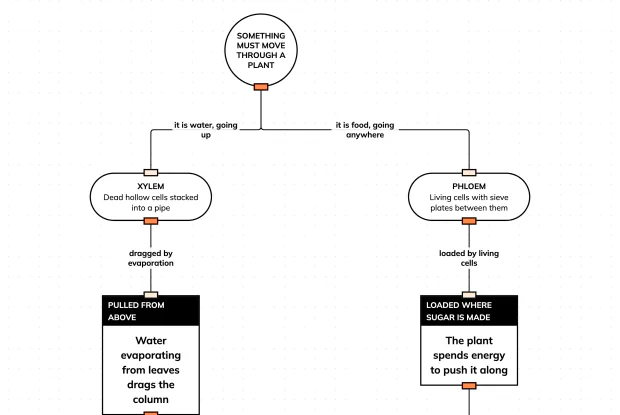
Xylem carries water one way through dead cells; phloem carries dissolved sugar in either direction through living cells.
CodePLU Goal
Upgrading Human Mental Models
Learn how to think in Workflows

Concept Development By codeplu.com
Different cargo, different cells, different directions. Almost nothing about the two systems is shared except that both are tubes.
Two Separate Delivery Systems
A plant has a problem of distance. Water arrives at the roots and is needed in the leaves, metres away at the top of a tree. Sugar is made in the leaves and is needed everywhere — in the roots, in a growing bud, in a developing fruit, in every cell that is not photosynthesising. Diffusion is hopeless over those distances, as an earlier track showed, so the plant needs transport tissue.
What it builds is not one system but two, running side by side through the whole plant and sharing almost nothing. Xylem carries water and dissolved minerals upwards. Phloem carries dissolved sugar to wherever it is wanted. They are made from different cells, move their cargo by completely different mechanisms, and only one of them is alive.
Keeping them apart is the examinable skill, and the easiest way to hold the difference is to remember that xylem is a pipe and phloem is a delivery service. One is passive plumbing that can only ever run one way; the other is living tissue that decides where to send things. The playground below sets the two chains beside each other.
Different Cells, Different Mechanisms, Different Directions
What is xylem made of, and why is it dead?
Xylem is built from cells that die as they mature. Their end walls break down and their contents disappear, leaving a continuous hollow tube running from root to leaf, with walls strengthened by a tough material called lignin. Being dead is not a flaw but the point: a cell full of cytoplasm would obstruct the flow, and an empty rigid tube offers almost no resistance. The lignin does a second job too, because those thickened tubes are a large part of what holds a plant up — wood is mostly old xylem. A tissue that is simultaneously the plumbing and the scaffolding is a remarkably efficient piece of design, and it costs the plant nothing to run.
What pulls the water up?
Evaporation from the leaves, which is called transpiration. Water vapour escapes through the pores on a leaf's underside, and as each molecule leaves it tugs on the one behind it. Water molecules cling to one another strongly enough that the whole column in the xylem is pulled upwards as a single thread, all the way from the roots. Nothing pushes from below and the plant spends no energy on it — the sun does the work by evaporating the water. This is why a plant short of water closes its leaf pores, and why a cut flower in a vase keeps drinking long after it has no roots at all.
How is phloem different?
In almost every respect. Phloem cells are alive, and instead of dissolving their end walls completely they keep them as sieve plates, perforated like a colander so that contents can pass from one cell to the next. Alongside each sieve tube sits a companion cell packed with mitochondria, and that energy is spent actively loading sugar into the tube where it is made and unloading it where it is wanted. The movement is therefore not passive: it costs the plant energy, which is exactly what the last track described as active transport, and it is why phloem stops working in tissue that has been killed, while xylem in a dead stem carries on perfectly well.
Why can phloem go both ways?
Because where the sugar is needed changes with the season and the plant's stage. In summer the leaves are making sugar and sending it down to be stored in roots or a tuber. In spring a potato or a tree draws that stored sugar back upwards to build new shoots and leaves before any leaf exists to make more. Phloem therefore carries its cargo from wherever sugar is being produced or released to wherever it is being used, and since both ends can change, so can the direction. Xylem has no such flexibility and never needs any, because water only ever comes from below and leaves are the only place it is lost.
Real World Example
What Happens When a Tree Is Ring-Barked
Strip a complete band of bark from around a trunk and the tree dies — but not quickly, and not from thirst. What survives and what fails tells you exactly where the two tissues lie.
Step 1
The cut removes the phloem, not the xylem
Phloem lies just inside the bark, near the outside of the trunk, while xylem is deeper in — the wood itself. Cutting a ring through the bark therefore severs every phloem tube running down the trunk while leaving the xylem completely intact. This arrangement is worth remembering because it explains the whole outcome, and it is also why the cambium from the last tutorial sits between the two: it is the ring that makes new xylem inwards and new phloem outwards as the trunk thickens, keeping the two systems in their fixed positions year after year.
Step 2
The leaves carry on as normal at first
Water keeps rising through the undamaged xylem, so the leaves stay supplied and photosynthesis continues for weeks or months. From the outside the tree looks perfectly healthy. What has stopped is the downward delivery of sugar: the leaves make it and it piles up above the cut with nowhere to go, sometimes swelling the trunk visibly just above the ring. Nothing above the cut is short of anything at this stage, which is why the damage is so easy to underestimate, and why a ring-barked tree is often assumed to have survived the damage without lasting harm.
Step 3
The roots starve
Roots cannot photosynthesise and depend entirely on sugar arriving from the leaves through the phloem. With that supply cut they live on their stores, exhaust them, and die — and once the roots fail, water stops arriving and the rest of the tree follows. The whole process can take a year or more, which is the clearest possible demonstration that the two tissues are separate systems carrying different cargo. Foresters and gardeners use the technique deliberately to kill unwanted trees standing, since a dead tree left upright is easier and safer to fell later than a living one.
FAQs
Final Words
A plant runs two transport systems that share almost nothing. Xylem is dead hollow tubes, strengthened with lignin, carrying water and minerals upward only, pulled by evaporation from the leaves and costing the plant nothing. Phloem is living cells with sieve plates between them, carrying dissolved sugar in whichever direction it is wanted, actively loaded at a real cost in energy.
Cargo, construction, mechanism and direction all differ, which is why mixing them up loses so many marks and why ring-barking a tree starves its roots while its leaves carry on looking healthy. The next tutorial crosses to animals, where tissues are sorted by a different question: what covers a surface, and what fills the space between.
Continue This Track
This concept is part 3 of When Cells Take On a Job.
Why Does a Big Organism Need Tissues at All?
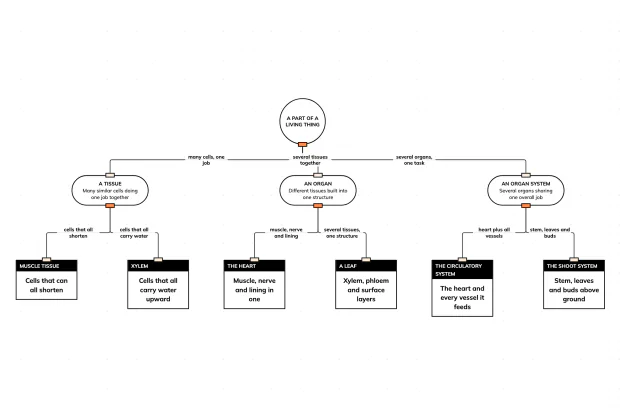
A single cell does every job itself. In a large organism the jobs are split between groups of specialised cells — tissues — which build organs and then systems. Sort six examples by level in an interactive playground.
Where Does a Plant Actually Grow From?
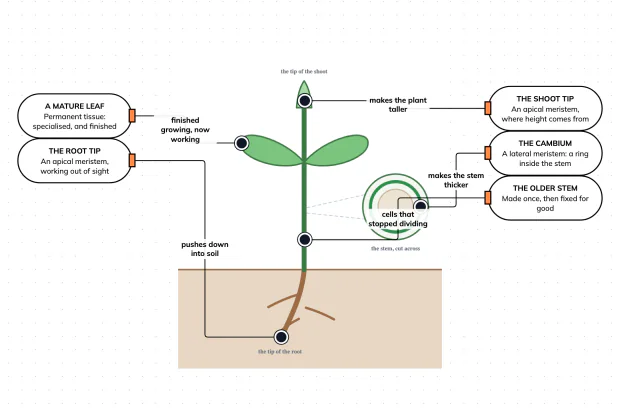
A plant grows only at its tips and from a ring inside its stem. Everywhere else is permanent tissue that has specialised and stopped dividing. Find the growth regions in an interactive playground.
Xylem and Phloem: Two Pipes Going Opposite Ways
A plant has two transport tissues. Xylem carries water upward through dead hollow cells; phloem carries dissolved sugar in either direction through living ones. Follow both in an interactive playground.
What Lines, Covers and Holds an Animal Together?
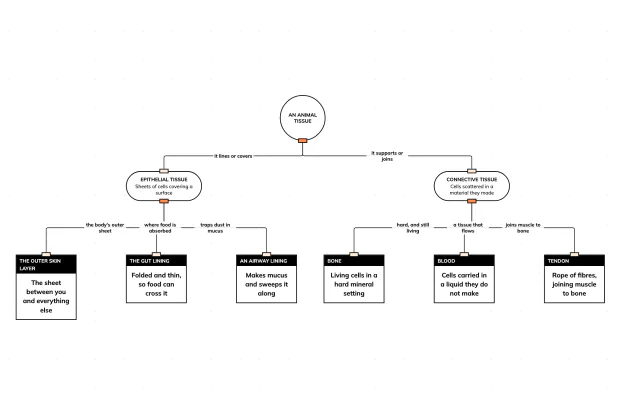
Epithelial tissue covers every surface of an animal, inside and out. Connective tissue fills the space between and holds the rest together — including bone and blood. Sort six examples in an interactive playground.
Muscle and Nerve: the Two Tissues That Act
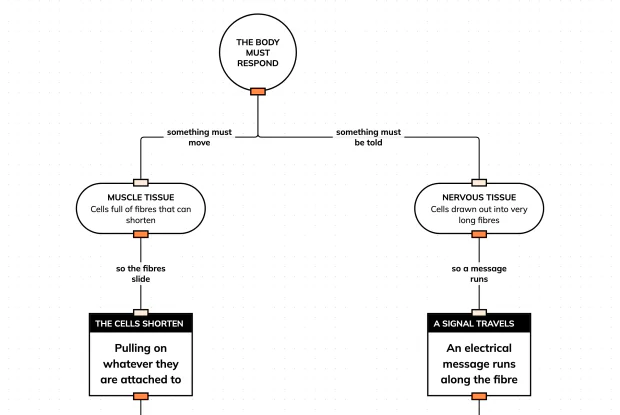
Muscle tissue is cells that shorten; nervous tissue is cells drawn out into fibres that carry signals. Neither can do the other job, and most responses need both. Compare them in an interactive playground.