What Lines, Covers and Holds an Animal Together?
Root Concept
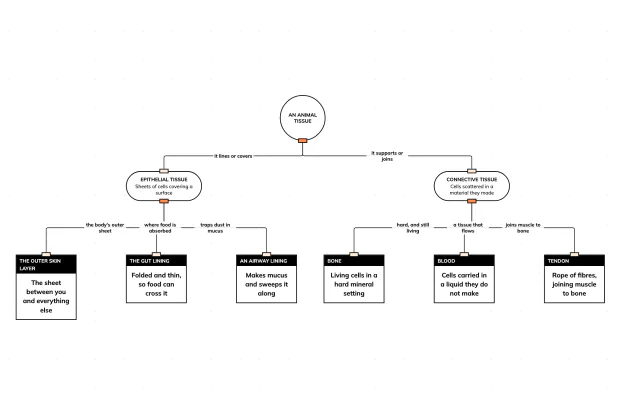
Epithelial tissue covers and lines surfaces; connective tissue supports, binds and fills the space between other tissues.
CodePLU Goal
Upgrading Human Mental Models
Learn how to think in Workflows

Concept Development By codeplu.com
Sorted by the job, not the material. That is why bone and blood end up in the same family.
The Tissues Nobody Thinks About
Ask anyone to name an animal tissue and they will say muscle or nerve. Those are the next tutorial. This one is about the two families that make up far more of a body than either, and get almost no attention because what they do sounds dull: covering things, and holding things together.
Animal tissues are grouped into four kinds, and two of them are these. Epithelial tissue forms sheets that cover every surface an animal has — not just the outside but the inside of the gut, the airways, the blood vessels and every gland. Connective tissue is everything that fills the space between other tissues and binds them in place.
Connective tissue is where the surprise is. It includes bone, cartilage, tendon, the fat under your skin and, awkwardly for most people's intuition, blood. They look nothing alike and they are grouped together for a good reason, which the playground below is built around: the four tissue families are sorted by what the cells do and how they are arranged, not by what the material feels like.
Two Families, Sorted by Job
What makes a tissue epithelial?
Cells packed tightly into a continuous sheet, sitting on a surface. There is almost no space between them, which is the point: an epithelium is a boundary, and a boundary with gaps in it is not doing its job. Every surface of an animal is covered by one, inside and out, so the lining of your gut, your airways, your bladder and your blood vessels are all epithelial. The shape varies with the task. Where the job is protection the cells are stacked in thick layers, as in skin. Where the job is letting things across they are a single layer flattened almost to nothing, as in the air sacs of a lung where only thinness will do.
Why is blood a connective tissue?
Because of how a connective tissue is defined: cells scattered in a surrounding material rather than packed into a sheet, with the material doing much of the work. In bone that material is hard and mineralised; in tendon it is rope-like fibres; in blood it is a liquid called plasma. The cells are spread out through it in every case. Judged by the definition, blood fits exactly, even though it flows and the others do not. This is a good example of biology classifying by structure and function rather than by appearance, and of why learning the definition beats learning the list, because the list never contains every case you will be asked about.
What does connective tissue actually do?
Supports, binds, separates and transports — four jobs that come down to filling the space between everything else and giving it something to attach to. Bone gives the body a frame and somewhere for muscles to pull against. Tendon joins muscle to bone and ligament joins bone to bone. Cartilage cushions joints where two bones meet. Fat stores energy and insulates. Blood carries materials from one place to another. Without connective tissue an animal would be a bag of organs with nothing holding any of them in position, which is close to what some simple animals actually are. It is the least noticed and the most abundant family in the body.
Why do epithelial tissues wear out so fast?
Because being the boundary means taking the damage. The lining of your gut faces digestive acid and constant scraping, your skin meets everything you touch, and both are replaced continuously — gut lining in a matter of days, skin a little more slowly. That turnover depends on a supply of dividing cells underneath, which is why epithelial tissues sit on a base layer where division happens. It also explains why damage to a surface normally heals completely while damage deeper in may not: the machinery for replacing an epithelium is already running, so a graze heals without a scar whereas a deep cut usually leaves a scar behind for life.
Real World Example
What the Lining of Your Airways Does All Day
The tube from your nose to your lungs is lined with an epithelium doing a continuous cleaning job, and it is the clearest everyday example of a covering tissue that is not merely a cover.
Step 1
Some cells make mucus
Scattered through the lining are cells whose only job is producing mucus, a sticky layer that coats the whole airway. Every breath brings in dust, pollen, smoke particles and bacteria, and most of them stick to this layer within a few centimetres of entering. That is the first half of the system: an adhesive surface that catches things before they reach the delicate air sacs, where anything landing would be far harder to remove and where the barrier has to stay thin enough for gases to cross and could tolerate no coating of any kind at all.
Step 2
Others sweep it away
The rest of the lining cells are covered in cilia — tiny hair-like projections that beat in a coordinated wave, hundreds of times a minute, always in the same direction. They push the loaded mucus up the airways towards the throat, where it is swallowed without you ever noticing. A sheet of cells is therefore running a conveyor belt, and the whole arrangement works only because an epithelium is a continuous sheet: a gap would be a place where the belt stopped and the dirt stayed put. The two cell jobs only work as a pair.
Step 3
Stopping the sweep has consequences
Cilia are easily paralysed. Tobacco smoke stops them beating, which is why a smoker's airways accumulate mucus that has to be coughed up instead. Cold air and some infections slow them too, and when the belt stops the trapped material simply stays where it landed. This is a description of how the tissue behaves rather than advice about anyone's health, and it makes the point that an epithelium is active machinery rather than a passive wrapper. A tissue that merely covered would need nothing like two specialised cell types working in concert, hour after hour, for a lifetime.
FAQs
Final Words
Epithelial tissue covers and lines every surface an animal has, packed into continuous sheets with no gaps, and shaped by its task — thick and layered where it protects, flattened almost to nothing where things must cross. Connective tissue is the opposite arrangement: cells scattered through a matrix they produced, supporting, binding and transporting.
That definition is why bone, tendon, cartilage, fat and blood sit together in one family despite looking nothing alike — the matrix differs, the arrangement does not. Learning the definition rather than the list is what makes blood stop being a surprise. The last tutorial in this track takes the two remaining animal tissues, the ones that do something rather than hold something.
Continue This Track
This concept is part 4 of When Cells Take On a Job.
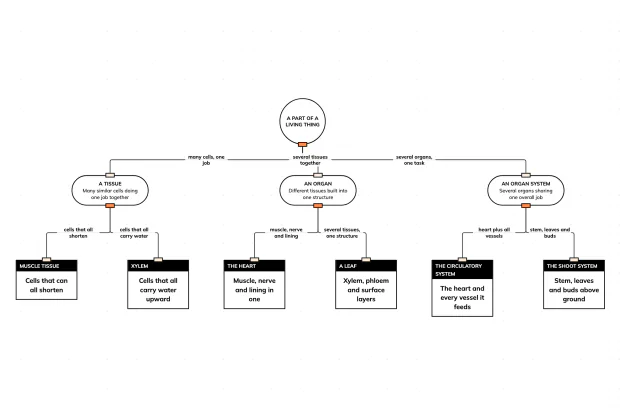
Why Does a Big Organism Need Tissues at All?
A single cell does every job itself. In a large organism the jobs are split between groups of specialised cells — tissues — which build organs and then systems. Sort six examples by level in an interactive playground.
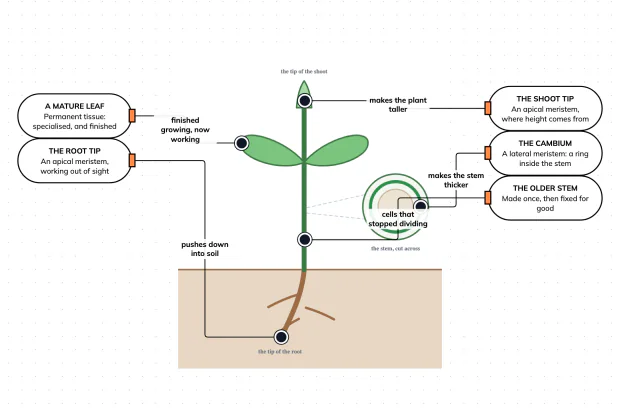
Where Does a Plant Actually Grow From?
A plant grows only at its tips and from a ring inside its stem. Everywhere else is permanent tissue that has specialised and stopped dividing. Find the growth regions in an interactive playground.
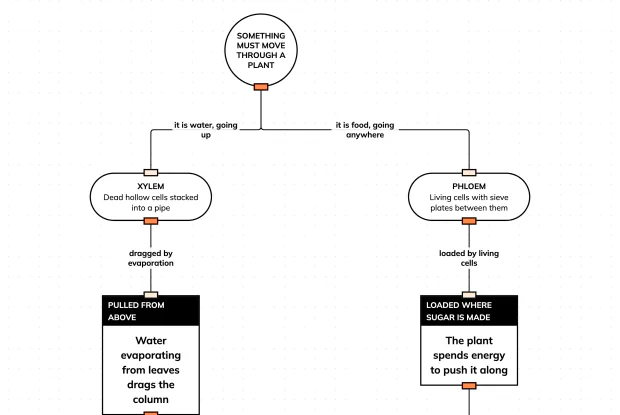
Xylem and Phloem: Two Pipes Going Opposite Ways
A plant has two transport tissues. Xylem carries water upward through dead hollow cells; phloem carries dissolved sugar in either direction through living ones. Follow both in an interactive playground.
What Lines, Covers and Holds an Animal Together?
Epithelial tissue covers every surface of an animal, inside and out. Connective tissue fills the space between and holds the rest together — including bone and blood. Sort six examples in an interactive playground.
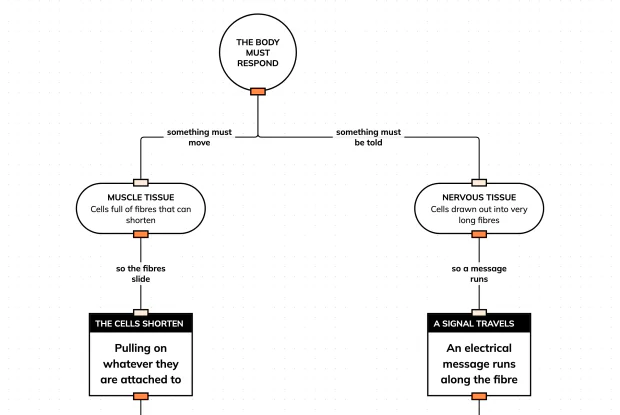
Muscle and Nerve: the Two Tissues That Act
Muscle tissue is cells that shorten; nervous tissue is cells drawn out into fibres that carry signals. Neither can do the other job, and most responses need both. Compare them in an interactive playground.