When Cells Take On a Job
A bacterium does every job itself, and the previous tracks showed both how and why that forces it to stay tiny. A large organism cannot work that way, and not only because of size: a cell that must do everything can be excellent at nothing, since the requirements of contracting, absorbing and signalling pull a cell's design in different directions. The answer is division of labour. Cells specialise, and a group of similar specialised cells doing one job is a tissue — the first level at which specialisation actually buys anything. Tissues combine into organs, which is why a leaf counts as readily as a heart, and organs into systems. This track then takes the tissues themselves, plant first. Plants grow from only a few small regions called meristems: apical ones at the tips of every shoot and root, and a lateral one, the cambium, hidden as a ring inside the stem — which is why a nail hammered into a trunk stays at the same height for twenty years while the trunk thickens around it. What those meristems build includes two transport tissues that share almost nothing: xylem, dead hollow tubes carrying water upward for free, pulled by evaporation from the leaves; and phloem, living cells carrying dissolved sugar in whichever direction it is wanted, loaded actively at a real cost in energy. The track closes on animals and their four tissue families, sorted by what the cells do rather than what the material feels like — which is why bone and blood end up in the same group — and finishes with the two that act rather than hold: muscle, which can only ever shorten and so can only ever pull, and nerve, which moves nothing at all and carries the decision instead.
CodePLU Goal
Upgrading Human Mental Models
Learn how to think in Workflows
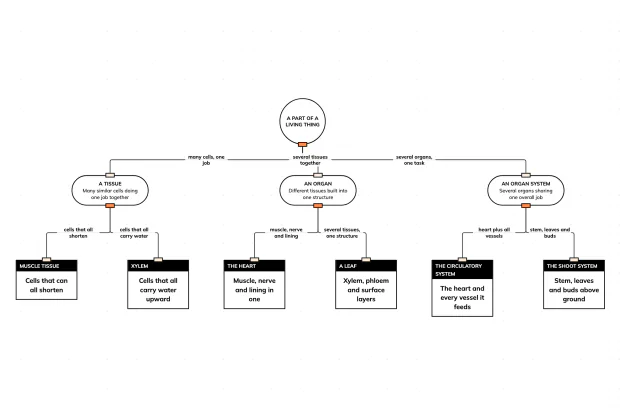
Why Does a Big Organism Need Tissues at All?
A single cell does every job itself. In a large organism the jobs are split between groups of specialised cells — tissues — which build organs and then systems. Sort six examples by level in an interactive playground.
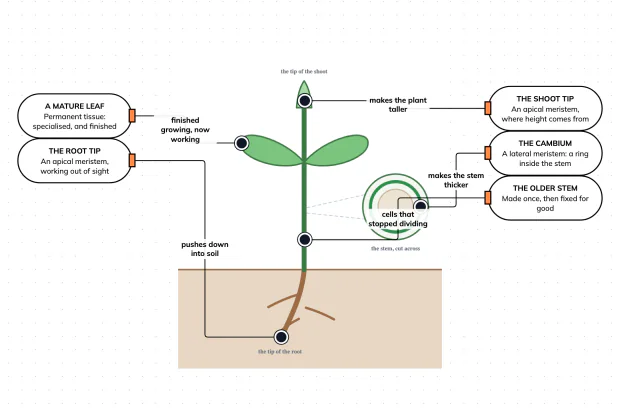
Where Does a Plant Actually Grow From?
A plant grows only at its tips and from a ring inside its stem. Everywhere else is permanent tissue that has specialised and stopped dividing. Find the growth regions in an interactive playground.
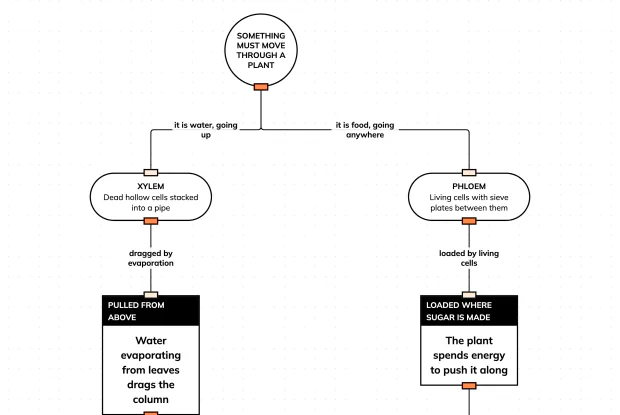
Xylem and Phloem: Two Pipes Going Opposite Ways
A plant has two transport tissues. Xylem carries water upward through dead hollow cells; phloem carries dissolved sugar in either direction through living ones. Follow both in an interactive playground.
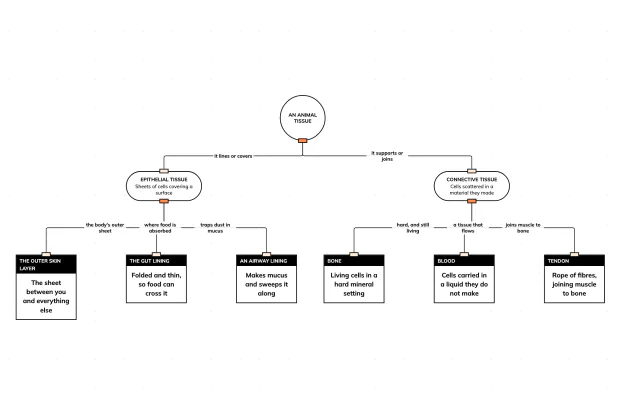
What Lines, Covers and Holds an Animal Together?
Epithelial tissue covers every surface of an animal, inside and out. Connective tissue fills the space between and holds the rest together — including bone and blood. Sort six examples in an interactive playground.
Muscle and Nerve: the Two Tissues That Act
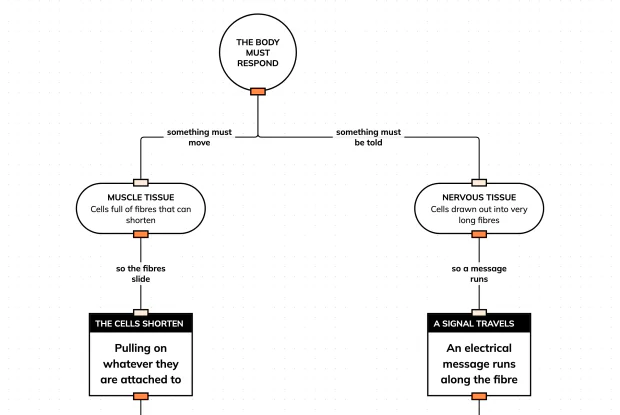
Muscle tissue is cells that shorten; nervous tissue is cells drawn out into fibres that carry signals. Neither can do the other job, and most responses need both. Compare them in an interactive playground.