Why Does a Big Organism Need Tissues at All?
Root Concept
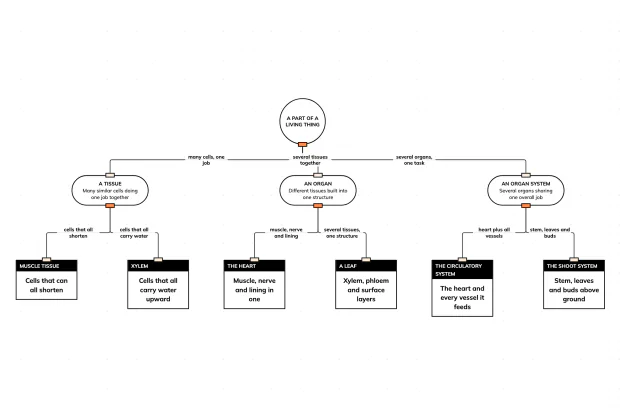
A tissue is a group of similar cells doing one job; organs combine tissues and systems combine organs.
CodePLU Goal
Upgrading Human Mental Models
Learn how to think in Workflows

Concept Development By codeplu.com
Each level is made of the one below it. What changes going up is not the material but how much is specialised.
What Gets Lost When You Stay Small
A bacterium does everything itself. One cell takes in food, releases energy, builds its own proteins, senses its surroundings and divides — and it manages all of that with no help, because there is no one else. The previous track showed how, and also why it forces a bacterium to stay tiny.
A large organism cannot work that way, and the reason is not size alone. If every one of your thirty trillion cells tried to do every job, each would be a jack of all trades and good at none of them. Nothing could be very good at contracting, because the same cell would also need to be good at absorbing and at carrying signals, and those requirements pull a cell's design in different directions.
The answer is division of labour, the same principle that runs a hospital or a factory. Cells specialise: some become long and full of fibres that shorten, others become flat and thin for covering, others become hollow tubes. A group of similar specialised cells doing one job is a tissue. Tissues combine into organs, organs into systems, and the playground below asks you to place six examples on the right rung of that ladder.
The Ladder, and Where People Slip On It
What exactly is a tissue?
A group of similar cells, working together at one job. The word similar is doing real work in that sentence: a tissue is not simply any clump of cells but cells of the same specialised kind, built the same way for the same purpose. Muscle tissue is a mass of cells that can all shorten; xylem is a column of cells that all carry water. Because they are alike, the job they do is the one thing they do extremely well, and none of them has to compromise its shape or contents for a second role. A tissue is therefore the first level at which specialisation actually buys anything. Below it, a single cell is still a generalist.
What makes something an organ rather than a tissue?
More than one kind of tissue, built into a single structure with a job of its own. A heart is not simply muscle: it is muscle tissue to squeeze, nervous tissue to set the rhythm, a smooth lining so blood does not clot inside it and connective tissue holding the whole thing together. Remove any one of those and it is not a heart. The test to apply is whether you can name two different tissues in it. This is where most mistakes happen, because the word organ sounds as though it should mean something large or important, and it does not — it means something built from several tissues.
Why is a leaf an organ?
Because it passes exactly that test, and it is the example that catches people out. A leaf contains xylem bringing water in, phloem carrying sugar away, a protective surface layer with pores in it, and a packed middle layer full of chloroplasts. That is four tissues co-operating in one structure with one overall job, which makes a leaf every bit as much an organ as a heart. Plants have organs and organ systems in just the way animals do; the names are less familiar because school biology spends more time on animal bodies, not because plants are built more simply. Asking whether you can name two tissues inside it works on a leaf exactly as it does on a heart.
Does every living thing have all these levels?
No, and the ladder is a description rather than a requirement. A bacterium is one cell and stops there. Many algae are no more than colonies of similar cells with no tissues at all. A jellyfish has tissues but very little that would count as an organ. The levels appear as organisms get larger and more specialised, and each one appears because the one below it stopped being enough. Reading the ladder upwards is reading a history of what size costs, which is a more useful way to hold it than as a list to recite. An organism only builds the levels its size actually forces on it, and stops there without penalty.
Real World Example
What a Factory Does That a Workshop Cannot
A single craftsman and a factory can make the same object. Comparing how they do it makes the case for specialisation much clearer than cells do at first.
Step 1
One worker does everything, slowly
A lone furniture maker cuts, shapes, joins, sands and finishes every chair. They need every tool and every skill, their bench has to serve every stage, and nothing about the workspace can be optimised for any one task because it has to do them all. This is the bacterium: completely self-sufficient, genuinely impressive, and limited by the fact that one unit can only be arranged one way. Scaling up means more craftsmen each doing everything, which multiplies output but improves nothing about how any single chair gets made, because every bench is still a compromise.
Step 2
Split the jobs and each can be specialised
In a factory one group only cuts, with a bench built for cutting and tools that do nothing else. Another only finishes, in a dust-free room that would be useless for sawing. Each group is now far better at its own stage than any craftsman could be, precisely because it has given up being able to do anything else. That is what a tissue is: a group that has committed to one job and been shaped for it, and a muscle cell packed with contracting fibres has no room left to do much else at all.
Step 3
But now nothing works alone
Specialisation has a price. The cutting shop cannot produce a chair, and if the finishing room stops, the whole line stops with it. The factory only exists as the combination — which is exactly why organisms with tissues also need organs to combine them, systems to combine the organs, and transport and signalling to keep every part supplied and coordinated. Every rung of the ladder above tissue exists to solve a problem created by the rung below, which is why the ladder has the shape it does rather than being an arbitrary list someone chose.
FAQs
Final Words
A tissue is a group of similar cells doing one job, and it exists because a cell that has to do everything can be excellent at nothing. Tissues combine into organs — a structure built from several different tissues, which is why a leaf counts just as much as a heart — and organs combine into systems sharing one overall task.
Each rung appears because the rung below stopped being enough, so the ladder is a record of what being large costs rather than a list to memorise. The rest of this track takes the tissues themselves, starting with the one question a plant answers quite differently from an animal: where does new growth actually come from?
Continue This Track
This concept is part 1 of When Cells Take On a Job.
Why Does a Big Organism Need Tissues at All?
A single cell does every job itself. In a large organism the jobs are split between groups of specialised cells — tissues — which build organs and then systems. Sort six examples by level in an interactive playground.
Where Does a Plant Actually Grow From?
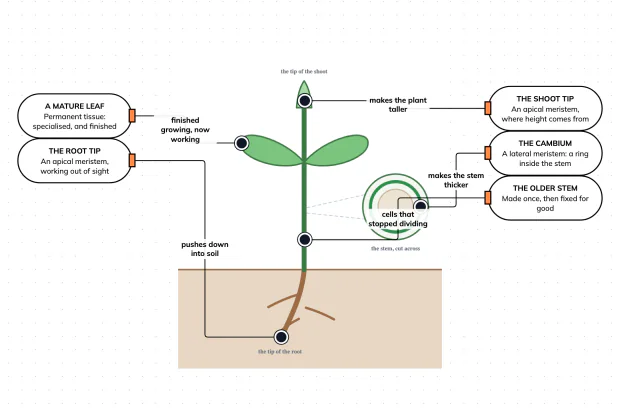
A plant grows only at its tips and from a ring inside its stem. Everywhere else is permanent tissue that has specialised and stopped dividing. Find the growth regions in an interactive playground.
Xylem and Phloem: Two Pipes Going Opposite Ways
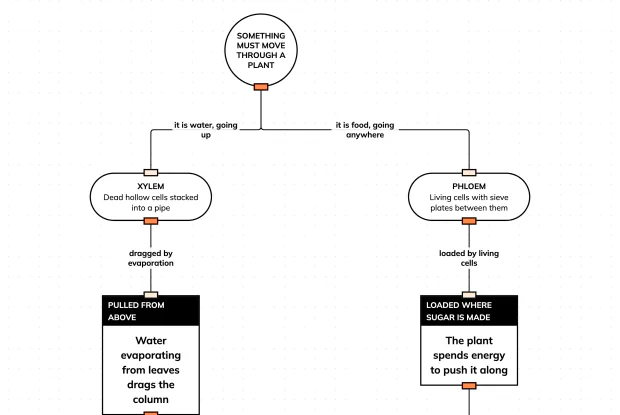
A plant has two transport tissues. Xylem carries water upward through dead hollow cells; phloem carries dissolved sugar in either direction through living ones. Follow both in an interactive playground.
What Lines, Covers and Holds an Animal Together?
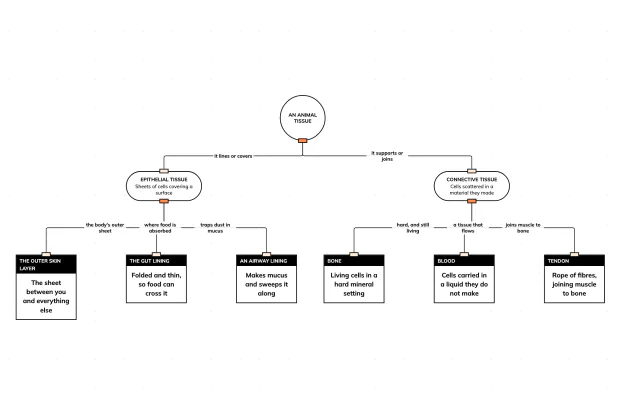
Epithelial tissue covers every surface of an animal, inside and out. Connective tissue fills the space between and holds the rest together — including bone and blood. Sort six examples in an interactive playground.
Muscle and Nerve: the Two Tissues That Act
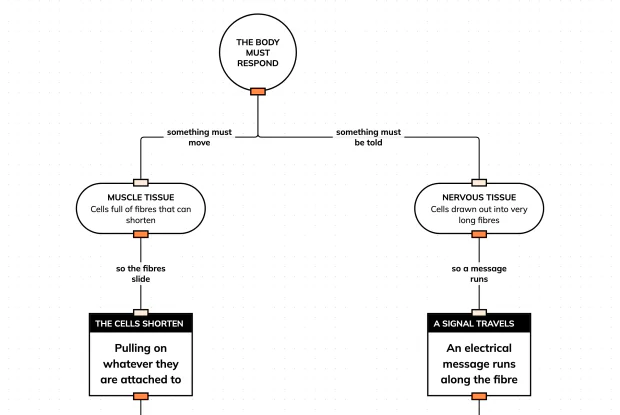
Muscle tissue is cells that shorten; nervous tissue is cells drawn out into fibres that carry signals. Neither can do the other job, and most responses need both. Compare them in an interactive playground.