Muscle and Nerve: the Two Tissues That Act
Root Concept
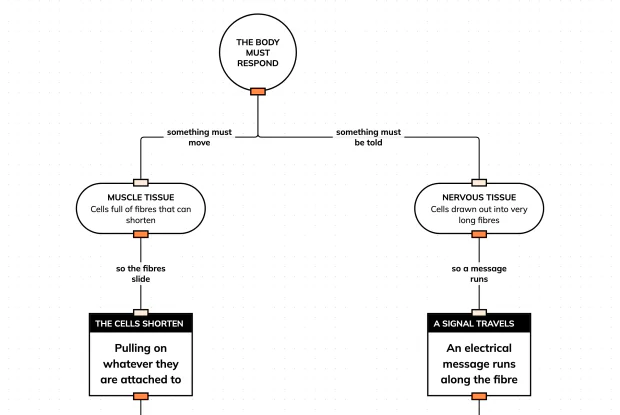
Muscle tissue acts by shortening; nervous tissue acts by carrying a signal, and neither can do the other job.
CodePLU Goal
Upgrading Human Mental Models
Learn how to think in Workflows

Concept Development By codeplu.com
Both begin with the body needing to respond. One ends in movement and the other in the decision about when to move.
Doing, Rather Than Holding
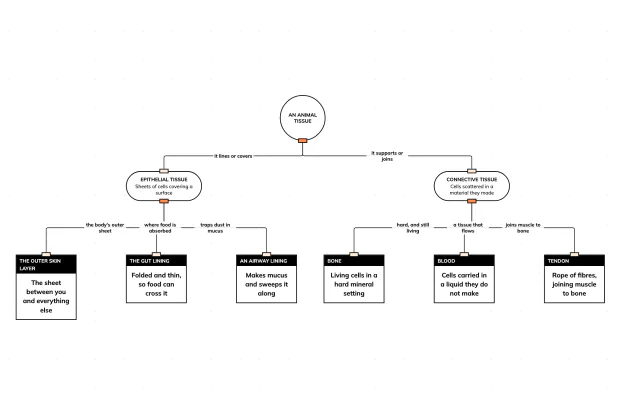
The last tutorial covered the two tissue families that cover surfaces and fill space. They are the bulk of a body and they are, in a sense, passive: a sheet of epithelium sits there being a boundary, and bone sits there being a frame. This tutorial is about the other two, which exist to do something.
Muscle tissue is cells that can shorten. That is the whole of what muscle does, and it is worth stating plainly, because the commonest misconception in the topic follows from forgetting it: a muscle can only pull, never push. Everything from lifting an arm to squeezing food along your gut to emptying your heart is one set of cells getting shorter and dragging something with them.
Nervous tissue does the opposite kind of job. Its cells are drawn out into fibres that can be startlingly long — a single one can run from the base of your spine to your foot — and they carry electrical signals from one end to the other. A nerve cell moves nothing at all. It carries the instruction, and something else does the moving, which is why almost every response in an animal needs both tissues working together.
Shortening, Signalling, and Why Both Are Needed
How does a muscle cell shorten?
By sliding, not by shrinking. A muscle cell is packed with two kinds of protein filament lying alongside one another, and when the cell is triggered the filaments pull themselves past each other so the whole cell becomes shorter and fatter. Nothing is compressed and no material is lost. Because the filaments can only pull themselves together, the cell can only shorten — and so a muscle can only pull. That is why muscles are arranged in opposing pairs: the biceps bends the elbow and the triceps on the other side straightens it, because neither one can push the joint back, and each has to be undone by its partner rather than by itself.
Are all muscles the same?
There are three kinds, and the differences are about control rather than mechanism. Skeletal muscle is attached to bones and is under conscious control — you decide to move your arm. Smooth muscle lines the gut, the bladder and blood vessels and works without you knowing, squeezing food along and adjusting how wide a vessel is. Cardiac muscle is found only in the heart, contracts rhythmically without being told to by anything outside itself, and does not tire. All three shorten in the same way; what differs is who gives the order and whether they can keep going indefinitely without rest. A heart that tired would be a serious design fault, and a bicep that did not would be very hard to control.
What does a nerve cell actually do?
Carries a signal quickly from one place to another, and nothing else. A nerve cell has a cell body with the nucleus in it and one very long fibre running away from it, often wrapped in a fatty sheath that makes the signal travel faster. The signal is electrical along the fibre and chemical at the junction where one nerve cell meets the next or meets a muscle. Speed is the whole point: diffusion could never carry a message from your foot to your brain in any useful time, and a signal travelling tens of metres per second can do it before you notice. Length and speed are the two properties the whole tissue is built around.
Why does a response need both?
Because deciding and doing are different jobs and no single cell is built for both. Touch something hot and sensory nerve cells carry a signal from your skin inwards; the spinal cord makes the decision; motor nerve cells carry the order out to the muscles of your arm; the muscle shortens and the arm moves. Four stages, two tissue types, and the whole thing takes a fraction of a second. Remove the nervous tissue and the muscle has no idea when to contract. Remove the muscle and the decision has nothing whatever to act on. The two tissues are useless separately and together account for nearly everything an animal does.
Real World Example
Pulling Your Hand Off Something Hot
A reflex is the clearest demonstration of what each tissue contributes, because it happens too fast for anything else to be involved.
Step 1
A nerve carries the news inward
Heat-sensitive endings in the skin of your fingertip generate a signal, and a sensory nerve fibre carries it up your arm towards the spinal cord. The fibre is a single cell running most of that distance, which is why nervous tissue contains the longest cells in the body by a wide margin. Nothing has moved yet and nothing has been decided — this stage is pure information transfer, and it is the one job muscle tissue could not do at any speed that would be useful to an animal. Information has to arrive before anything can usefully happen.
Step 2
The decision is made short of the brain
The signal arrives at the spinal cord and is passed almost immediately to a motor nerve heading back out, without waiting to travel up to the brain. That shortcut is what makes a reflex fast: the journey to the brain and back would add a delay you would notice, and for a burn the delay matters a great deal. Your brain is informed, but it finds out at roughly the same moment your arm is already moving, which is why the jerk feels as though it happened entirely without you having anything to do with it, because in a real sense it did.
Step 3
Muscle does the only thing it can
The motor nerve reaches the muscles of your upper arm and triggers them, the filaments inside slide past each other, the cells shorten and your forearm is pulled upward. Notice that nothing pushed your hand away — the arm was pulled back by a muscle contracting on one side of the joint, because pulling is the only action available to any muscle anywhere. Two tissues, each doing the single thing it is built for, and the whole sequence finishing in well under a second from the first touch to the arm being clear of the heat.
FAQs
Final Words
Muscle and nervous tissue are the two that act rather than hold. A muscle cell shortens by sliding filaments past one another, which means it can only ever pull — so muscles come in opposing pairs, and the three types differ in who controls them rather than in how they work. A nerve cell moves nothing and carries a signal very fast along a fibre that can be more than a metre long.
Neither can do the other job, which is why nearly every response needs both: nerve to carry the news and the order, muscle to do the pulling. That completes the four animal tissue families and closes this track. You can now take any part of a plant or an animal and say what tissue it is, what that tissue does, and which level of organisation it belongs to.
Continue This Track
This concept is part 5 of When Cells Take On a Job.
Why Does a Big Organism Need Tissues at All?
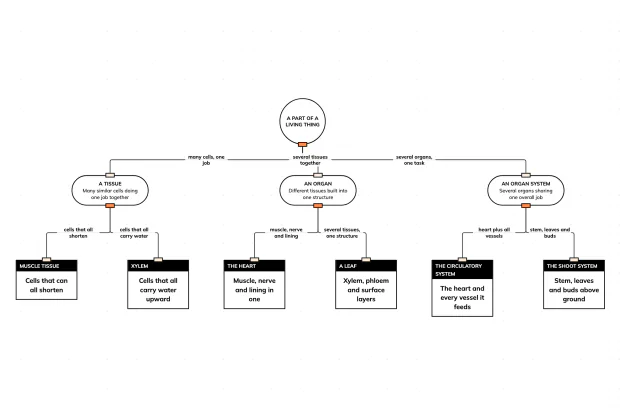
A single cell does every job itself. In a large organism the jobs are split between groups of specialised cells — tissues — which build organs and then systems. Sort six examples by level in an interactive playground.
Where Does a Plant Actually Grow From?
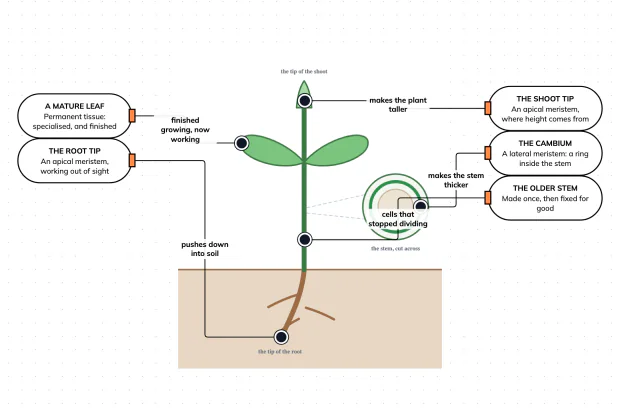
A plant grows only at its tips and from a ring inside its stem. Everywhere else is permanent tissue that has specialised and stopped dividing. Find the growth regions in an interactive playground.
Xylem and Phloem: Two Pipes Going Opposite Ways
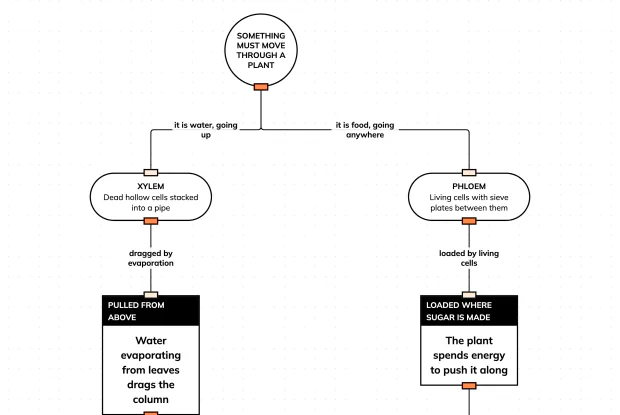
A plant has two transport tissues. Xylem carries water upward through dead hollow cells; phloem carries dissolved sugar in either direction through living ones. Follow both in an interactive playground.
What Lines, Covers and Holds an Animal Together?
Epithelial tissue covers every surface of an animal, inside and out. Connective tissue fills the space between and holds the rest together — including bone and blood. Sort six examples in an interactive playground.
Muscle and Nerve: the Two Tissues That Act
Muscle tissue is cells that shorten; nervous tissue is cells drawn out into fibres that carry signals. Neither can do the other job, and most responses need both. Compare them in an interactive playground.