Where Does a Plant Actually Grow From?
Root Concept
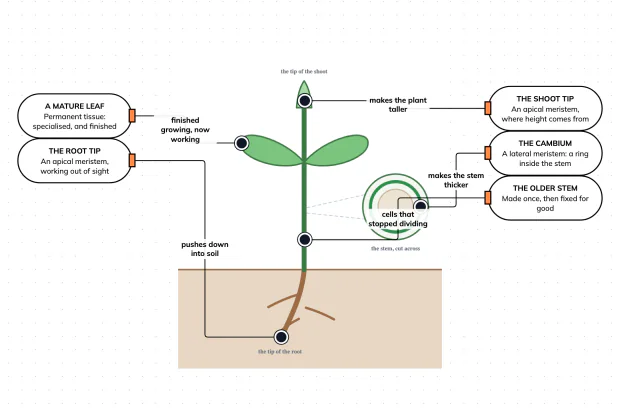
New plant cells are made only in meristems — at the tips of shoots and roots, and in a ring inside the stem.
CodePLU Goal
Upgrading Human Mental Models
Learn how to think in Workflows

Concept Development By codeplu.com
Only three small regions make new cells. Everything else on the plant was made once and then specialised.
Growth Happens in Very Few Places
An animal grows more or less all over. A child's arm gets longer because cells throughout it divide, and the whole limb enlarges together. Plants do not work that way at all, and the difference is sharper than almost anyone expects before they are told.
A plant makes new cells in a few small regions and nowhere else. Those regions are called meristems, and they are the only places in the entire plant where cells are still dividing. Everything else — every mature leaf, every length of older stem, every root that has stopped extending — is permanent tissue: cells that divided once, took on a shape and a job, and will never divide again.
This has a consequence you can test. Hammer a nail into a tree trunk a metre above the ground and come back in twenty years: the nail is still a metre above the ground. The trunk has grown thicker around it but not taller beneath it, because height is added only at the tips. The playground below asks you to find the three growth regions on a plant and the two places that are finished work.
Three Growth Regions, and What Everything Else Is
What is a meristem?
A region of cells that have kept the ability to divide. Meristem cells are small, thin-walled, packed with cytoplasm and have little or no vacuole — all signs of a cell that is building rather than storing. They divide repeatedly, and each division leaves one cell behind to carry on dividing while the other is free to enlarge and specialise into whatever the plant needs there. That arrangement is what lets a plant keep growing throughout its life rather than reaching a final size, and it is why a tree can still be adding wood after two hundred years while an animal of any age has long since stopped growing.
Why do the tips make a plant longer?
Because that is where the apical meristems sit — one just behind the tip of every shoot and one just behind the tip of every root. New cells are produced there and then stretch, and it is the stretching that does most of the actual lengthening. The root tip has a tough cap of cells over it, constantly worn away and replaced, protecting the dividing region as it is pushed through the soil. Pinching out the growing tip of a plant removes its apical meristem, which is why gardeners do it: the plant cannot extend that shoot any further and puts its effort into side branches instead, which is the whole basis of pruning.
What makes a stem get thicker?
A completely separate meristem, shaped as a thin ring running the whole length of the stem just inside the surface. It is called the cambium, and because it is buried you cannot see it without cutting across the stem — which is why the figure shows a cut-away. Cells divide outwards and inwards from this ring, adding new tissue year after year, and in a tree the inward layers build up as wood. The rings you count in a cut tree trunk are the record of that ring working faster in spring and slower in autumn, one pair of bands for each year. Nothing in the trunk below is changing while that happens.
What does "permanent tissue" mean?
Tissue made of cells that have finished dividing and taken on their final form. The word permanent is about the cells' state rather than how long they last: a leaf is permanent tissue and still falls off in autumn. Once a cell has specialised — filled itself with chloroplasts, thickened its walls, or hollowed out into a tube — it has committed, and a plant cannot usually undo that. Everything on a plant that is doing a job rather than making new cells falls into this category, which is the overwhelming majority of it by volume — a tree is almost entirely finished tissue, with a few millimetres of meristem.
Real World Example
Why a Hedge Gets Denser When You Cut It
Cutting a plant back makes it bushier, which sounds backwards until you know where the dividing cells are and what keeps the side ones switched off.
Step 1
The tip suppresses the buds below it
A growing shoot tip does more than extend itself: it releases a chemical signal that travels down the stem and keeps the side buds dormant. Those buds are meristems too, fully capable of growing into branches, but while the tip is active they stay shut. The effect is called apical dominance, and it is why an unpruned plant often grows tall and leggy with long bare stretches of stem — all the effort goes into the one tip at the top, which is the only place the plant is currently making new cells above ground.
Step 2
Cutting removes the signal, not the ability
Clip the top off and the apical meristem goes with it, so the suppressing signal stops. The side buds further down are untouched and still perfectly able to divide, and within days several of them break and start growing into branches of their own. Nothing was added by the cut; something was removed. This is also why the timing matters to a gardener: cut above a bud and that bud takes over, cut in the middle of a bare stretch and there is no meristem left nearby to respond, and that stem simply stays bare.
Step 3
Each new branch has its own tip
Every shoot that breaks out carries its own apical meristem, so where there was one growing point there are now several, each lengthening and each suppressing the buds below itself. Cut those back and the process repeats, which is how a hedge becomes dense enough to be a screen rather than a row of thin stems. A hedge trimmer is doing nothing more sophisticated than removing apical meristems over and over, and the plant responds the same way every time because the mechanism never changes, however often it is repeated over the years, and whatever the species.
FAQs
Final Words
A plant grows from very few places. Apical meristems at the tip of every shoot and every root add length, and a lateral meristem called the cambium — a ring hidden inside the stem — adds thickness. Those regions are the only ones still dividing, and everything else on the plant is permanent tissue that specialised once and finished.
That single fact explains a nail staying at the same height in a tree for twenty years, the rings in a cut trunk, and why cutting a hedge back makes it denser rather than thinner. The next tutorial follows what those meristems build: two sets of tubes running through the whole plant, carrying different things in opposite directions.
Continue This Track
This concept is part 2 of When Cells Take On a Job.
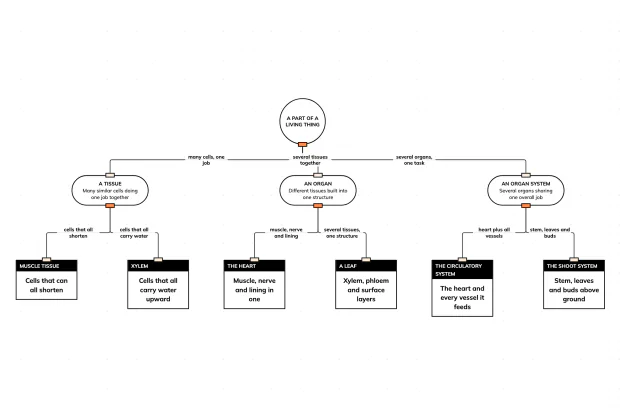
Why Does a Big Organism Need Tissues at All?
A single cell does every job itself. In a large organism the jobs are split between groups of specialised cells — tissues — which build organs and then systems. Sort six examples by level in an interactive playground.
Where Does a Plant Actually Grow From?
A plant grows only at its tips and from a ring inside its stem. Everywhere else is permanent tissue that has specialised and stopped dividing. Find the growth regions in an interactive playground.
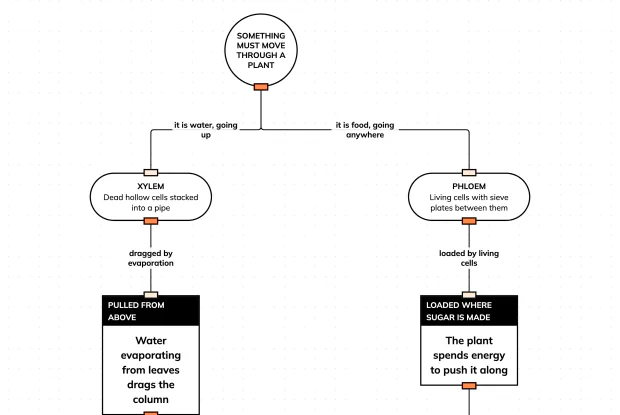
Xylem and Phloem: Two Pipes Going Opposite Ways
A plant has two transport tissues. Xylem carries water upward through dead hollow cells; phloem carries dissolved sugar in either direction through living ones. Follow both in an interactive playground.
What Lines, Covers and Holds an Animal Together?
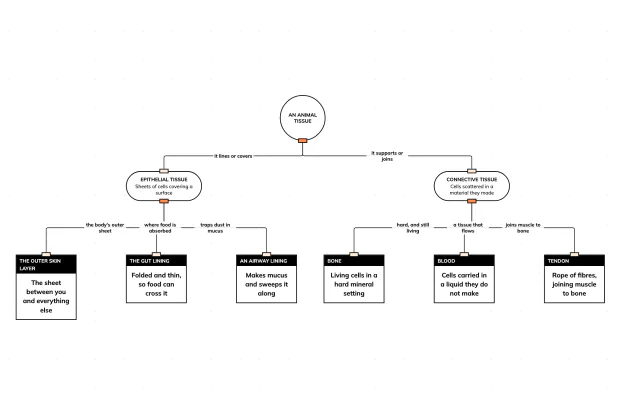
Epithelial tissue covers every surface of an animal, inside and out. Connective tissue fills the space between and holds the rest together — including bone and blood. Sort six examples in an interactive playground.
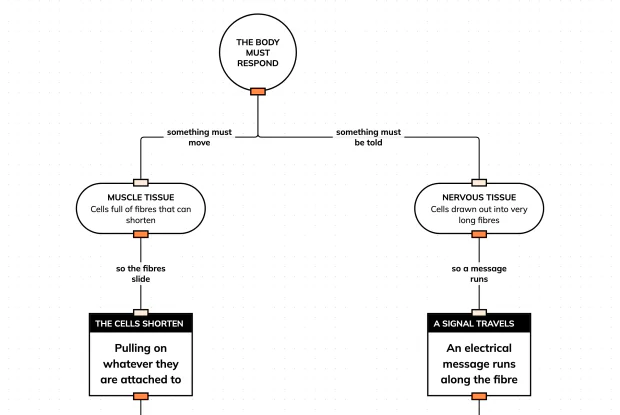
Muscle and Nerve: the Two Tissues That Act
Muscle tissue is cells that shorten; nervous tissue is cells drawn out into fibres that carry signals. Neither can do the other job, and most responses need both. Compare them in an interactive playground.