How Do You Turn a Word Problem Into an Equation?
Root Concept
Translating is mechanical once the unknown has a name: each phrase in the sentence becomes one piece of the equation, in the order it is said.
CodePLU Goal
Upgrading Human Mental Models
Learn how to think in Workflows

Concept Development By codeplu.com
Name the unknown, then match each equation to the situation it describes
Why Is the Hardest Part Before Any Solving?
Most people who say they cannot do word problems can solve the equations perfectly well. What stops them is the step before: turning a sentence about parcels or ages or money into a line of algebra. That step feels like it needs inspiration, and it does not. It needs a name for the unknown and a careful reading, in that order.
Start by asking what the question is actually asking for, and give that thing a letter. If the question is how heavy one parcel is, then let x be the weight of one parcel — not the total, not the number of parcels. Writing down let x be the weight of one parcel, in words, takes five seconds and prevents more errors than any other habit in this topic.
Then translate the sentence in the order it is said. Twice a number becomes 2x. Plus three becomes + 3. Gives eleven becomes = 11. Put them together and you have 2x + 3 = 11, and the hard part is over. In the playground below you will match three equations to the situations they describe, with two situations that look very similar and are not.
How Does a Sentence Become an Equation?
What should the letter stand for?
The thing the question asks for, and usually one of it rather than all of it. If three equal parcels weigh twelve kilograms and you are asked the weight of one, let x be the weight of one parcel; then three of them is 3x and the equation is 3x = 12. Choosing x to be the total weight instead leaves you with an equation that is true but useless, because it does not contain the thing you want. Write the choice down in words before writing any algebra. It feels slow and it is the difference between a translation you can trust and one you have to re-derive halfway through. If a problem has two unknowns, pick the one everything else can be described in terms of.
Which words become which symbols?
A small vocabulary covers almost everything at this level. Is, gives, comes to and equals all become the equals sign. More than, increased by and plus become addition. Less than, reduced by and take away become subtraction. Twice, three times and of become multiplication. Shared equally between becomes division. Two of these need care. More than reverses the order it is written in — five more than a number is x + 5, which happens to come out the same, but three less than a number is x − 3 and not 3 − x, which is a genuinely different quantity. And of means multiply, so half of a number is x ÷ 2.
How do you check the translation before solving it?
Try a number in both the sentence and the equation and see whether they agree. Take three less than a number is seven. Guess the number is ten: the sentence says three less than ten, which is seven, and that is right. Now test your equation: if you wrote x − 3 = 7, then ten minus three is seven, so it agrees. If you had written 3 − x = 7, ten would give negative seven, and the disagreement tells you the translation is wrong before you have wasted any time solving it. This takes about ten seconds and catches the reversal errors that are otherwise invisible until the final answer looks strange.
Real World Example
What Does the Translation Look Like Step by Step?
A real question, translated slowly enough that every piece can be pointed at:
The situation in words
Four friends, a service charge, 620 rupees
Four friends eat out and agree to split the food evenly between them. The bill also carries a fixed service charge of sixty rupees, which is not split per dish but added once at the end. The total comes to six hundred and twenty rupees. The question is what each person's share of the food came to. Read that twice before writing anything, because there are three numbers in it and only two of them belong in the equation the same way. The sixty is added once; the share is multiplied by four; and the six hundred and twenty is what the whole thing equals.
Naming the unknown
Let f be one person's food share
The question asks what each person's food came to, so that is what gets the letter: let f be one person's share of the food, in rupees. Notice what f is not. It is not the total food bill, it is not what each person actually pays including service, and it is not the whole bill divided by four. Any of those would be a reasonable thing to want, and each would give a different equation. Writing the sentence out in words pins it down, and it is the single step that separates people who find word problems straightforward from people who find them impossible.
Translating in order
4f + 60 = 620
Now go along the sentence. Four people each paying f for food is 4f. The service charge adds sixty once, so that is + 60. The total comes to six hundred and twenty, so that is = 620. The equation is 4f + 60 = 620, and the translating is finished. Before solving, test it: if each share were a hundred rupees, the bill would be four hundred plus sixty, which is four hundred and sixty — too small, so f must be bigger than a hundred. That sanity check costs nothing and would immediately expose an equation with the sixty in the wrong place.
FAQs
Final Words
Word problems come apart in two steps, and only the first needs any thought. Decide what the question is asking for and give that a letter, writing the choice down in words. Then walk along the sentence turning each phrase into a symbol in the order it is said.
Two habits carry most of the weight: naming one of something rather than a total, and testing the finished equation with a guessed number before solving anything. Get the translation right and the rest of this track is machinery. Next comes the shortcut everybody uses for the machinery — moving a term across the equals sign.
Continue This Track
This concept is part 1 of Solving Equations Properly.
How Do You Turn a Word Problem Into an Equation?
Most of a word problem is done before any solving starts. Learn how to name the unknown and translate a sentence into an equation in an interactive playground.
What Does Moving a Term Across the Equals Sign Do?
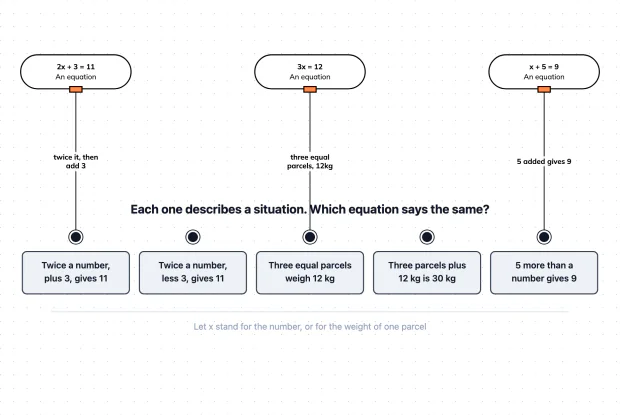
Transposing looks like a separate rule with its own sign-flipping magic. It is the two-sides move with the middle line left out. See what it hides in a playground.
How Do You Solve an Equation With x on Both Sides?
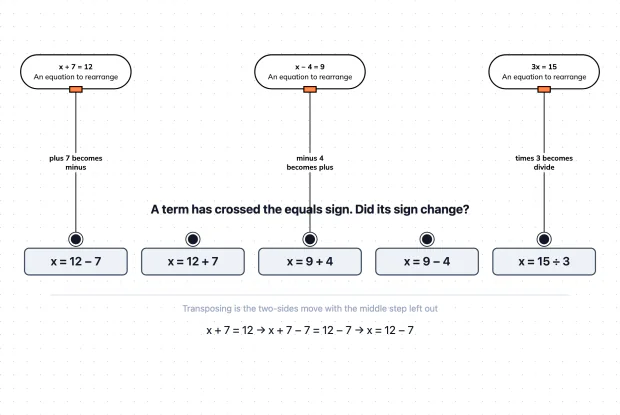
When the letter appears on both sides, one extra move comes first: collect the letters onto one side. Walk the whole solution on a balance scale in a playground.
How Do You Solve an Equation That Has Brackets?
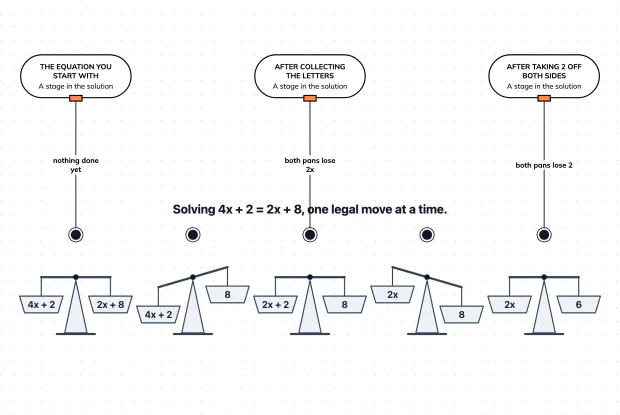
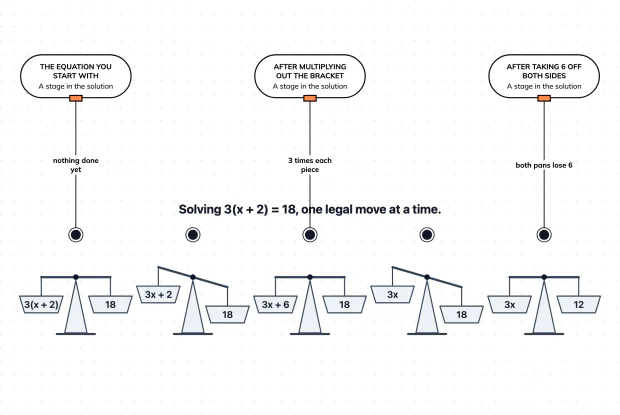
A bracket in an equation can be multiplied out, or it can be divided away. Learn both routes and follow the solution on a balance scale in an interactive playground.
How Do You Solve an Equation With a Fraction in It?
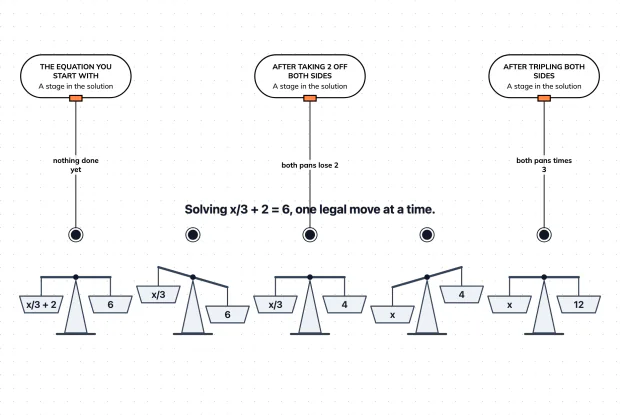
A fraction in an equation is a division waiting to be undone by a multiplication. Learn how to clear it and follow the whole solution on a balance scale.
How Do You Check That Your Solution Is Right?
A solution is the value that makes both sides agree, so checking is simply putting it back in. Learn what a check proves and test three values in a playground.