What Does Moving a Term Across the Equals Sign Do?
Root Concept
Transposing is not a new rule: it is doing the same thing to both sides, with the middle line not written down, which is why the sign flips.
CodePLU Goal
Upgrading Human Mental Models
Learn how to think in Workflows

Concept Development By codeplu.com
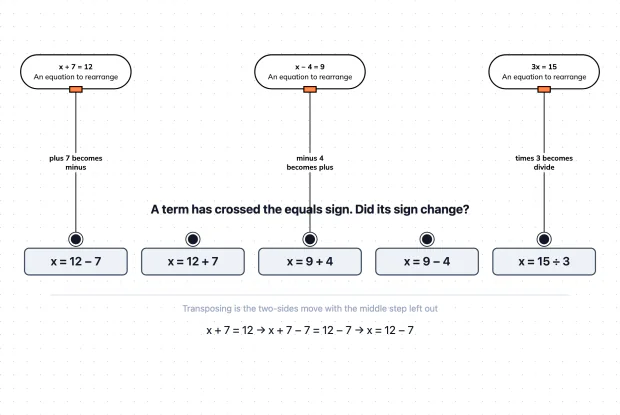
One term moves in each — match it to the line that correctly follows
Is Moving a Term a Rule of Its Own?
Somewhere early on, most people are told that you can move a term to the other side of an equation as long as you change its sign. It works, it saves a line of writing, and it is almost always taught without any reason attached. That missing reason is why so many people end up flipping signs at random when the equation gets harder.
Here is the whole of it. Start with x + 7 = 12. Subtract seven from both sides, which is the move you already know is allowed, and you get x + 7 − 7 = 12 − 7. The left side tidies to x, and the right is 12 − 7. So x = 12 − 7. Now compare the first line and the last: the + 7 has vanished from the left and a − 7 has appeared on the right.
That is transposing. Nothing crossed the equals sign and nothing changed its mind about being positive; a subtraction was applied to both sides and the middle line was not written down. In the playground below, five results are shown for three starting equations, and two of them are exactly what you get if the sign is not flipped.
Why Does the Sign Change?
What is really happening when a term moves?
The opposite operation is being applied to both sides. A term that is added gets subtracted from both sides, so it appears on the other side as a subtraction. A term that is subtracted gets added, so it appears as an addition: from x − 4 = 9 you get x = 9 + 4. Multiplication and division work the same way, which is the part most often forgotten. In 3x = 15 the x is multiplied by three, so both sides are divided by three and you get x = 15 ÷ 3. The sign does not flip there because there is no sign to flip — the operation inverts instead. Saying change the sign covers only half the cases, which is exactly why knowing the reason beats memorising the slogan.
When should you write the middle line out?
While you are learning, and whenever an equation is long enough to lose track in. The middle line is the one that shows both sides changing identically, and writing it makes every step checkable by somebody else — including you, tomorrow. Once the move is automatic, skipping it saves real time and nobody will mark you down. The danger sits in between: abandoning the middle line before the move is automatic is how people start moving terms without flipping, or flipping terms that never moved. A good test of readiness is whether you can say out loud which operation you applied to both sides. If you cannot, write the line.
What goes wrong when people use it as a rule?
Two things, and both appear in the playground. The first is not flipping at all, so x + 7 = 12 becomes x = 12 + 7 and the answer comes out nineteen instead of five. Substituting back catches it instantly: nineteen plus seven is twenty-six, not twelve. The second is flipping a term that has not moved anywhere, usually when tidying up one side of an equation — signs only change when a term crosses the equals sign, never when terms are simply collected on the same side. Many beginners also try to transpose part of a term, moving the 3 out of 3x while leaving the x behind. A term travels whole or not at all.
Real World Example
What Does Moving a Term Look Like on the Scales?
The balance picture makes transposing look like what it is — taking the same thing off both pans:
The situation
parcel + 7 kg tray = 12 kg
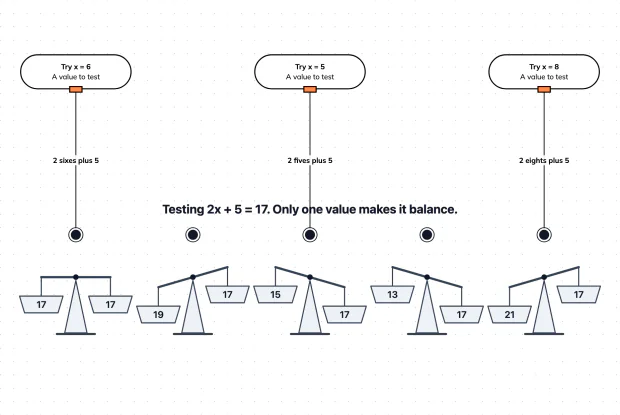
You put a parcel onto a weighing tray and the display reads twelve kilograms. The tray itself weighs seven kilograms, and the display is including it. In symbols that is x + 7 = 12, where x is the parcel. Physically, the left pan holds a parcel and a tray, and the right pan holds twelve kilograms of weights, and the two sides balance. Nobody would call this algebra, but every step that follows is something you could actually do with your hands, which is the point of keeping the picture in mind. The question is how to get the tray out of the reading without disturbing the balance.
Taking seven off both pans
x = 12 − 7
Lift the seven kilogram tray off the left pan. The scales tip immediately, so to restore the balance you take seven kilograms of weights off the right pan as well. Now the left holds only the parcel and the right holds five kilograms, and they balance again. Written down, the middle line is x + 7 − 7 = 12 − 7, and the finished line is x = 12 − 7. The seven has not crossed anything. It was removed from both sides, and the arithmetic on the right is what is left over.
Why the shortcut looks like magic
+ 7 goes, − 7 appears
Put the first line and the last line side by side and hide the middle. On the left, a seven that was being added has gone. On the right, a seven is now being subtracted. It looks exactly as though the term walked across the equals sign and changed its sign on the way, which is why that is how people describe it. The description is a summary of the outcome rather than an account of the mechanism, and it is fine to use once you know what it is summarising. Use it before then and the sign flips become guesswork.
FAQs
Final Words
Transposing is not a rule of its own. Applying the opposite operation to both sides and leaving out the middle line makes it look as though a term walked across the equals sign and changed its sign on the way. Knowing that is what makes the shortcut safe to use.
It also tells you what to do when there is no sign to flip: a multiplied term inverts to a division rather than changing sign. Write the middle line until the move is automatic. Next comes the first equation where the letter appears on both sides at once.
Continue This Track
This concept is part 2 of Solving Equations Properly.
How Do You Turn a Word Problem Into an Equation?
Most of a word problem is done before any solving starts. Learn how to name the unknown and translate a sentence into an equation in an interactive playground.
What Does Moving a Term Across the Equals Sign Do?
Transposing looks like a separate rule with its own sign-flipping magic. It is the two-sides move with the middle line left out. See what it hides in a playground.
How Do You Solve an Equation With x on Both Sides?
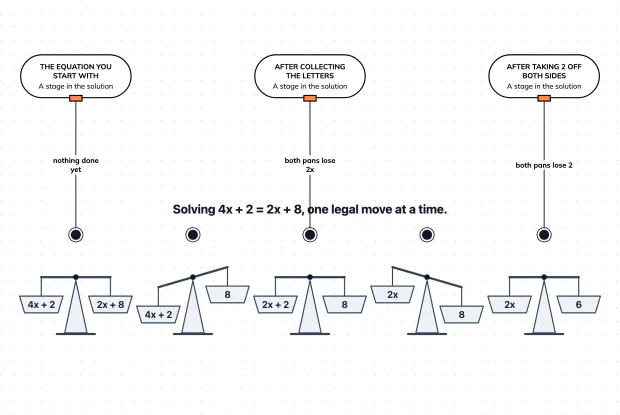
When the letter appears on both sides, one extra move comes first: collect the letters onto one side. Walk the whole solution on a balance scale in a playground.
How Do You Solve an Equation That Has Brackets?
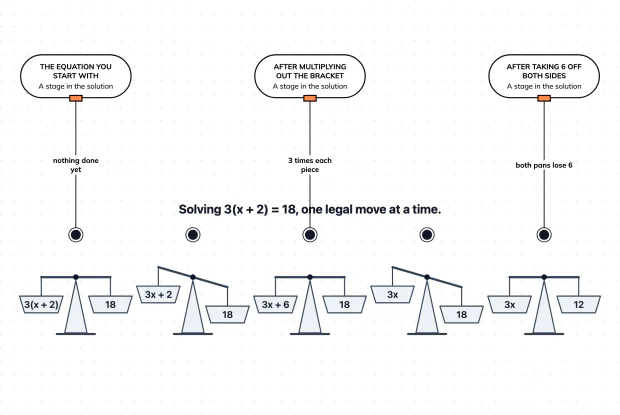
A bracket in an equation can be multiplied out, or it can be divided away. Learn both routes and follow the solution on a balance scale in an interactive playground.
How Do You Solve an Equation With a Fraction in It?
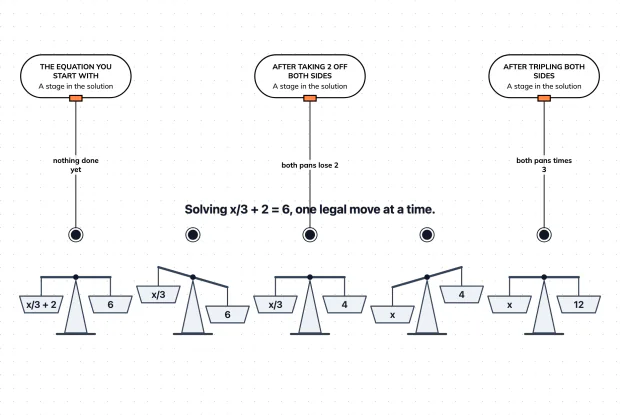
A fraction in an equation is a division waiting to be undone by a multiplication. Learn how to clear it and follow the whole solution on a balance scale.
How Do You Check That Your Solution Is Right?
A solution is the value that makes both sides agree, so checking is simply putting it back in. Learn what a check proves and test three values in a playground.