How Do You Solve an Equation With a Fraction in It?
Root Concept
Dividing by three is undone by multiplying by three, so a fraction is cleared the same way any other operation is — by doing its opposite to both sides.
CodePLU Goal
Upgrading Human Mental Models
Learn how to think in Workflows

Concept Development By codeplu.com
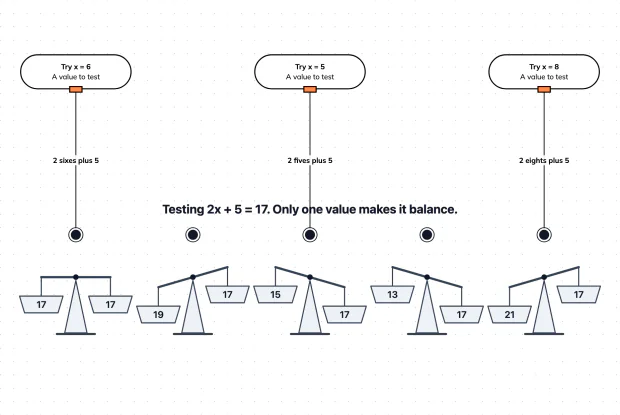
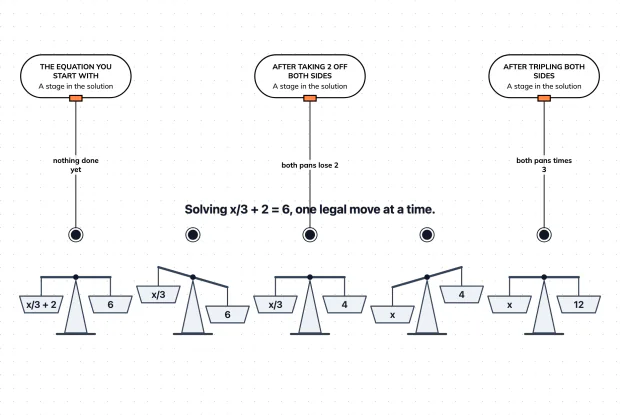
Clear the number, then undo the division — match each stage to its scale
Why Does a Fraction Make an Equation Look Harder?
x/3 + 2 = 6 tends to stop people who could solve 2x + 3 = 11 without blinking, and the reason is presentation rather than difficulty. A fraction looks like a new kind of object. It is not. x/3 simply means x divided by three, and division is something you already know how to undo.
Work in the usual order and it comes apart cleanly. First clear the loose number: take two off both sides and you have x/3 = 4. Now deal with the division. Multiplying by three undoes dividing by three, so multiply both sides by three and you get x = 12. Two moves, both of them ones you have used before.
On the scales, the left pan holds a third of the parcel plus two loose weights. Take two off each pan, then triple what is on both pans, and you end up with a whole parcel against twelve. In the playground below you match each stage to its scale, and two of the scales show a move that reached one pan and not the other.
How Do You Get Rid of the Fraction?
What does a fraction in an equation actually mean?
It means a division, written the compact way. x/3 is x divided by three, and it behaves exactly as any other division does. That matters because it tells you the inverse without having to remember a separate fraction rule: dividing by three is undone by multiplying by three, and that is the whole technique. Be careful about which part is divided, though. In x/3 + 2 only the x is over the three; the 2 is not. That is a genuinely different equation from (x + 2)/3, where the whole of x + 2 is divided. Reading which pieces are inside the division is the first thing to do, and a wrong reading here produces a tidy, confident and completely wrong answer.
Should you clear the fraction first or last?
Usually last, when only one term is a fraction. Clearing the loose numbers first leaves x/3 = 4, and then a single multiplication finishes it. If you multiply everything by three at the very start instead, you get x + 6 = 18, which is also correct and also solvable — just remember that multiplying both sides means every term on both sides, including the 2 and the 6. Forgetting one of them is the usual error with this approach. When an equation has several fractions with different bottom numbers, clearing them all at the start is clearly better: multiply through by a number that all the bottoms divide into, and the whole thing turns into an ordinary equation in one move.
What if the letter is on the bottom of the fraction?
Then the equation is a different animal and the method changes, which is worth knowing so you can spot it rather than solve it wrongly. In 12/x = 3, the unknown is the thing you are dividing by, so multiplying both sides by three does not help. Multiply both sides by x instead and you get 12 = 3x, which is ordinary again. One extra condition comes with it: x cannot be zero, because dividing by zero is undefined. At this level you will mostly meet the letter on top, but recognising the other shape stops you applying a method that was never built for it.
Real World Example
Where Would a Fraction Turn Up Naturally?
Fractions appear in equations whenever something has been split up before you were told about it:
The situation
A third of the prize, plus 2000
A quiz prize is shared equally between three teammates. One of them also had a separate two thousand rupee voucher, and she ends the day with six thousand rupees in total. The question is what the whole prize was. Let x be the full prize. Her share of it is x divided by three, written x/3, and adding the voucher gives her total. Notice that the voucher is not divided by anything — it was hers alone — which is exactly why the equation has the 2000 outside the fraction rather than inside it. Getting that placement right is most of the work in this question.
Writing it down
x/3 + 2000 = 6000
The equation is x/3 + 2000 = 6000. Before solving, check the reading against the story: if the whole prize were nine thousand, her share would be three thousand, plus two thousand makes five thousand, which is less than six — so the prize must be larger than nine thousand. That takes a few seconds and confirms the equation describes the situation properly. Had somebody written (x + 2000)/3 = 6000 instead, they would be claiming the voucher was shared out between all three, which is a different and wrong story with a different and wrong answer.
Clearing the fraction
x = 12000
Take two thousand off both sides, which leaves x/3 = 4000: her share of the prize alone was four thousand. Now undo the division by multiplying both sides by three, giving x = 12000. The whole prize was twelve thousand rupees. Check it against the story rather than the algebra: twelve thousand split three ways is four thousand each, plus her two thousand voucher makes six thousand, which is what she ended with. Each step also meant something on its own — the four thousand was a real number about her share, not just a line of working.
FAQs
Final Words
A fraction in an equation is only a division written compactly, so it is undone the way any division is — multiply both sides by the number underneath. Clear the loose numbers first and the multiplication is the last move, leaving the letter alone.
Read carefully what is inside the division before anything else, because x/3 + 2 and (x + 2)/3 are different equations with different answers. And if you clear the fraction at the start instead, every term on both sides has to be multiplied. Next comes the step that catches all of these mistakes: checking.
Continue This Track
This concept is part 5 of Solving Equations Properly.
How Do You Turn a Word Problem Into an Equation?
Most of a word problem is done before any solving starts. Learn how to name the unknown and translate a sentence into an equation in an interactive playground.
What Does Moving a Term Across the Equals Sign Do?
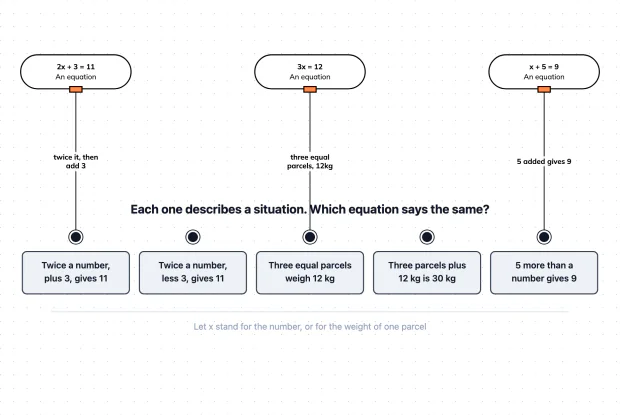
Transposing looks like a separate rule with its own sign-flipping magic. It is the two-sides move with the middle line left out. See what it hides in a playground.
How Do You Solve an Equation With x on Both Sides?
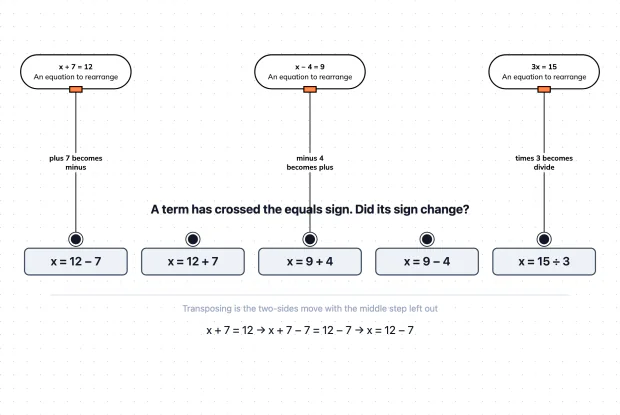
When the letter appears on both sides, one extra move comes first: collect the letters onto one side. Walk the whole solution on a balance scale in a playground.
How Do You Solve an Equation That Has Brackets?
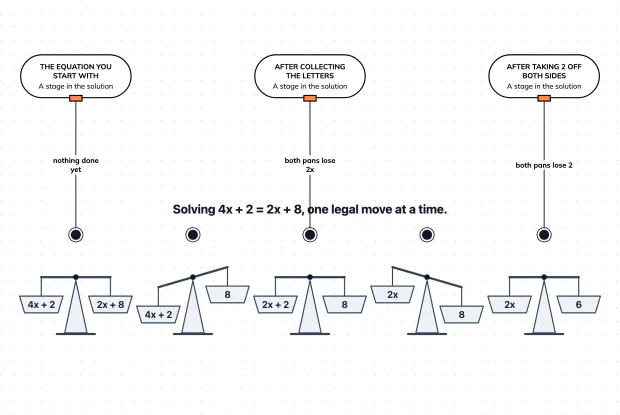
A bracket in an equation can be multiplied out, or it can be divided away. Learn both routes and follow the solution on a balance scale in an interactive playground.
How Do You Solve an Equation With a Fraction in It?
A fraction in an equation is a division waiting to be undone by a multiplication. Learn how to clear it and follow the whole solution on a balance scale.
How Do You Check That Your Solution Is Right?
A solution is the value that makes both sides agree, so checking is simply putting it back in. Learn what a check proves and test three values in a playground.