How Do You Check That Your Solution Is Right?
Root Concept
A solution is defined as the value that makes both sides equal, so substituting it back is not a formality — it is the definition being tested directly.
CodePLU Goal
Upgrading Human Mental Models
Learn how to think in Workflows

Concept Development By codeplu.com
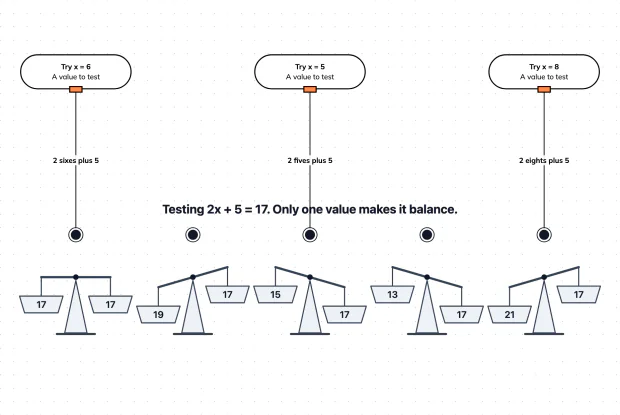
Only the true solution makes both pans balance — test each value
Why Is Substituting Back Worth the Ten Seconds?
Checking gets treated as the tidy thing you do if there is time left. It is better than that. An equation is a claim that two sides are equal, and a solution is exactly the value that makes the claim true. So putting your answer back in and seeing whether both sides agree is not a ritual — it is testing the definition directly.
Take 2x + 5 = 17 and suppose you have worked out that x is 6. Work out the left side on its own: two sixes are twelve, plus five is seventeen. The right side is seventeen. They match, so six is genuinely a solution, and you now know it rather than hoping it. Try five instead and the left gives fifteen against a right of seventeen, so five is not.
The important detail is that you substitute into the ORIGINAL equation, not into a line halfway down your working. If you made a mistake in line two, checking against line three will happily agree with itself and tell you nothing. In the playground below, three candidate values are tested against 2x + 5 = 17, and only one of the scales balances.
What Does Checking Actually Prove?
How do you carry out the check?
Work out each side separately and compare the two numbers at the end. Do not work across the equals sign as though it were part of one long sum, because that is how people accidentally confirm their own error. For 2x + 5 = 17 with x as 6: left side, two times six is twelve and adding five gives seventeen. Right side, seventeen. Seventeen equals seventeen, so it holds. Write the two results down rather than doing it in your head, especially under exam pressure — a check performed entirely in your head tends to agree with whatever you already believe. The whole thing takes about ten seconds and it is the cheapest insurance in mathematics.
Why must you use the original equation?
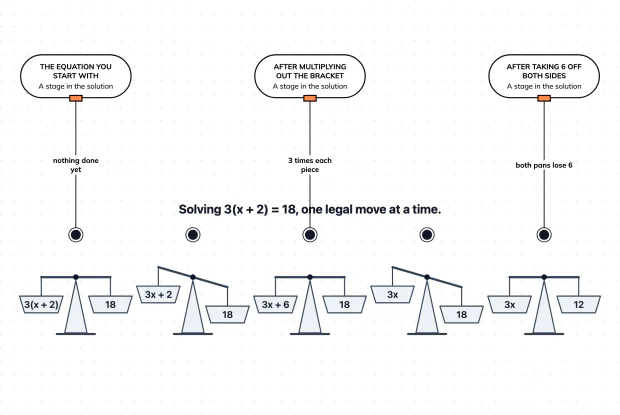
Because an error made early gets copied into everything after it. Suppose you are solving 3(x + 2) = 18 and you expand it wrongly as 3x + 2 = 18. From there you would get 3x = 16 and an answer of about 5.33. Check that against your own wrong second line and it fits perfectly, because the mistake is baked into it. Check it against the original and the left side gives 3 times 7.33, which is about 22, not 18 — and the disagreement points straight at the expansion. This is the single most valuable habit in the whole of solving: the original equation is the only line you know for certain is right.
What does it mean if the two sides disagree?
That something is wrong, but not yet where. The usual culprits are in a short list: a sign that did not flip when a term crossed the equals sign, a minus that stopped at the first term of a bracket, a term left unmultiplied, or plain arithmetic. Work back through your lines and check each one against the line above it until you find the step where they stop agreeing. It is also worth noticing how far out you are, because the size of the gap often names the error — being out by exactly the amount of one term usually means a term went missing, and getting a number twice as large as it should be usually means a division was skipped.
Real World Example
What Does a Check Save You From?
Checking is worth most exactly when the answer will be acted on by somebody else:
The problem
2x + 5 = 17 metres of fencing
A garden needs fencing along two equal sides plus a fixed five metre stretch at the back, and the total ordered is seventeen metres. Somebody wants to know how long each of the two equal sides is, so they can mark the ground out before the fencing arrives. The equation is 2x + 5 = 17. It is not a hard one, and that is rather the point: the mistakes that survive are usually made on easy questions, because nobody slows down for them. The answer is going to be paced out on real grass by somebody holding a tape measure.
The answer, unchecked
x = 11 looks plausible
A hurried solver adds five to both sides instead of subtracting, gets 2x = 22, and lands on x = 11. Nothing about eleven looks alarming. It is a whole number, it is smaller than seventeen, and it would pass a quick glance. The garden gets marked out with two eleven metre sides and a five metre back, which is twenty-seven metres of fence for a seventeen metre order. The error is not caught by inspection, by neatness or by confidence. It is caught by one thing only, and that thing takes ten seconds. Nothing else in the working would have raised a flag.
The ten seconds
22 + 5 is not 17
Put eleven back into the original equation. Left side: two elevens are twenty-two, plus five is twenty-seven. Right side: seventeen. Twenty-seven is not seventeen, so eleven is not the answer, and the check has done its job before anybody bought fencing. Going back, the five should have been subtracted, giving 2x = 12 and x = 6. Check that: two sixes are twelve, plus five is seventeen, which matches. Six metres a side, and this time the tape measure will agree with the arithmetic. Ten seconds against a wasted afternoon and ten metres of fence nobody ordered is not a close contest, and it is the same ten seconds whether the question is easy or hard.
FAQs
Final Words
Checking is not tidiness. An equation claims two sides are equal and a solution is the value that makes that true, so substituting your answer back into the ORIGINAL equation and comparing the two sides is testing the definition itself. Ten seconds, and it catches nearly everything.
Work each side out separately, write both numbers down, and compare. When they disagree, the size of the gap usually points at the error. With this in place the whole method of solving is complete — translate, rearrange, solve, and confirm.
Continue This Track
This concept is part 6 of Solving Equations Properly.
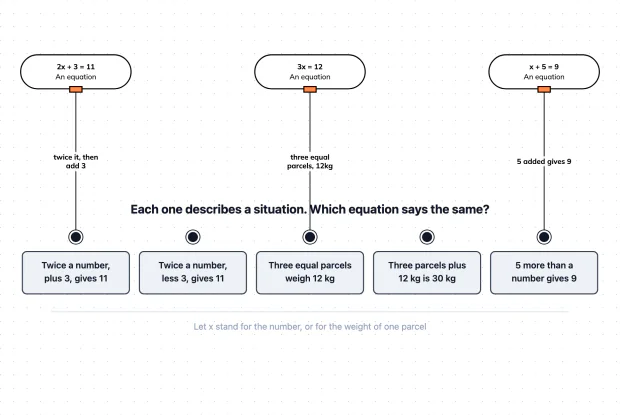
How Do You Turn a Word Problem Into an Equation?
Most of a word problem is done before any solving starts. Learn how to name the unknown and translate a sentence into an equation in an interactive playground.
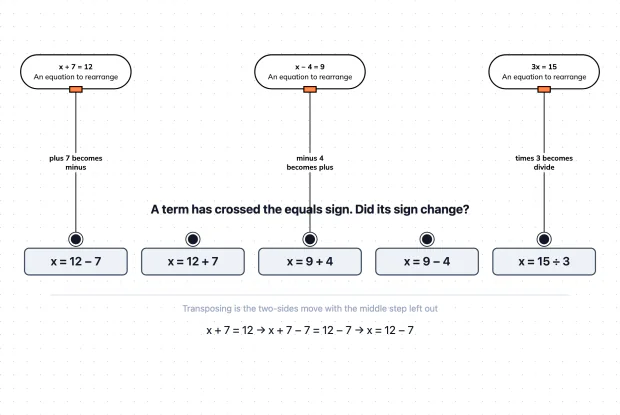
What Does Moving a Term Across the Equals Sign Do?
Transposing looks like a separate rule with its own sign-flipping magic. It is the two-sides move with the middle line left out. See what it hides in a playground.
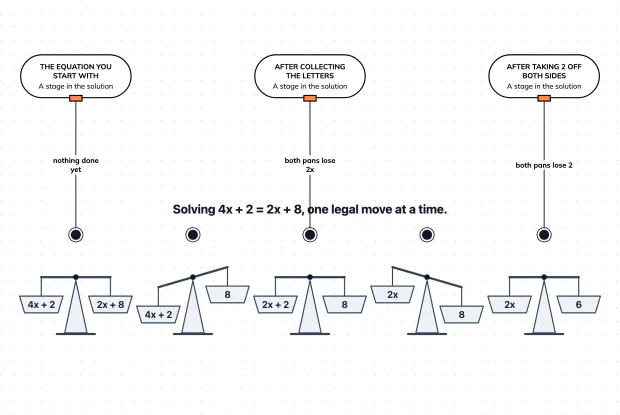
How Do You Solve an Equation With x on Both Sides?
When the letter appears on both sides, one extra move comes first: collect the letters onto one side. Walk the whole solution on a balance scale in a playground.
How Do You Solve an Equation That Has Brackets?
A bracket in an equation can be multiplied out, or it can be divided away. Learn both routes and follow the solution on a balance scale in an interactive playground.
How Do You Solve an Equation With a Fraction in It?
A fraction in an equation is a division waiting to be undone by a multiplication. Learn how to clear it and follow the whole solution on a balance scale.
How Do You Check That Your Solution Is Right?
A solution is the value that makes both sides agree, so checking is simply putting it back in. Learn what a check proves and test three values in a playground.