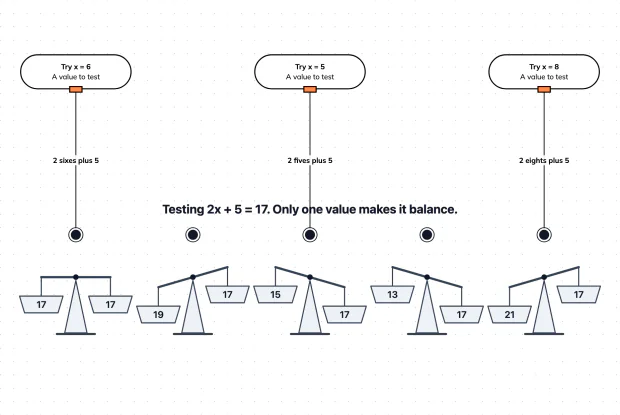
How Do You Solve an Equation With x on Both Sides?
Root Concept
An x on each pan is still just a weight on each pan, so removing the same number of x from both keeps the balance and leaves an ordinary equation.
CodePLU Goal
Upgrading Human Mental Models
Learn how to think in Workflows

Concept Development By codeplu.com
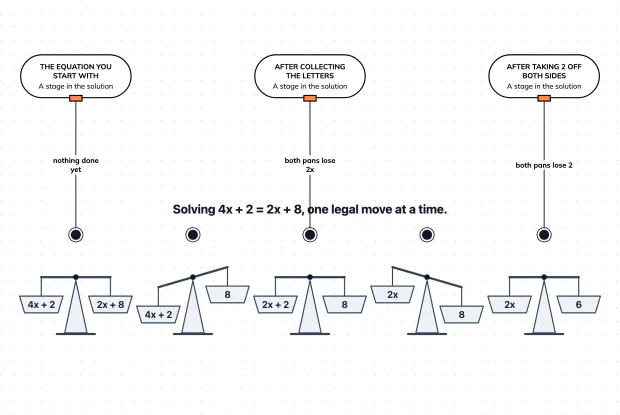
Letters first, then numbers — match each stage to its scale
What Changes When the Letter Appears Twice?
4x + 2 = 2x + 8 looks harder than anything so far, and for one honest reason: every method you have met ends with the letter alone on one side, and here it is on both. The fix is a single extra move at the front, and after it you are back on ground you already know.
Think of the scales. The left pan holds four boxes and two loose weights; the right pan holds two boxes and eight loose weights, and the whole thing balances. Boxes are just objects with weight, so you may lift two boxes off the left pan as long as you lift two off the right as well. Do that and the left has two boxes and two weights, the right has eight weights, and the balance is untouched.
In symbols, taking 2x off both sides turns 4x + 2 = 2x + 8 into 2x + 2 = 8, which has the letter on one side only and is exactly the kind of equation you can already solve. Take two off both sides to get 2x = 6, halve both sides, and x is 3. In the playground below you match each stage to the scale that shows it, with two scales showing a move applied to one pan only.
How Do You Handle Letters on Both Sides?
Which side should the letters go to?
Move the smaller letter term, so the one you keep stays positive. In 4x + 2 = 2x + 8 the smaller is 2x, so take 2x off both sides and you are left with 2x on the left. Do it the other way — take 4x off both — and you get 2 = −2x + 8, which is perfectly correct and slightly more awkward, because you now have a negative letter term to deal with. Neither is wrong and both give x = 3, so this is a tip rather than a rule. If the letters happen to be equal on both sides, something interesting happens: they cancel entirely, and what is left is either obviously true or obviously false, which tells you the equation has either every solution or none.
Why is taking 2x off both sides allowed?
Because it is the same move you have used all along: do the same thing to both sides. There is nothing special about subtracting a letter term rather than a number. On the scales you are lifting two identical boxes off each pan, and since the boxes weigh the same as each other, the two pans lose exactly the same amount and the balance holds. Many beginners feel they are not allowed to subtract something they do not know the value of, and the picture is the answer to that worry — you do not need to know what a box weighs to know that taking one off each side keeps things level. The unknown stays unknown and the equation stays true.
What order should the moves go in?
Letters first, then numbers, then the coefficient. Collect the letter terms onto one side, then clear the loose numbers away from that side, then divide by whatever is multiplying the letter. Following that order means every step leaves a simpler equation than the one before, and you never have to undo your own work. Doing it in a different order is not wrong but usually costs an extra line. One habit worth keeping from the start: write each new equation on its own line underneath, rather than editing the line above. An equation you have written over three times is one you cannot check, and checking is how mistakes get caught.
Real World Example
When Would Both Sides Have the Unknown?
Letters on both sides is what comparing two rules looks like, and it comes up constantly:
Two plans, two rules
4m + 2 and 2m + 8
One phone plan charges four rupees a minute plus a two rupee connection fee. A second charges two rupees a minute but a much higher eight rupee fee. For m minutes of calling, the first costs 4m + 2 and the second costs 2m + 8. Neither is simply better. The first is cheaper for very short calls because its fee is low; the second wins on long calls because its rate is low. Somewhere between them there is a call length where they cost exactly the same, and that crossover point is what most people actually want to know.
Asking when they are equal
4m + 2 = 2m + 8
Setting the two expressions equal to each other is how you ask for the crossover, and it is why the letter ends up on both sides. The equation 4m + 2 = 2m + 8 says find the number of minutes at which these two plans charge the same. Nothing has been solved yet, but notice that the question itself has a shape you could not have written before this tutorial. Any time two different rules describe the same quantity and you want to know where they meet, you get an equation with the unknown on both sides.
Solving and reading the answer
m = 3 minutes
Take 2m off both sides to get 2m + 2 = 8. Take two off both sides for 2m = 6. Halve both sides and m is 3. Check it by working out each plan separately for a three minute call: the first gives twelve plus two, which is fourteen; the second gives six plus eight, which is also fourteen. They agree, so three minutes is the crossover. Now the practical reading: below three minutes the first plan is cheaper, above three minutes the second is, and somebody choosing between them only has to know whether their calls usually run long.
FAQs
Final Words
An equation with the letter on both sides needs one extra move at the start: take the smaller letter term off both sides. That is the same do-it-to-both-sides rule you already had, applied to a letter term instead of a number, and it leaves an ordinary equation behind.
After that, the order never changes — letters, then loose numbers, then divide by the coefficient. Check by working out each side separately, because that is what the equation actually claims. Next comes an equation where a bracket has to be dealt with before any of this can start.
Continue This Track
This concept is part 3 of Solving Equations Properly.
How Do You Turn a Word Problem Into an Equation?
Most of a word problem is done before any solving starts. Learn how to name the unknown and translate a sentence into an equation in an interactive playground.
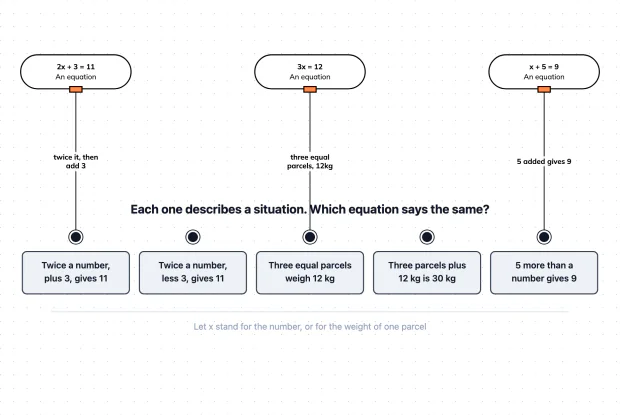
What Does Moving a Term Across the Equals Sign Do?
Transposing looks like a separate rule with its own sign-flipping magic. It is the two-sides move with the middle line left out. See what it hides in a playground.
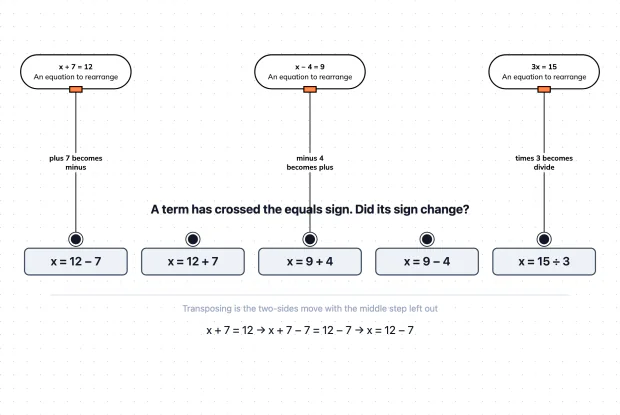
How Do You Solve an Equation With x on Both Sides?
When the letter appears on both sides, one extra move comes first: collect the letters onto one side. Walk the whole solution on a balance scale in a playground.
How Do You Solve an Equation That Has Brackets?
A bracket in an equation can be multiplied out, or it can be divided away. Learn both routes and follow the solution on a balance scale in an interactive playground.
How Do You Solve an Equation With a Fraction in It?
A fraction in an equation is a division waiting to be undone by a multiplication. Learn how to clear it and follow the whole solution on a balance scale.
How Do You Check That Your Solution Is Right?
A solution is the value that makes both sides agree, so checking is simply putting it back in. Learn what a check proves and test three values in a playground.