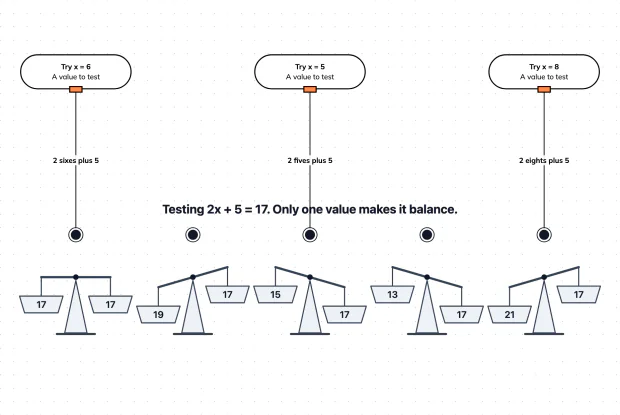
How Do You Solve an Equation That Has Brackets?
Root Concept
A bracket is one grouped quantity, so you may either expand it or divide the whole equation by the number multiplying it — both keep the balance.
CodePLU Goal
Upgrading Human Mental Models
Learn how to think in Workflows

Concept Development By codeplu.com
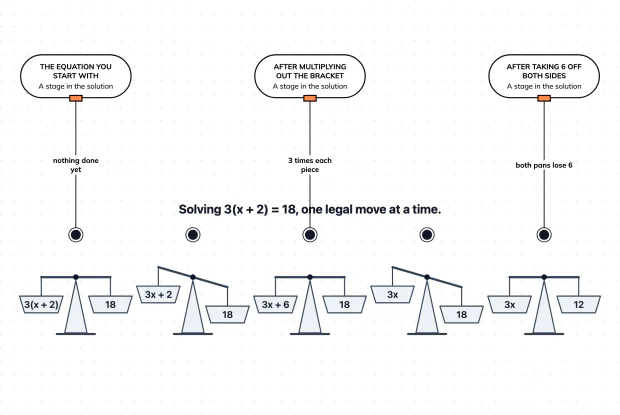
Expand the bracket, then solve — match each stage to its scale
Does the Bracket Have to Be Multiplied Out?
3(x + 2) = 18 has something none of the earlier equations had: a bracket sitting in the way. The usual advice is to multiply it out first, and that works. Three lots of x is 3x, three lots of 2 is 6, so the equation becomes 3x + 6 = 18, and from there it is the routine you already know — take six off both sides for 3x = 12, then divide by three for x = 4.
There is a second route that is quicker here and is worth knowing, because a lot of people are never shown it. The left side is three lots of something. If three lots of that something weigh eighteen, then one lot weighs six. So divide both sides by three straight away and you get x + 2 = 6, which takes one more step to finish.
Both are legal, both give x = 4, and which is quicker depends on the numbers. The playground below follows the multiply-out route, because it always works and the other does not always divide neatly. One of the scales shows what happens if only the first term inside the bracket gets multiplied — the error from expanding brackets, now visible as a tipped scale.
What Do You Do With the Bracket?
What does multiplying out do to the equation?
It replaces the bracket with the separate terms it stands for, and it changes nothing else. 3(x + 2) becomes 3x + 6, so the equation 3(x + 2) = 18 becomes 3x + 6 = 18. The right side is untouched, because nothing happened to it — you rewrote one side into an equal form rather than doing something to both sides. That distinction matters: expanding is tidying, not a two-sides move. The error to watch for is the one from the previous track, writing 3x + 2 and leaving the second term unmultiplied. In an equation that mistake is worse than usual, because it produces a perfectly reasonable-looking answer that is simply wrong, and only a check will expose it.
When is dividing first the better route?
When the number outside the bracket divides neatly into the number on the other side. In 3(x + 2) = 18, three goes into eighteen exactly six times, so dividing both sides by three gives x + 2 = 6 and the equation is nearly finished. Compare 3(x + 2) = 20, where dividing gives x + 2 = 20 ÷ 3 and you are now carrying a fraction through the rest of the working. There, multiplying out first is kinder. Neither route is more correct than the other, and it is genuinely worth pausing for a second before starting to see whether the division is clean. That one second often saves a line and a fraction.
What if there is a minus in front of the bracket?
Then every term inside changes sign when the bracket goes, exactly as it did when subtracting expressions. In 20 − 2(x + 3) = 10, the bracket expands to give 20 − 2x − 6 = 10, and the minus reaches the 6 as well as the 2x. Writing 20 − 2x + 6 is the common slip and it changes the answer. Collect the numbers on the left to get 14 − 2x = 10, and the rest is ordinary. The safe habit is to expand the bracket on a line of its own before doing anything else, so that the sign work and the solving never happen in the same step.
Real World Example
Where Does a Bracket Come From in the First Place?
Brackets appear naturally whenever several identical groups are involved, which is why this shape of equation is so common:
The situation
3 bags, each a toy plus 2 sweets
You make up three identical party bags. Each one holds a toy costing x rupees and two sweets costing one rupee each, so each bag costs x + 2 rupees. Three bags therefore cost 3(x + 2) rupees, and the bracket is there for a real reason: it groups what goes into one bag so that the three can multiply the whole group. Writing 3x + 2 instead would describe something quite different — three toys and a single pair of sweets between them, which is not what you made at all. The bracket is doing genuine work in the description.
What the receipt says
3(x + 2) = 18
The total on the receipt is eighteen rupees, so 3(x + 2) = 18. Now the question is what one toy cost. Take the multiply-out route: three lots of x is 3x and three lots of 2 is 6, so the equation becomes 3x + 6 = 18. The six is the cost of all the sweets across all three bags, which is a genuinely meaningful number rather than an artefact of the algebra. Take six off both sides and you have 3x = 12, which says the three toys came to twelve rupees between them.
The shorter route, and the check
x = 4 either way
Dividing first is quicker here. Three identical bags cost eighteen, so one bag costs six: x + 2 = 6, and the toy is four rupees. The multiply-out route lands in the same place, since 3x = 12 gives x = 4. Check it against the original situation rather than against your own working: a four rupee toy plus two one-rupee sweets makes six rupees a bag, and three bags come to eighteen, which is what the receipt said. Checking against the situation catches translation errors that checking against the equation never would, because a wrongly written equation will happily agree with itself.
FAQs
Final Words
A bracket in an equation has two honest routes through it. Multiply it out and solve what is left, which always works; or divide both sides by the number in front of it, which is quicker when that number divides the other side neatly. Pausing for a second to pick saves a line more often than not.
The error to guard against is the one from expanding brackets: every term inside gets multiplied, and a minus in front reaches all of them. Expand on a line of its own so the sign work never shares a step with the solving. Next comes the last awkward shape — an equation with a fraction in it.
Continue This Track
This concept is part 4 of Solving Equations Properly.
How Do You Turn a Word Problem Into an Equation?
Most of a word problem is done before any solving starts. Learn how to name the unknown and translate a sentence into an equation in an interactive playground.
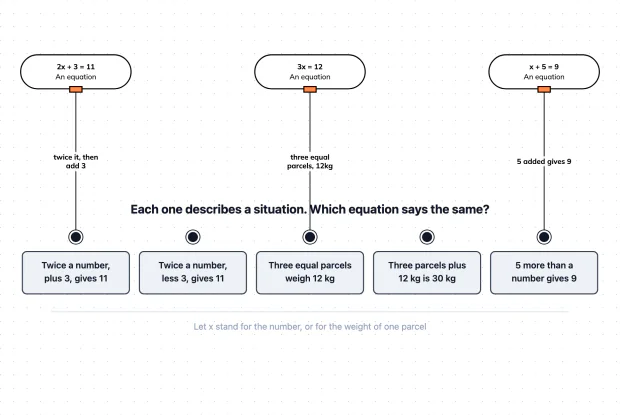
What Does Moving a Term Across the Equals Sign Do?
Transposing looks like a separate rule with its own sign-flipping magic. It is the two-sides move with the middle line left out. See what it hides in a playground.
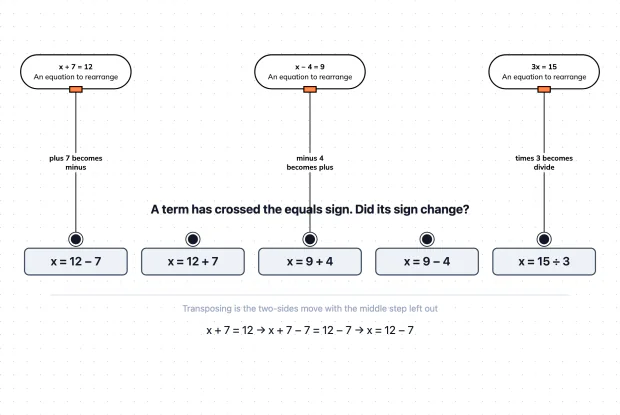
How Do You Solve an Equation With x on Both Sides?
When the letter appears on both sides, one extra move comes first: collect the letters onto one side. Walk the whole solution on a balance scale in a playground.
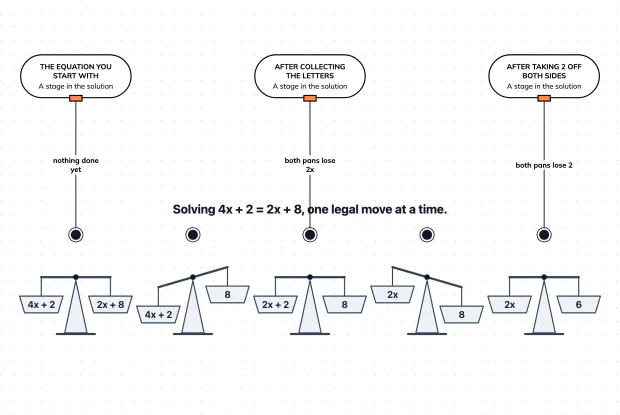
How Do You Solve an Equation That Has Brackets?
A bracket in an equation can be multiplied out, or it can be divided away. Learn both routes and follow the solution on a balance scale in an interactive playground.
How Do You Solve an Equation With a Fraction in It?
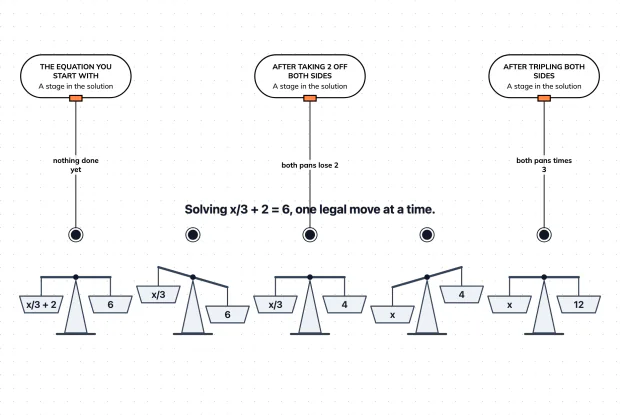
A fraction in an equation is a division waiting to be undone by a multiplication. Learn how to clear it and follow the whole solution on a balance scale.
How Do You Check That Your Solution Is Right?
A solution is the value that makes both sides agree, so checking is simply putting it back in. Learn what a check proves and test three values in a playground.