Why Your Weight Changes but Your Mass Does Not
Root Concept
Mass measures how much matter something is made of and is the same everywhere, while weight is the force gravity exerts on that mass and changes with where you are — which is why the two need different units and why everything falls at the same rate once the air is removed.
CodePLU Goal
Upgrading Human Mental Models
Learn how to think in Workflows

Concept Development By codeplu.com
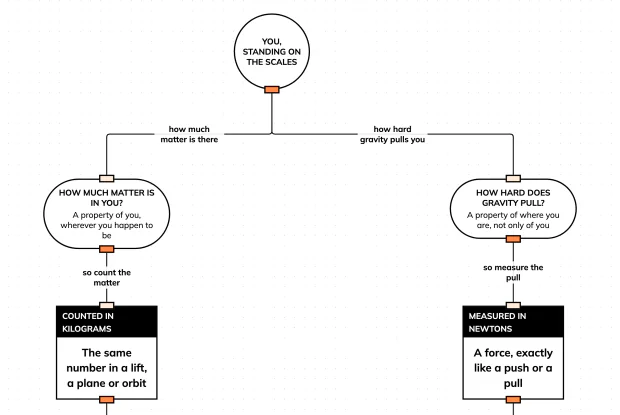
Both branches start from the same person on the same scales. The question you ask decides which quantity you get, and the two answers behave completely differently.
Why Do Bathroom Scales Use the Wrong Unit?
Step on the bathroom scales and they report a number in kilograms. Physics says that is a mass, and that your weight is something else entirely, measured in a different unit. This sounds like pedantry until you take the scales somewhere else, at which point it becomes the whole story.
In everyday English the two words are interchangeable, and for people who never leave the Earth that causes no trouble at all. **Many beginners therefore assume physics is simply being fussy here.** Actually the two quantities behave so differently that one of them changes on the Moon while the other cannot.
Mass measures how much matter you are made of. It is also, from the previous tutorial, the thing that resists being accelerated: the quantity that decided how sluggishly the loaded trolley responded to a push. Weight is a force, the pull that gravity exerts on that mass, and forces are measured in newtons.
Separating them does more than tidy up the vocabulary. It answers a question the earlier tutorial on falling objects raised and could not finish — why a hammer and a feather hit the ground together once the air is gone — and the answer turns out to fall straight out of the relationship between force, mass and acceleration.
Two Quantities Hiding Behind One Word
What exactly does mass measure?
How much matter there is, and nothing about where that matter happens to be. A two-kilogram bag of flour contains a certain quantity of flour, and carrying it up a mountain, into orbit or out to the Moon changes none of it. That is why mass is the quantity that appears in the force relationship: what resists being accelerated is the amount of stuff you are trying to shift, which travels with the object. The same bag needs the same push to get it moving at the same rate on a space station as on a kitchen floor, and astronauts discover this the first time they try to stop a floating toolbox. Weightless does not mean massless, and a drifting object will still bruise you.
What exactly does weight measure?
The force gravity exerts on a mass, which makes it a force like any push or pull and gives it newtons as its unit. Weight depends on two things rather than one: how much mass there is, and how strong gravity is where you are standing. On Earth, gravity pulls with roughly ten newtons for every kilogram, so a sixty-kilogram person weighs about six hundred newtons. On the Moon the pull is about one sixth as strong, so the same person weighs roughly a hundred newtons while containing exactly as much matter as before. **Nothing was removed from them on the journey** — the pull simply got weaker, and weight is a statement about the pull.
Why do bathroom scales still work, then?
Because they measure weight and quietly divide, which is a sensible piece of engineering rather than a mistake. A set of scales senses how hard you press down on it, which is a force. It then converts that into kilograms using the strength of Earth gravity, because the people buying scales want to know their mass and are reliably standing on Earth while asking. Take the same scales to the Moon and they would report about a sixth of your mass, not because your mass changed but because the conversion built into them is only true in one place. Kitchen balance scales behave differently and would still be right, since comparing two masses does not depend on how strongly either is being pulled.
So why does everything fall at the same rate?
Because the mass appears twice and cancels itself out. A heavier object has a larger weight pulling it down, which on its own would speed it up more — but it also has more mass resisting acceleration, by exactly the same factor. Double the mass and you double both the pull and the resistance, so the acceleration you end up with is unchanged. That is why, with the air removed, a hammer and a feather reach the ground together, as the earlier tutorial on falling objects described. What that tutorial could show but not yet explain was the reason, and this is it: gravity is the one force that scales with the very quantity that resists it.
Real World Example
One Person, Three Places
The mass is carried unchanged through all three. Only the surroundings differ, and only the weight responds to them.
Step 1
On Earth, where the two words agree
Standing in a bathroom at home, our traveller has a mass of sixty kilograms and a weight of about six hundred newtons, because Earth gravity pulls with roughly ten newtons on every kilogram. The scales display sixty, having measured the six hundred and divided by ten without mentioning it. Everything agrees here, which is precisely why the confusion survives: as long as you stay on one planet, the two quantities are locked together by a fixed number and either one can stand in for the other. Nothing in ordinary life pulls them apart, so ordinary language never needed two words.
Step 2
On the Moon, where they part company
The same traveller steps onto the lunar surface still made of exactly sixty kilograms of the same matter — nothing was left behind. Lunar gravity pulls with about one sixth of the Earth figure, so the weight drops to roughly one hundred newtons and walking feels extraordinary. Their mass has not changed by a gram, which matters more than it sounds: pushing off from a lunar rock takes the same effort as pushing off from an Earth rock of the same mass, because what resists that push is the mass and not the weight. Apollo astronauts bounced easily and still could not change direction quickly.
Step 3
In orbit, where the weight seems to vanish
On a space station the traveller floats, and the usual description is that they are weightless. The mass is unchanged once again, and this is where that fact becomes practical rather than academic. Stopping a drifting sixty-kilogram crewmate takes just as much force as it would on the ground, which is why astronauts move deliberately and brace before catching anything. The floating is real, but it comes from everything falling together rather than from gravity having switched off — the station is well inside Earth gravity and is simply falling around the planet, which is a different situation entirely from gravity being absent.
FAQs
Final Words
Mass counts the matter in an object and is the quantity that resists being accelerated. It is the same in a kitchen, on a mountain, on the Moon and in orbit. Weight is the force gravity exerts on that mass, it is measured in newtons, and it changes whenever the strength of gravity does.
Keeping them apart explains why a floating astronaut still has to brace before catching something, and why bathroom scales would mislead you anywhere but here. It also answers the falling question properly: gravity pulls harder on more mass and that same mass resists harder, so the two cancel and everything accelerates alike.
So far every force has been treated one object at a time. The next tutorial asks what happens when motion is handed from one object to another, and finds a quantity that survives the exchange.
Continue This Track
This concept is part 2 of What It Takes to Change Motion.
Why a Heavier Object Is Harder to Speed Up
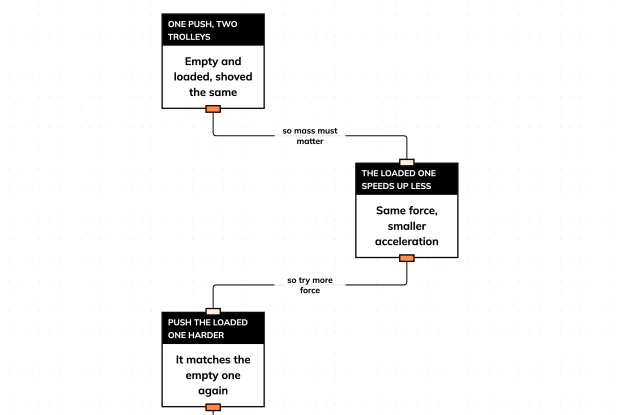
The same push moves an empty trolley easily and a loaded one barely at all. Find out why force sets acceleration rather than speed, and assemble the relationship step by step in an interactive playground.
Why Your Weight Changes but Your Mass Does Not
Bathroom scales say kilograms, and physics says that is the wrong unit for a weight. Find out what each quantity really measures, and sort the two apart in an interactive playground.
Why a Slow Lorry Is Harder to Stop Than a Fast Bicycle
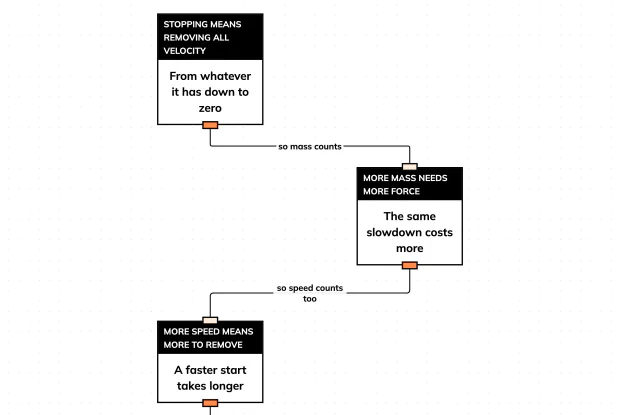
Is a heavy slow thing or a light fast thing harder to stop? Neither mass nor speed answers it alone. Build momentum step by step and find the number that settles it, in an interactive playground.
What Stays the Same When Two Things Collide
In a collision both objects change speed, yet one number refuses to move. Find out why momentum is swapped rather than lost, and work through a collision in the right order in an interactive playground.
Why Cars Are Built to Crumple
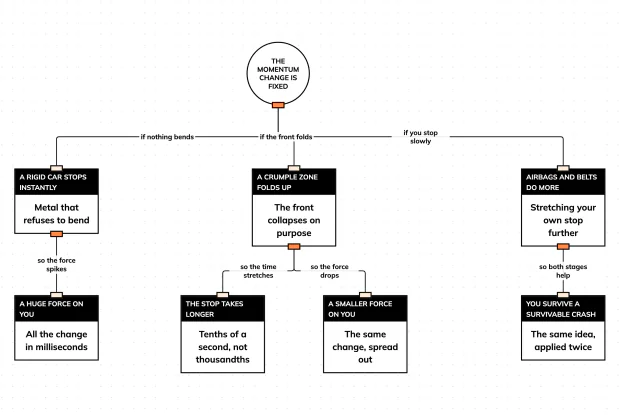
A car that falls apart in a crash protects you better than one that survives intact. Find out why stretching the stop reduces the force, and trace the consequences in an interactive playground.