What Stays the Same When Two Things Collide
Root Concept
In any collision the forces the two objects exert on each other are equal, opposite and last exactly as long as each other, so whatever momentum one object gains the other loses — which makes the total momentum before a collision the same as the total afterwards.
CodePLU Goal
Upgrading Human Mental Models
Learn how to think in Workflows

Concept Development By codeplu.com
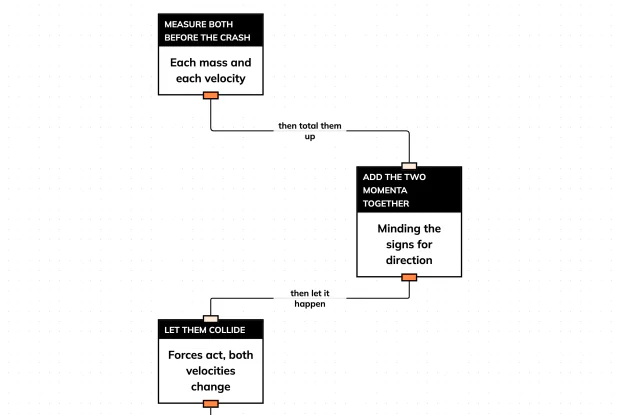
These steps have to be done in this order. Totalling after the crash without having totalled before it leaves you with a number and nothing to compare it against.
Where Does the Motion Go in a Crash?
Two snooker balls meet on a table. One arrives moving, the other is sitting still, and a moment later the first has stopped dead while the second rolls away at almost exactly the speed the first one had. Something was clearly handed over.
That handover is the subject here. The previous tutorial built momentum as mass multiplied by velocity, a number measuring how much motion something carries. This one shows that the number is not merely useful for comparing objects — it is exchanged between them, and the total is the same before and after.
**A common first reaction is that a crash destroys motion**, because crashes are violent and things usually end up slower or stopped. Actually what a crash destroys is the tidy arrangement of the motion, not the momentum. Add up the momenta of everything involved, remembering that opposite directions carry opposite signs, and the total before the collision equals the total afterwards.
This is one of the most reliable statements in physics, and the reason for it was already met in an earlier tutorial: forces come in equal and opposite pairs acting on different objects. What this tutorial adds is that the pair also lasts for the same length of time, and that is enough to make the bookkeeping exact.
Reading a Collision in the Right Order
Why must the totals match?
Because the two objects push on each other with equal and opposite forces, for exactly the same length of time. The pairing of forces came from the earlier tutorial on what forces do; the shared duration is obvious once stated, since the two objects are in contact with each other and must stop touching at the same instant. A force acting for a time changes an object momentum, so if the forces are equal and opposite and the times are identical, then one object gains precisely what the other loses. Add the two changes and they cancel. There is nothing left over, which is why the total cannot shift however violent the collision is.
Why does direction have to be tracked?
Because momentum carries a direction, and ignoring it gives answers that are badly wrong rather than slightly wrong. Take two identical cars travelling towards each other at the same speed. One has a positive momentum and the other an equal negative one, so the total before the collision is zero. They crash, crumple and stop. The total afterwards is also zero, and nothing has been violated. **Beginners often read that as momentum being destroyed — actually it was zero all along.** Choose a positive direction at the start, keep it for every number in the problem, and the sums work out without special cases. Treating both cars as positive would give a before-total of twice one car and an after-total of nothing, and the rule would seem to fail when the arithmetic was simply done wrongly.
Is the energy conserved as well?
Not usually, and this is where momentum and energy part company most sharply. Momentum is conserved in every collision without exception. Kinetic energy is only conserved when nothing is dented, heated or made to make a noise, which rules out almost every real collision. The two cars that met head-on finished with no kinetic energy at all, and the energy went into bending metal, warming the wreckage and the sound of the impact. Conservation of energy still holds, as the earlier energy tutorial established — the energy simply left the kinetic store for others. Momentum had nowhere to go, because there is no other kind of momentum to turn into.
Why does the order of the steps matter?
Because the whole claim is a comparison, and a comparison needs both of its numbers. The method is to total the momentum before the collision, let the collision happen, total it again and check the two against each other. Skipping the first total leaves you measuring an aftermath with nothing to measure it against, which is the commonest way of getting these problems wrong. It also matters that both objects are included at every stage. Leaving out the stationary snooker ball because it is not moving yet gives a before-total that is accidentally correct and an after-total that is not, and the method then appears to fail when it was only applied to half the problem.
Real World Example
Three Collisions, One Unchanged Total
The three cases look completely different and the same arithmetic covers all of them, which is the point worth taking away.
Step 1
The snooker ball that stops dead
A cue ball of 0.16 kilograms rolls at 2 metres per second into an identical ball at rest. The total momentum before is 0.32 kilogram metres per second, all of it carried by the moving ball. After the collision the cue ball has stopped and the second ball travels at close to 2 metres per second, so the total is still 0.32 — the same number, now carried by a different ball. Nothing was created or destroyed; the momentum simply changed owner. This is the cleanest demonstration available because the two masses are equal, which makes the swap complete.
Step 2
The head-on crash that totals zero
Two cars of 1,200 kilograms each approach at 15 metres per second from opposite directions. Taking rightwards as positive, one carries +18,000 kilogram metres per second and the other −18,000, so the total before the crash is zero. They meet, crumple and come to rest in a heap, and the total afterwards is zero as well. The destruction is real and it is all in the energy, which went into deforming metal and heating it. The momentum bookkeeping was never disturbed, because the two values cancelled before anything happened at all. Swap one car for a heavier one and the pair would finish sliding slowly in the heavier car direction, carrying exactly the difference between the two.
Step 3
The rifle that pushes back
This one runs the process in reverse and still obeys it. A 4 kilogram rifle and its 0.004 kilogram bullet both sit at rest, so the total momentum is zero. The cartridge fires and the bullet leaves at 800 metres per second, carrying 3.2 kilogram metres per second forwards. The total must still be zero, so the rifle takes 3.2 backwards, which at its much larger mass means about 0.8 metres per second — the recoil into the shoulder. Nothing collided here, yet the same rule fixed the answer, because the forces were still an equal and opposite pair.
FAQs
Final Words
In a collision the two objects push on each other with equal and opposite forces for exactly the same length of time, so whatever momentum one gains the other loses. Add them up and the changes cancel, which means the total momentum before a collision is the total afterwards, every time and without exception.
Getting the answer right needs the direction tracked and the steps taken in order: total before, let it happen, total after, compare. Two cars meeting head-on finish at rest without breaking anything, because their total was zero from the start. The energy is a different story and most of it leaves the kinetic store.
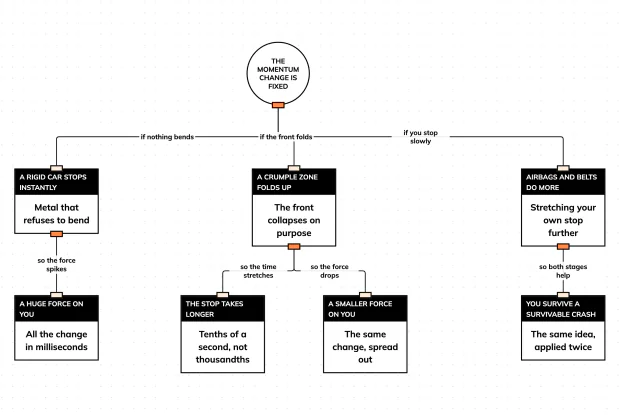
Momentum has been treated so far as something to count. The last tutorial of this track asks what decides the force during the crash, and finds that a car designed to fall apart protects you better than one built to survive.
Continue This Track
This concept is part 4 of What It Takes to Change Motion.
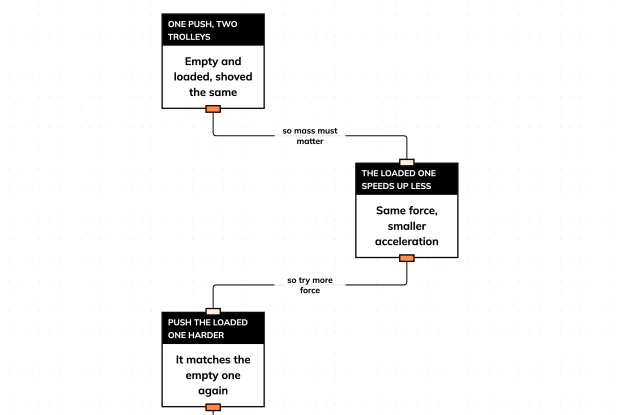
Why a Heavier Object Is Harder to Speed Up
The same push moves an empty trolley easily and a loaded one barely at all. Find out why force sets acceleration rather than speed, and assemble the relationship step by step in an interactive playground.
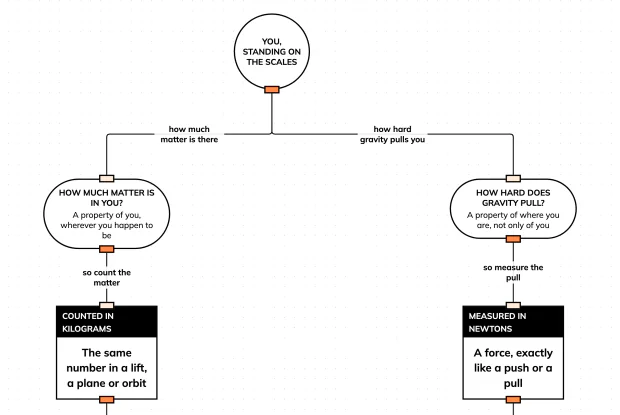
Why Your Weight Changes but Your Mass Does Not
Bathroom scales say kilograms, and physics says that is the wrong unit for a weight. Find out what each quantity really measures, and sort the two apart in an interactive playground.
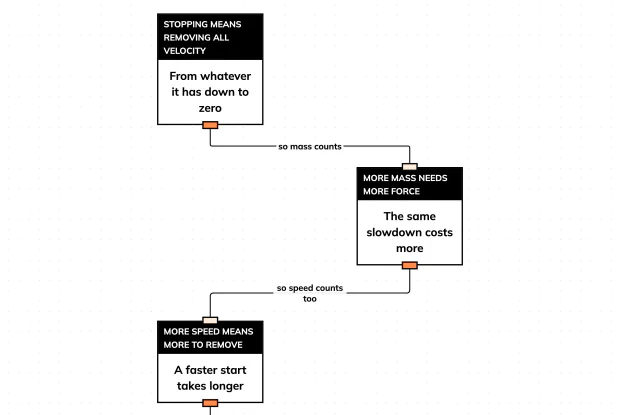
Why a Slow Lorry Is Harder to Stop Than a Fast Bicycle
Is a heavy slow thing or a light fast thing harder to stop? Neither mass nor speed answers it alone. Build momentum step by step and find the number that settles it, in an interactive playground.
What Stays the Same When Two Things Collide
In a collision both objects change speed, yet one number refuses to move. Find out why momentum is swapped rather than lost, and work through a collision in the right order in an interactive playground.
Why Cars Are Built to Crumple
A car that falls apart in a crash protects you better than one that survives intact. Find out why stretching the stop reduces the force, and trace the consequences in an interactive playground.