Why a Slow Lorry Is Harder to Stop Than a Fast Bicycle
Root Concept
Momentum is mass multiplied by velocity, a single number measuring how much motion something carries — which is why a slow heavy object and a fast light one can be equally hard to stop, and why neither mass nor speed answers the question on its own.
CodePLU Goal
Upgrading Human Mental Models
Learn how to think in Workflows

Concept Development By codeplu.com
Each step rules out an answer that is only half right. The chain ends with the one quantity that covers both halves at once.
What Makes Something Hard to Stop?
Here is a question with an obvious answer that turns out to be wrong. Which is harder to stop: a lorry crawling through a car park at walking pace, or a racing cyclist going flat out?
Most people say the cyclist, because the cyclist is moving fast and fast feels dangerous. Others say the lorry, because the lorry is heavy and heavy feels unstoppable. **Both answers are reaching for one quantity when the question needs two.** A cyclist and bicycle might come to a hundred kilograms at ten metres per second; a forty-tonne lorry at walking pace is carrying roughly a hundred times more.
That comparison only works because something was multiplied. Not the mass on its own, which would say the lorry wins every time including when parked. Not the speed on its own, which would say a thrown tennis ball outranks a moving train. The quantity that answers the question is mass multiplied by velocity, and physics calls it momentum.
Momentum is worth meeting on its own terms because it behaves like a substance rather than a label. Things carry it, hand it to each other and never quite lose it — which is what the next tutorial is about, and why this one builds the quantity carefully before using it.
Building a Number for How Much Motion
Why is mass alone not the answer?
Because a stationary lorry is not hard to stop at all — it is already stopped. Mass tells you how strongly something resists a change of motion, which the previous tutorials established, but resisting a change is not the same as having motion to get rid of. Park the forty-tonne lorry and the force needed to keep it at rest is nothing whatsoever. **Many beginners treat heavy and hard to stop as the same idea — actually heaviness only matters once the thing is moving.** That is the first clue that whatever quantity answers this question has to include the velocity as well, and has to go to zero when the velocity does.
Why is speed alone not the answer either?
Because a fast enough pebble is still a pebble. A tennis ball served at fifty metres per second is moving far faster than a goods train leaving a station, and catching the tennis ball is something people do for fun while stepping in front of the train is not. Speed describes how quickly something is covering ground and says nothing about how much of it there is to slow down. So the two candidates have opposite blind spots: mass ignores whether anything is happening, and speed ignores how much is happening. A quantity that works has to fail in neither direction, which means it must involve both and must go to zero if either one does.
What does multiplying them actually give you?
A single number that scales correctly with each one separately, which is exactly what the question demands. Double the mass and you double the momentum; double the velocity and you double it too. The unit follows from the multiplication rather than being invented: kilograms multiplied by metres per second, written kg m/s, which has no friendlier name and does not need one. And because velocity carries a direction, momentum does too — a ball thrown left and an identical ball thrown right have momenta of the same size pointing opposite ways. That detail looks like bookkeeping here and becomes the whole story the moment two objects collide. Adding the two quantities instead of multiplying them would fail immediately, because a parked lorry would then still score forty thousand.
Is momentum just another word for energy?
No, and keeping them apart saves real confusion later. Both grow when something moves faster, so they feel like the same idea dressed differently, but they answer different questions and behave differently. Momentum depends on velocity once and carries a direction; kinetic energy depends on speed twice over and has no direction at all. The practical consequence is that two objects moving towards each other can have a total momentum of zero while carrying plenty of energy between them, which is not a contradiction but a sign that the two quantities are genuinely measuring different things about the same moving object. Their units differ too, which is the quickest way to catch yourself using one where the other belongs: energy is counted in joules and momentum never is.
Real World Example
Four Things, Ranked by How Hard They Are to Stop
Every figure here is approximate and the ranking is what matters. Notice how often the fast thing loses to the heavy one.
Step 1
The tennis ball that feels fast
A tennis ball has a mass of about sixty grams, which is 0.06 kilograms, and a hard serve sends it off at roughly fifty metres per second. Multiplying gives a momentum of about three kilogram metres per second. That is genuinely small, and it is why a player can return the serve with a racket held in one hand rather than being knocked over by it. The ball is the fastest object in this whole comparison and finishes last by a wide margin, which is the clearest possible demonstration that speed on its own does not settle the question being asked.
Step 2
The sprinting cyclist
A racing cyclist and their bicycle together come to something near eighty kilograms, travelling at perhaps twelve metres per second when going flat out. The momentum works out at around a thousand kilogram metres per second, which is over three hundred times the tennis ball figure even though the cyclist is moving less than a quarter as fast. The mass has done all of that work. Anyone who has been clipped by a cyclist on a shared path knows the result physically, and it is a different order of event from catching a served ball.
Step 3
The lorry at walking pace
A fully laden articulated lorry can reach forty tonnes, which is forty thousand kilograms, and in a car park it might be doing a gentle two metres per second. The momentum comes to about eighty thousand kilogram metres per second — some eighty times the cyclist and nearly thirty thousand times the tennis ball, while moving more slowly than either. This is the case the whole tutorial was built around, and the arithmetic is not close. It is also why reversing lorries are fitted with alarms and why site rules keep people away from them even at a crawl.
FAQs
Final Words
Neither mass nor speed answers the question of how hard something is to stop. Mass ignores whether anything is moving and speed ignores how much there is of it, so the quantity that works has to be built from both. Multiplying them gives momentum, measured in kilogram metres per second.
The arithmetic then settles arguments that intuition gets wrong. A tennis ball served at fifty metres per second carries less momentum than a cyclist at a quarter of that speed, and a forty-tonne lorry at walking pace outranks them both by a factor in the tens of thousands.
Momentum also has a direction, which has looked like bookkeeping so far. The next tutorial puts two objects together and lets them collide, and that direction turns out to be the reason a total can stay fixed while both objects change.
Continue This Track
This concept is part 3 of What It Takes to Change Motion.
Why a Heavier Object Is Harder to Speed Up
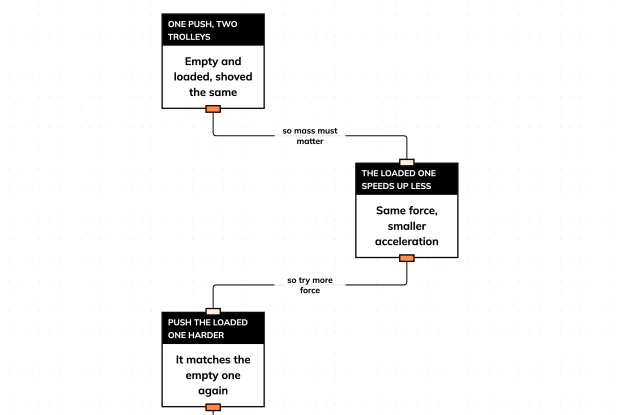
The same push moves an empty trolley easily and a loaded one barely at all. Find out why force sets acceleration rather than speed, and assemble the relationship step by step in an interactive playground.
Why Your Weight Changes but Your Mass Does Not
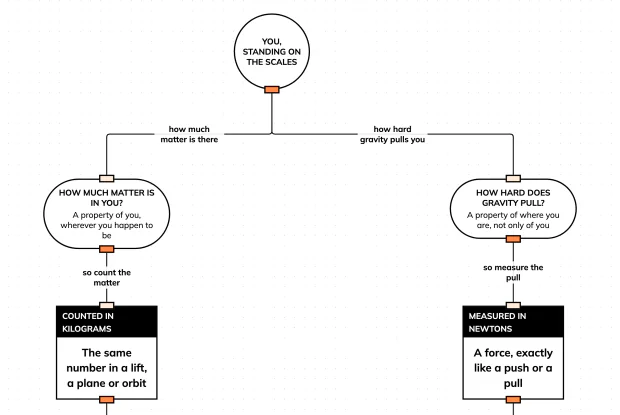
Bathroom scales say kilograms, and physics says that is the wrong unit for a weight. Find out what each quantity really measures, and sort the two apart in an interactive playground.
Why a Slow Lorry Is Harder to Stop Than a Fast Bicycle
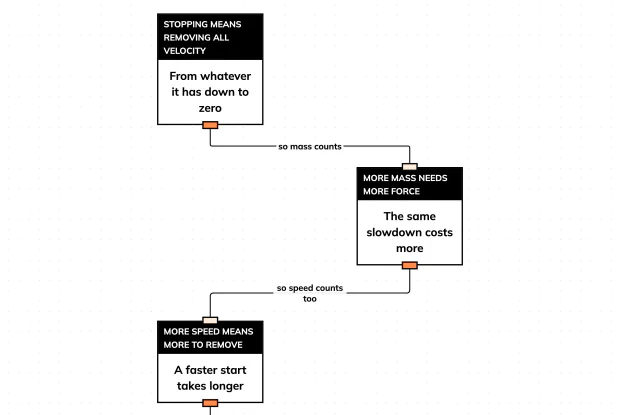
Is a heavy slow thing or a light fast thing harder to stop? Neither mass nor speed answers it alone. Build momentum step by step and find the number that settles it, in an interactive playground.
What Stays the Same When Two Things Collide
In a collision both objects change speed, yet one number refuses to move. Find out why momentum is swapped rather than lost, and work through a collision in the right order in an interactive playground.
Why Cars Are Built to Crumple
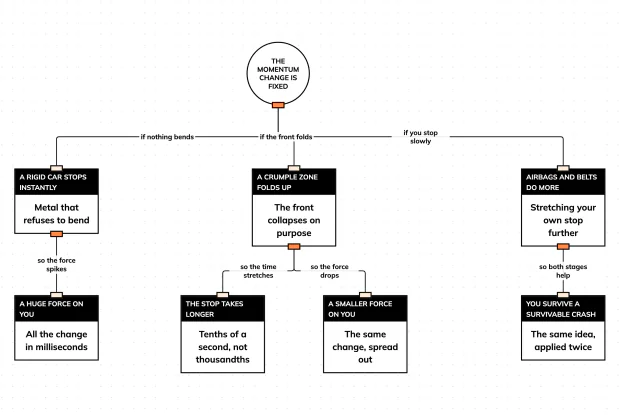
A car that falls apart in a crash protects you better than one that survives intact. Find out why stretching the stop reduces the force, and trace the consequences in an interactive playground.