Why a Heavier Object Is Harder to Speed Up
Root Concept
A force does not set how fast something goes, it sets how quickly the going changes — and the same force produces less change in a larger mass, which is why force, mass and acceleration lock together into a single relationship rather than three separate facts.
CodePLU Goal
Upgrading Human Mental Models
Learn how to think in Workflows

Concept Development By codeplu.com
Each step follows from the one above it. The chain starts with something you can do in a supermarket and ends with a relationship that holds for a trolley, a train and a planet.
What Does a Push Actually Decide?
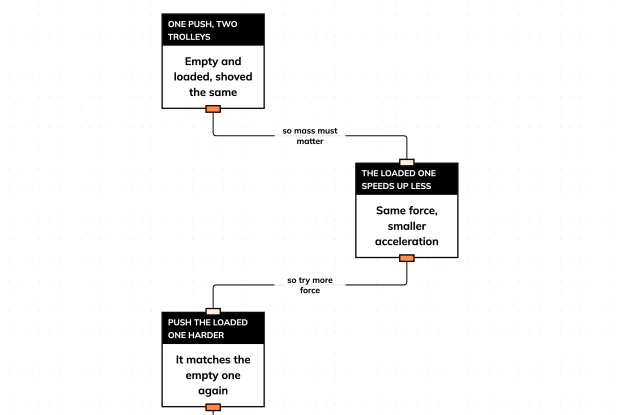
Push an empty shopping trolley and it takes off. Load it with six bags of shopping, push exactly as hard, and it crawls away from you. Everyone has felt this, and almost everyone explains it slightly wrongly.
The common explanation is that the heavy trolley needs more force to move. That cannot be the whole story, because the heavy trolley **did** move — just less eagerly. Nothing refused to budge. What changed was how quickly it picked up speed, and that is a different quantity from whether it moved at all.
An earlier tutorial established that a resultant force changes motion rather than maintaining it, and another gave the name for that change: acceleration. This one joins them. A force does not decide how fast something ends up going. It decides how quickly the speed is changing while the force acts, and the mass decides how much change you get for your money.
Put those together and three quantities stop being separate facts to memorise. Force, mass and acceleration turn out to be one relationship seen from three sides, and once you have it you can predict the trolley, a braking lorry and a rocket with the same sentence.
From a Shopping Trolley to a Relationship
Why does the same push give less acceleration?
Because acceleration is what the force buys, and a larger mass is a more expensive purchase. Give the empty trolley a steady push and its speed climbs quickly; give the loaded trolley the identical push and the speed still climbs, just more slowly. **Many beginners read this as the heavy trolley resisting motion — actually it is accepting the motion at a lower rate.** The distinction matters because the first reading suggests there is some threshold of force you must beat before anything happens, and on a level floor with good wheels there is not. Any resultant force at all produces some acceleration. Double the mass and the same force produces half the acceleration, which is a precise claim rather than a vague sense that heavy things are sluggish.
What happens if you push the heavy one harder?
It speeds up exactly as the light one did, which is the observation that turns a vague rule into a usable one. Load the trolley so it carries twice the mass, then push with twice the force, and the acceleration comes back to what it was when the trolley was empty. Nothing about the trolley has been overcome or compensated for — the two changes simply cancel. That is what makes the relationship a proportion rather than a list of cases. Acceleration grows in step with the force and shrinks in step with the mass, so if you change both by the same factor in the same direction, the acceleration you end up with has not moved at all.
What does F = ma actually claim?
It claims that for any object, the resultant force acting on it equals its mass multiplied by its acceleration — and that is a statement about behaviour before it is anything to calculate with. Read it as a sentence: the push you apply is spent producing change of motion, and how much change you get depends on how much there is to shift. The letters are shorthand for that sentence and not a replacement for it. **A tutorial that teaches this as numbers in, number out has taught substitution rather than physics.** Rearranging the equation to find a mass or an acceleration is ordinary arithmetic and belongs with the mathematics category; what belongs here is knowing what was asserted before any rearranging starts.
Why must it be the resultant force?
Because several forces usually act at once, and only their combined effect governs the motion. Push a trolley forwards with 20 newtons while friction drags backwards with 5, and the acceleration comes from the resultant 15, not from the 20 you applied. The earlier tutorial on balanced forces established this and it is doing real work here: if you put your own push into the relationship and ignore friction, your prediction comes out too large every time. It also explains the case that looks like an exception. A car cruising at a steady motorway speed has its engine working hard and no acceleration at all, because drag and friction have grown to match the drive — the resultant is zero even though the individual forces are large.
Real World Example
The Same Relationship at Three Scales
Each case changes one of the three quantities and leaves the others alone, which is the quickest way to see that the relationship is doing the work rather than the example.
Step 1
The trolley, with and without the shopping
Start where everybody already has the evidence. An empty trolley given a firm shove reaches walking pace in about a second, while the same shove on a fully loaded one takes several seconds to get there. The force your arms supply has not changed and neither has the floor, so the only thing that can account for the difference is the mass you added. Notice what did not happen: the loaded trolley never refused to move. It accelerated the whole time, just at a smaller rate, which is exactly what the relationship predicts and not what the everyday phrase too heavy to push would lead you to expect on a level floor.
Step 2
Why a loaded lorry needs a longer slip road
A slip road exists to let traffic reach motorway speed before joining, and a fully laden lorry needs far more of it than a car. Its engine is enormous compared with a car engine, so the force is not the problem — the mass is, and it can be forty times the car figure while the force is nowhere near forty times larger. The result is a much smaller acceleration and therefore a much longer run-up to the same final speed. The same reasoning runs backwards for braking, which is why lorries are given stopping distances of their own rather than being expected to match the car in front.
Step 3
The rocket that accelerates harder as it empties
A rocket burns fuel at a roughly steady rate, so the thrust pushing it upwards stays nearly constant for most of the climb. Its mass, though, drops continuously, because the fuel being burned was most of what the rocket weighed at the pad. With the force fixed and the mass falling, the acceleration must rise — and it does, markedly, so that the final minute of a launch is far more violent than the first. Nothing was adjusted to produce that. It is the relationship playing out in real time, with one of its three quantities changing because the vehicle is consuming itself.
FAQs
Final Words
A resultant force sets acceleration, not speed, and the mass decides how much acceleration a given force buys. Those two statements are the whole of it, and together they say that force equals mass multiplied by acceleration — one relationship rather than three quantities to keep track of separately.
The trolley makes it obvious, the lorry makes it matter and the rocket shows it working while one of the three quantities changes underneath you. In every case the force that counts is the resultant, which is why a car at a steady motorway speed has a hard-working engine and no acceleration at all.
One word has been used carefully here and not yet examined. Mass is what resists being accelerated, and weight is a force — the next tutorial separates them, and finds that the difference explains why everything falls at the same rate when the air is taken away.
Continue This Track
This concept is part 1 of What It Takes to Change Motion.
Why a Heavier Object Is Harder to Speed Up
The same push moves an empty trolley easily and a loaded one barely at all. Find out why force sets acceleration rather than speed, and assemble the relationship step by step in an interactive playground.
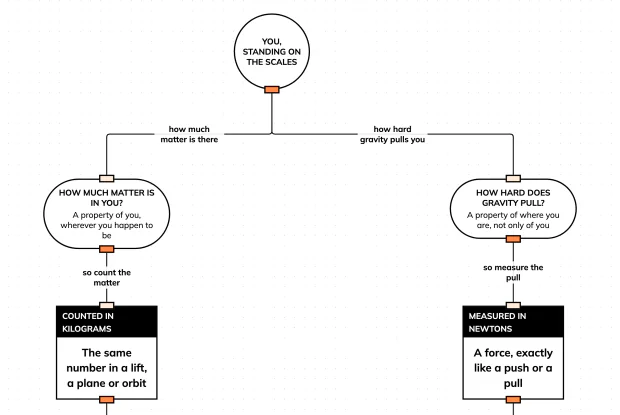
Why Your Weight Changes but Your Mass Does Not
Bathroom scales say kilograms, and physics says that is the wrong unit for a weight. Find out what each quantity really measures, and sort the two apart in an interactive playground.
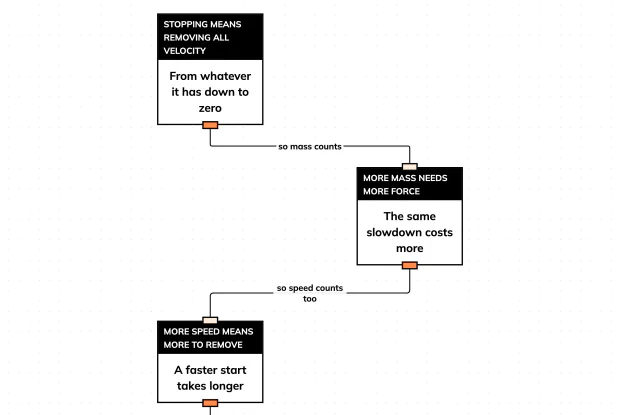
Why a Slow Lorry Is Harder to Stop Than a Fast Bicycle
Is a heavy slow thing or a light fast thing harder to stop? Neither mass nor speed answers it alone. Build momentum step by step and find the number that settles it, in an interactive playground.
What Stays the Same When Two Things Collide
In a collision both objects change speed, yet one number refuses to move. Find out why momentum is swapped rather than lost, and work through a collision in the right order in an interactive playground.
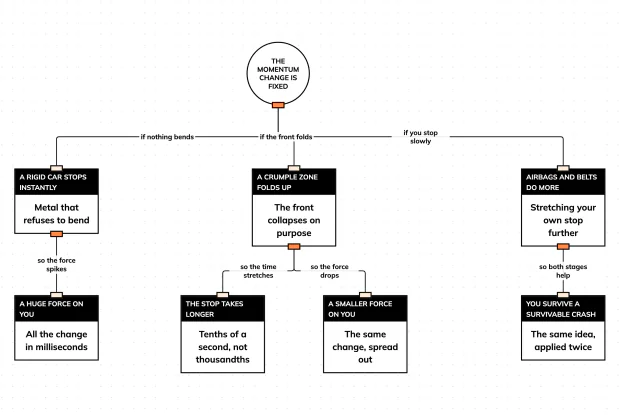
Why Cars Are Built to Crumple
A car that falls apart in a crash protects you better than one that survives intact. Find out why stretching the stop reduces the force, and trace the consequences in an interactive playground.