Why Cars Are Built to Crumple
Root Concept
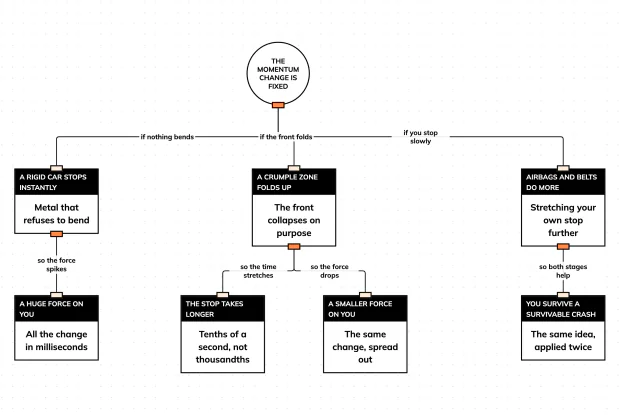
The momentum a crash has to remove is fixed by the speed and mass you arrived with, and force multiplied by time is what removes it — so the only quantity engineers can change is the time, and every safety feature in a car exists to make the stop last longer and the force smaller.
CodePLU Goal
Upgrading Human Mental Models
Learn how to think in Workflows

Concept Development By codeplu.com
The cause at the top cannot be altered by any design. Both branches below are the same decision made differently, and only one of them is survivable.
Why Would Anyone Design a Car to Break?
Look at a modern car after a front-end collision and it is a wreck. The bonnet is concertinaed, the front wing is folded, and the whole front third of the vehicle has given up. Look at a car from the 1960s after a similar impact and it can be remarkably intact.
**The obvious conclusion is that the old car was better built, and it is exactly backwards.** The old car stayed intact and its occupants did not. The modern car destroyed itself on purpose, and that is the feature being paid for rather than a failure of the metal.
The reason comes straight from the last two tutorials. A car travelling at thirty miles an hour carries a certain momentum, and stopping means removing all of it. That amount is fixed before the crash begins — no design decision can reduce it, because it depends only on the mass and the speed you arrived with.
What a designer can change is how long the removal takes. Momentum is removed by a force acting over a time, so a fixed amount of momentum can be taken away by a huge force very briefly or a modest force for longer. The second option is the one people walk away from, and everything from crumple zones to airbags exists to buy that extra time.
Spreading an Unavoidable Change Over More Time
What actually removes momentum?
A force acting for a length of time, and the two multiply together. This follows directly from the earlier relationship between force, mass and acceleration: a force produces an acceleration, acceleration is change of velocity per second, so a force applied for longer changes the velocity more. Multiply force by time and you get the change in momentum it produces, a quantity sometimes called impulse. The useful consequence is that the same momentum change can be achieved by many different combinations. A thousand newtons for a tenth of a second does the same job as ten thousand newtons for a hundredth, and your body cares enormously which of those it is subjected to.
Why does a longer stop mean a smaller force?
Because the product has to come out the same, so stretching one factor shrinks the other. The momentum to be removed is settled before the collision starts, which makes it the fixed quantity in the sum. If the stop takes ten times longer, the average force needed is a tenth as large. **This is the part that sounds like a trick and is not** — nothing has been avoided, and the total change is identical in both cases. All that has happened is that the same bill has been paid in instalments rather than at once. Human bodies tolerate moderate forces for a while and are destroyed by enormous ones briefly, so the instalment plan is what keeps people alive.
How does a crumple zone buy time?
By collapsing in a controlled way over a distance of half a metre or so, instead of stopping dead at the bumper. Folding metal takes time, and during that folding the passenger compartment is still moving forwards and slowing gradually rather than arriving at a standstill all at once. A rigid car stops in a few thousandths of a second; a car with a crumple zone takes perhaps a tenth of a second, which is a factor of thirty or more. The energy of the impact also goes into deforming that metal rather than into the cabin, which is a separate benefit of the same design and the reason the front is engineered to be the weakest part of the car.
Why are seatbelts and airbags needed as well?
Because the crumple zone slows the car and you are not attached to it. An unrestrained passenger keeps travelling at the original speed until something stops them, and in a rigid-bodied crash that something is the steering wheel or the windscreen, over a few centimetres. A seatbelt begins the job early and stretches slightly to extend it; an airbag then gives a surface that deflates as it is hit, lengthening the stop again. Each is the identical idea applied to a different object. The car buys time against the wall, and the belt and airbag buy time for the person against the car. This is also why an airbag alone is not enough: it is designed to work with a belt that has already begun slowing you, not to catch someone arriving at full speed.
Real World Example
The Same Crash, Stopped Three Ways
The momentum to be removed is about 15,600 kilogram metres per second in every case. Only the stopping time changes, and the force follows it.
Step 1
The rigid car, stopped in five milliseconds
An old car with a stiff chassis hits a solid wall and the structure barely deforms, so the vehicle comes to rest in something like five thousandths of a second. Removing 15,600 kilogram metres per second in that time needs an average force of over three million newtons, shared between the car and everything in it. No restraint can make a force of that size survivable, which is why crashes at quite ordinary speeds were routinely fatal before modern structures existed. The car looked fine afterwards and that was never the measure of anything useful.
Step 2
The crumple zone, stretched to a tenth of a second
The same car built with a front section designed to fold collapses progressively over about half a metre, and the cabin takes roughly a tenth of a second to come to rest. The same 15,600 kilogram metres per second now needs an average force of about 156,000 newtons, around twenty times smaller than before. Nothing about the crash was gentler and the wreckage is far worse to look at. The improvement is entirely in the timing, and the ruined bonnet is the visible evidence of the time having been bought rather than a sign the car failed.
Step 3
The passenger, stopped by belt and airbag
The driver is a separate object with a momentum of their own, and the crumple zone did nothing for them directly. Unrestrained, they continue at 13 metres per second until the steering column stops them in a few centimetres, which is a fraction of the time the car itself took. With a belt that stretches and an airbag that deflates as it is struck, their stop is extended to something close to the car own tenth of a second. The force on them falls by the same factor, which is the difference between bruising and a fatal injury.
FAQs
Final Words
The momentum a crash has to remove is settled before it starts, by the mass and the speed you arrived with. Nothing in the car can reduce it. What a force acting over a time does is remove it, and since the product is fixed, stretching the time is the only way to shrink the force.
That single idea explains the whole of car safety. A folding front buys the cabin a tenth of a second instead of a few thousandths, cutting the force twenty-fold, and the belt and airbag then do the same job again for the person inside. A car that survives intact has simply passed the bill to its occupants.
This track joined force, mass and acceleration and followed them into collisions. One force has been used throughout without being examined: gravity, which set your weight and pulls everything down at the same rate. The next track asks what it actually is, and why it keeps the Moon in the sky.
Continue This Track
This concept is part 5 of What It Takes to Change Motion.
Why a Heavier Object Is Harder to Speed Up
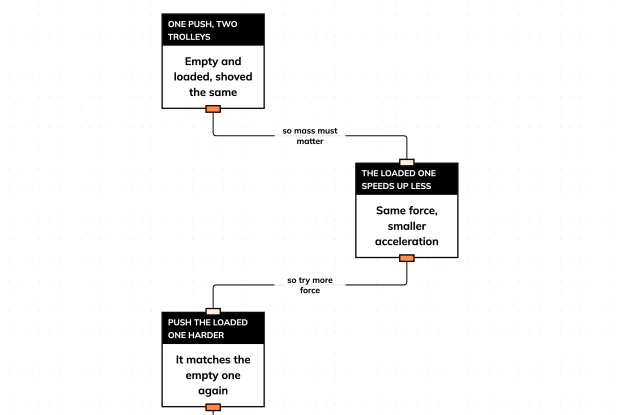
The same push moves an empty trolley easily and a loaded one barely at all. Find out why force sets acceleration rather than speed, and assemble the relationship step by step in an interactive playground.
Why Your Weight Changes but Your Mass Does Not
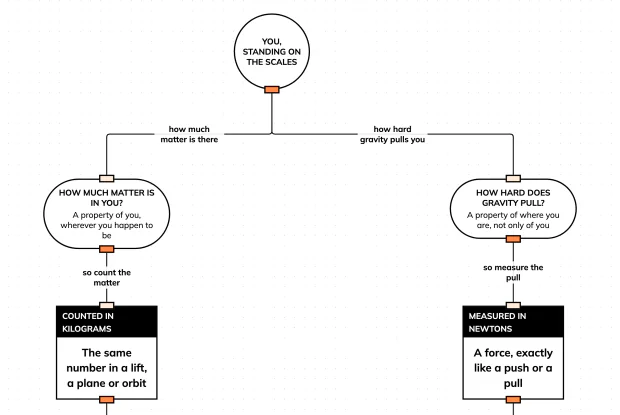
Bathroom scales say kilograms, and physics says that is the wrong unit for a weight. Find out what each quantity really measures, and sort the two apart in an interactive playground.
Why a Slow Lorry Is Harder to Stop Than a Fast Bicycle
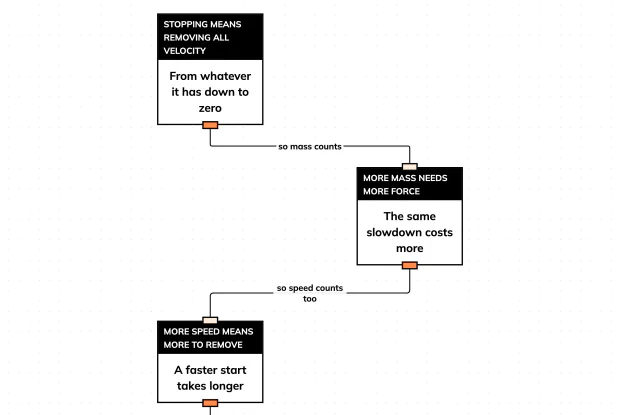
Is a heavy slow thing or a light fast thing harder to stop? Neither mass nor speed answers it alone. Build momentum step by step and find the number that settles it, in an interactive playground.
What Stays the Same When Two Things Collide
In a collision both objects change speed, yet one number refuses to move. Find out why momentum is swapped rather than lost, and work through a collision in the right order in an interactive playground.
Why Cars Are Built to Crumple
A car that falls apart in a crash protects you better than one that survives intact. Find out why stretching the stop reduces the force, and trace the consequences in an interactive playground.